QUESTION IMAGE
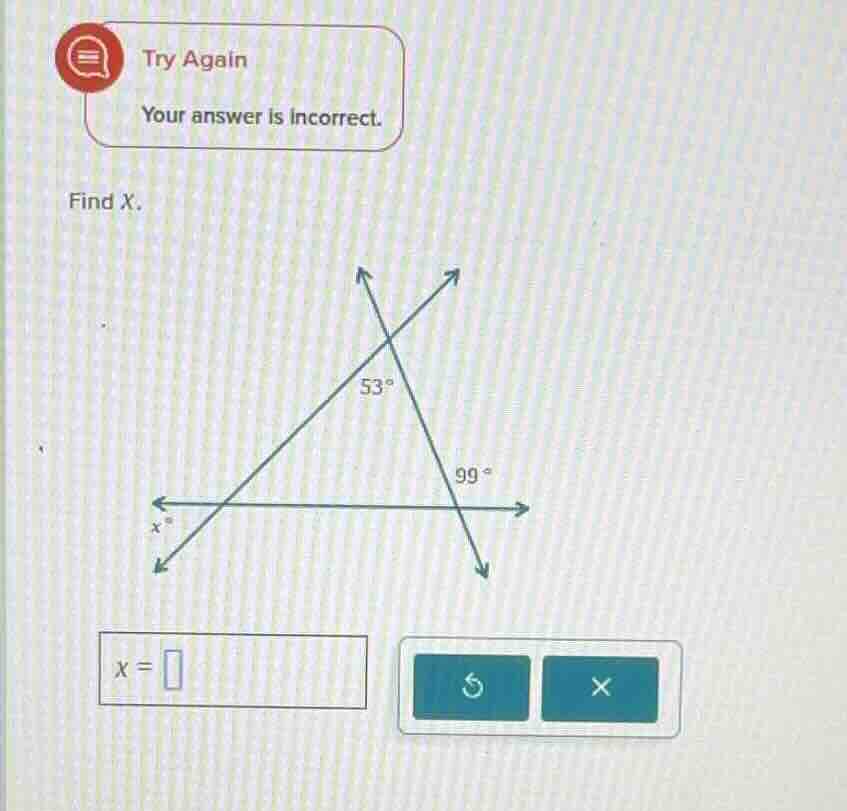
Question
try again
your answer is incorrect.
find x.
(there is a geometric figure with angles 53° and 99°, and we need to find x°)
x =
(there are two buttons: a refresh button and a close button)
Step1: Recall triangle exterior angle theorem
The exterior angle of a triangle is equal to the sum of the two non - adjacent interior angles. Also, we can use the fact that the sum of angles in a triangle is \(180^{\circ}\) and linear pairs sum to \(180^{\circ}\). First, find the adjacent angle to \(99^{\circ}\) in the triangle. The adjacent angle \(y\) (let's call it) and \(99^{\circ}\) form a linear pair, so \(y = 180 - 99=81^{\circ}\).
Step2: Use triangle angle - sum property
In the triangle, we know one angle is \(53^{\circ}\), another is \(81^{\circ}\), and we want to find the third angle which is equal to \(x\) (by vertical angles or alternate - angle properties). The sum of angles in a triangle is \(180^{\circ}\). Let the third angle be \(z\), then \(z=180-(53 + 81)\).
First, calculate \(53+81 = 134\). Then \(z = 180 - 134=46\)? Wait, no, wait. Wait, actually, the exterior angle related to \(x\): the exterior angle at the vertex opposite to \(x\) is \(99^{\circ}\), and one of the non - adjacent interior angles is \(53^{\circ}\), so by the exterior angle theorem, \(x+53 = 99\)? Wait, no, that's wrong. Wait, let's re - examine.
Wait, the angle adjacent to \(99^{\circ}\) is \(180 - 99 = 81^{\circ}\) (linear pair). Then in the triangle, the three angles are \(53^{\circ}\), \(81^{\circ}\), and the angle opposite to \(x\) (since \(x\) and that angle are vertical angles). So the sum of angles in a triangle is \(180^{\circ}\), so the angle opposite to \(x\) is \(180-(53 + 81)=180 - 134 = 46^{\circ}\)? No, wait, no. Wait, actually, the exterior angle theorem: the exterior angle is equal to the sum of the two non - adjacent interior angles. The exterior angle here is \(99^{\circ}\), one non - adjacent interior angle is \(53^{\circ}\), and the other non - adjacent interior angle is \(x\). So \(x + 53=99\)? Wait, no, that would give \(x = 99 - 53 = 46\)? Wait, but let's check again.
Wait, the angle that is supplementary to \(99^{\circ}\) is \(180 - 99=81^{\circ}\). Then in the triangle, the angles are \(53^{\circ}\), \(81^{\circ}\), and the angle at the vertex where \(x\) is vertical. So the sum of angles in a triangle is \(180\), so the third angle is \(180-(53 + 81)=46\). And since \(x\) is equal to that third angle (vertical angles), so \(x = 46\). Wait, but let's do it with exterior angle theorem. The exterior angle ( \(99^{\circ}\)) is equal to the sum of the two remote interior angles ( \(53^{\circ}\) and \(x\)). So \(x+53 = 99\), so \(x=99 - 53 = 46\). Yes, that's correct.

Snap & solve any problem in the app
Get step-by-step solutions on Sovi AI
Photo-based solutions with guided steps
Explore more problems and detailed explanations
\(46\)