QUESTION IMAGE
Question
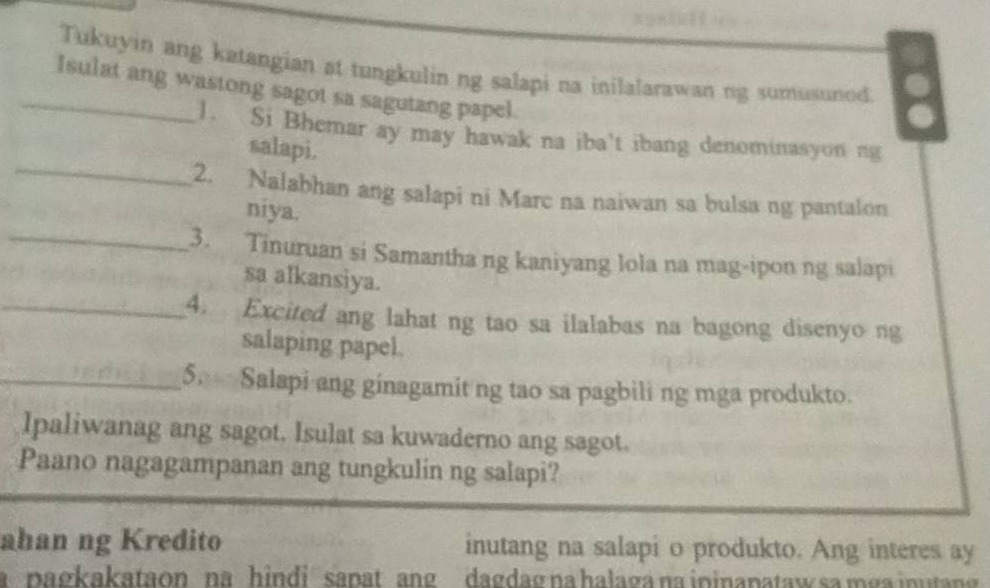
tukuyin ang katangian at tungkulin ng salapi na inilalarawan ng sumusunod. isulat ang wastong sagot sa sagutang papel.
- si bhemar ay may hawak na ibat ibang denominasyon ng salapi.
- nalabhan ang salapi ni marc na naiwan sa bulsa ng pantalon niya.
- tinuruan si samantha ng kaniyang lola na mag-ipon ng salapi sa alkansiya.
- excited ang lahat ng tao sa ilalabas na bagong disenyo ng salaping papel.
- salapi ang ginagamit ng tao sa pagbili ng mga produkto.
ipaliwanag ang sagot. isulat sa kuwaderno ang sagot.
paano nagagampanan ang tungkulin ng salapi?
aban ng kredito inutang na salapi o produkto. ang interes ay pagkakataon na hindi sapat ang dagdag na halaga na ipinapataw sa mga inutang
To solve this, we analyze each item based on the functions and characteristics of money (salapi):
Item 1
- Explanation: Having different denominations (iba’t ibang denominasyon) allows money to be a standard of value (unit of account) to measure and compare the value of goods/services.
- Characteristic/Function: Unit of Account (or “Standard of Value”)
Item 2
- Explanation: The money (salapi) was washed (nalabhan) but remains usable, showing its durability—it can withstand physical wear and still function as money.
- Characteristic/Function: Durability
Item 3
- Explanation: Saving money (mag-ipon ng salapi) in a piggy bank (alkansiya) uses money as a store of value—it preserves purchasing power over time for future use.
- Characteristic/Function: Store of Value
Item 4
- Explanation: Excitement over a new paper money (salaping papel) design relates to money’s acceptability (or “General Acceptance”)—people value and accept it as a medium of exchange, even based on its design (e.g., as legal tender).
- Characteristic/Function: Acceptability (or “General Acceptance”)
Item 5
- Explanation: Using money (salapi) to buy products (pagbili ng mga produkto) is money acting as a medium of exchange—it facilitates transactions by being widely accepted in trade.
- Characteristic/Function: Medium of Exchange
“Paano nagagampanan ang tungkulin ng salapi?” (How does money fulfill its role?)
Money fulfills its roles through:
- Medium of Exchange: It is widely accepted in transactions (e.g., buying goods).
- Unit of Account: It measures the value of goods/services (e.g., pricing items).
- Store of Value: It preserves purchasing power over time (e.g., saving money).
- Standard of Deferred Payment (optional, for credit): It settles debts over time (e.g., loans).
For example:
- As a medium of exchange, people use it to trade without barter (e.g., buying food).
- As a unit of account, prices (e.g., ₱50 for a book) let us compare values.
- As a store of value, saving money in a bank or piggy bank retains its value for future needs (e.g., buying a bike later).
Final Answers (for each item):
- Unit of Account (or “Standard of Value”)
- Durability
- Store of Value
- Acceptability
- Medium of Exchange
(For the essay: Explain how money acts as a medium of exchange, unit of account, store of value, etc., using real-life examples like buying goods, pricing items, or saving money.)

Snap & solve any problem in the app
Get step-by-step solutions on Sovi AI
Photo-based solutions with guided steps
Explore more problems and detailed explanations
To solve this, we analyze each item based on the functions and characteristics of money (salapi):
Item 1
- Explanation: Having different denominations (iba’t ibang denominasyon) allows money to be a standard of value (unit of account) to measure and compare the value of goods/services.
- Characteristic/Function: Unit of Account (or “Standard of Value”)
Item 2
- Explanation: The money (salapi) was washed (nalabhan) but remains usable, showing its durability—it can withstand physical wear and still function as money.
- Characteristic/Function: Durability
Item 3
- Explanation: Saving money (mag-ipon ng salapi) in a piggy bank (alkansiya) uses money as a store of value—it preserves purchasing power over time for future use.
- Characteristic/Function: Store of Value
Item 4
- Explanation: Excitement over a new paper money (salaping papel) design relates to money’s acceptability (or “General Acceptance”)—people value and accept it as a medium of exchange, even based on its design (e.g., as legal tender).
- Characteristic/Function: Acceptability (or “General Acceptance”)
Item 5
- Explanation: Using money (salapi) to buy products (pagbili ng mga produkto) is money acting as a medium of exchange—it facilitates transactions by being widely accepted in trade.
- Characteristic/Function: Medium of Exchange
“Paano nagagampanan ang tungkulin ng salapi?” (How does money fulfill its role?)
Money fulfills its roles through:
- Medium of Exchange: It is widely accepted in transactions (e.g., buying goods).
- Unit of Account: It measures the value of goods/services (e.g., pricing items).
- Store of Value: It preserves purchasing power over time (e.g., saving money).
- Standard of Deferred Payment (optional, for credit): It settles debts over time (e.g., loans).
For example:
- As a medium of exchange, people use it to trade without barter (e.g., buying food).
- As a unit of account, prices (e.g., ₱50 for a book) let us compare values.
- As a store of value, saving money in a bank or piggy bank retains its value for future needs (e.g., buying a bike later).
Final Answers (for each item):
- Unit of Account (or “Standard of Value”)
- Durability
- Store of Value
- Acceptability
- Medium of Exchange
(For the essay: Explain how money acts as a medium of exchange, unit of account, store of value, etc., using real-life examples like buying goods, pricing items, or saving money.)