QUESTION IMAGE
Question
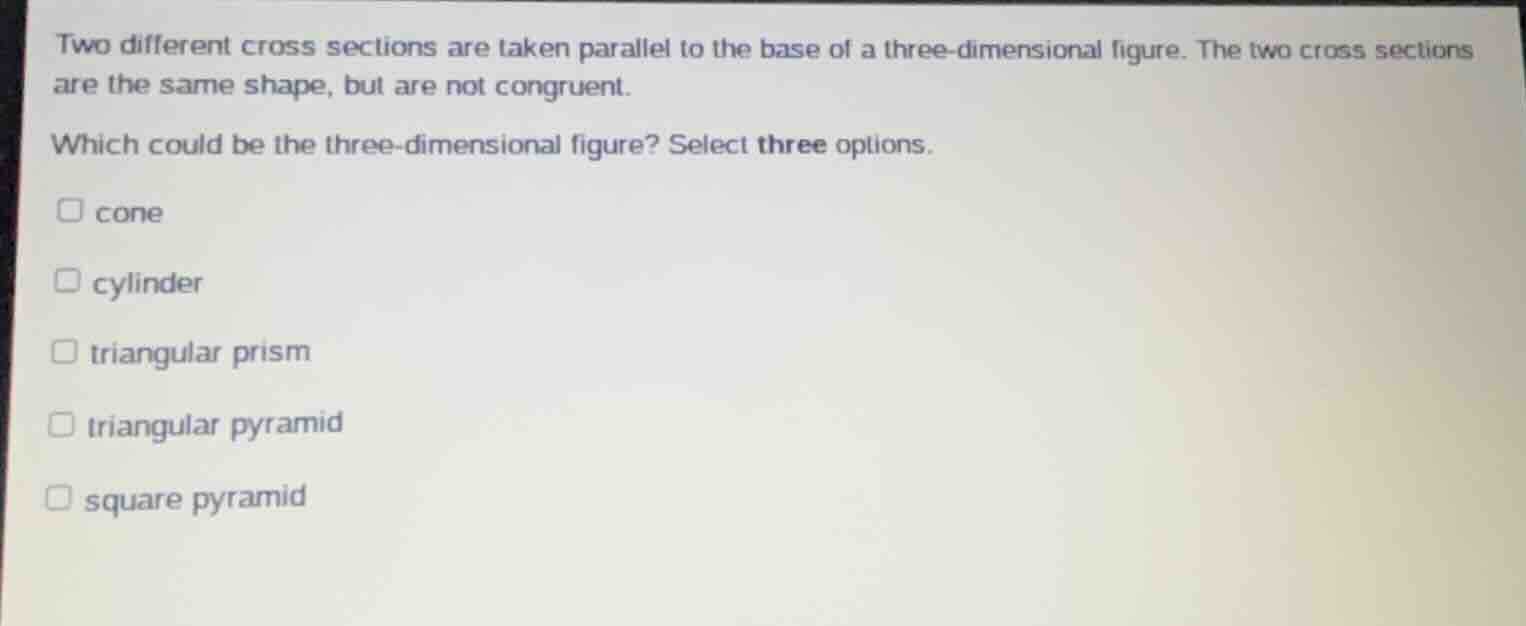
two different cross sections are taken parallel to the base of a three - dimensional figure. the two cross sections are the same shape, but are not congruent. which could be the three - dimensional figure? select three options. \\(\square\\) cone \\(\square\\) cylinder \\(\square\\) triangular prism \\(\square\\) triangular pyramid \\(\square\\) square pyramid
Brief Explanations
- Cone: When cross - sections are taken parallel to the base of a cone, the cross - sections are circles. As we move the plane parallel to the base up or down the cone, the radius of the circular cross - section changes. So the cross - sections are the same shape (circles) but not congruent (different radii).
- Triangular Pyramid (Tetrahedron): Cross - sections parallel to the base of a triangular pyramid are triangles. The size of these triangular cross - sections changes as the plane is moved parallel to the base, so they are the same shape but not congruent.
- Square Pyramid: Cross - sections parallel to the base of a square pyramid are squares. As the plane is moved parallel to the base (either up or down the pyramid), the side length of the square cross - section changes. Thus, the cross - sections are the same shape (squares) but not congruent.
- For the cylinder, cross - sections parallel to the base are congruent circles (since the radius and height - related dimensions for the cross - section do not change when the plane is parallel to the base).
- For the triangular prism, cross - sections parallel to the base are congruent triangles (because the prism has a constant cross - sectional area along its length when cut parallel to the base).

Snap & solve any problem in the app
Get step-by-step solutions on Sovi AI
Photo-based solutions with guided steps
Explore more problems and detailed explanations
A. cone
D. triangular pyramid
E. square pyramid