QUESTION IMAGE
Question
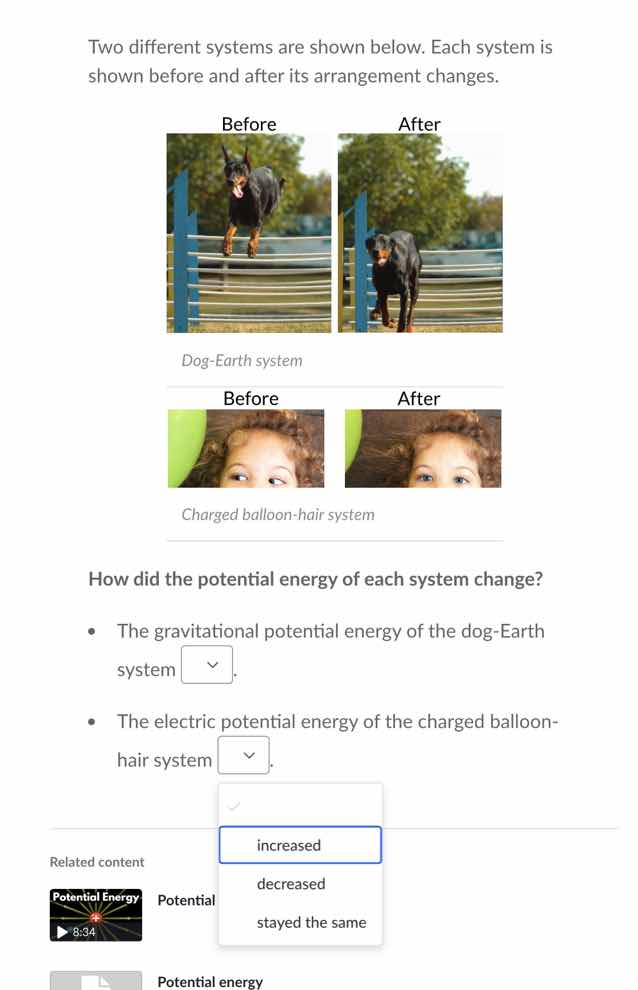
two different systems are shown below. each system is shown before and after its arrangement changes.
dog - earth system
charged balloon - hair system
how did the potential energy of each system change?
- the gravitational potential energy of the dog - earth system
- the electric potential energy of the charged balloon - hair system
options: increased, decreased, stayed the same
For the dog - Earth system (gravitational potential energy):
Step 1: Recall the formula for gravitational potential energy
The formula for gravitational potential energy (GPE) is $GPE = mgh$, where $m$ is the mass of the object, $g$ is the acceleration due to gravity, and $h$ is the height of the object relative to a reference point.
Step 2: Analyze the change in height for the dog
In the "before" image, the dog is at a certain height (jumping over the hurdle), and in the "after" image, the dog is on the ground (lower height). Since $m$ and $g$ remain constant, and $h$ decreases, using the formula $GPE = mgh$, the gravitational potential energy will decrease as the height of the dog (relative to the ground) decreases.
For the charged balloon - hair system (electric potential energy):
Step 1: Recall the concept of electric potential energy between charged objects
Electric potential energy between two charged objects depends on the distance between them and their charges. The formula for the electric potential energy of two point charges $q_1$ and $q_2$ separated by a distance $r$ is $U=\frac{kq_1q_2}{r}$ (where $k$ is Coulomb's constant). For a charged balloon and hair (which will have an opposite charge to the balloon when charged by induction or friction, assuming the balloon is charged and the hair is neutral initially but gets charged), when the balloon is moved away from the hair (in the "before" the balloon is near the hair, in the "after" the balloon is moved? Wait, no - looking at the images: in the "before" the balloon is near the hair (the girl's hair is not sticking up), in the "after" the hair is sticking up, which means the balloon has been moved away? Wait, no - actually, when the balloon is charged and brought near the hair, the hair is attracted. But in the "before" image, the balloon is near the hair (the hair is not yet sticking up), and in the "after" image, the hair is sticking up, which implies that the balloon has been moved away, or the hair is now attracted. Wait, no - the key is the distance between the charged balloon and the hair. In the "before" the balloon is close to the hair (the hair is lying down, maybe the balloon is just near, not causing much separation), and in the "after" the hair is standing up, which means the balloon has been moved away, increasing the distance between the balloon and the hair? Wait, no - actually, when the balloon is charged (say, negatively charged) and brought near the hair (neutral), the hair gets polarized and has an attractive force towards the balloon. But if the balloon is moved away, the distance $r$ between the balloon and the hair increases. For two charges (the balloon and the induced charge in the hair), as the distance between them increases, the electric potential energy (since they are attracted, like opposite charges) - the formula $U = \frac{kq_1q_2}{r}$, if $q_1$ and $q_2$ have opposite signs, then as $r$ increases, the magnitude of $U$ (which is negative for opposite charges) will increase (become less negative) or decrease? Wait, let's think in terms of work. If we move the balloon away from the hair (opposite charges, so attractive), we have to do work against the attractive force. Wait, no - if the balloon is charged and the hair is attracted, when we move the balloon away, the force between them is attractive, so the work done by the external force is positive, and the electric potential energy increases. Wait, but in the images: in the "before" the balloon is near the hair (the hair is not sticking up), in the "after" the hair is…
Step 1: Recall GPE formula
The formula for gravitational potential energy is $GPE = mgh$, where $m$ (mass of dog), $g$ (acceleration due to gravity) are constant, and $h$ is the height of the dog relative to the ground.
Step 2: Analyze height change
In the "before" state, the dog is at a higher height (jumping over the hurdle). In the "after" state, the dog is on the ground (lower height, so $h$ decreases).
Step 3: Determine GPE change
Since $GPE\propto h$ (with $m$ and $g$ constant), a decrease in $h$ leads to a decrease in $GPE$.
For the charged balloon - hair system (electric potential energy):
Step 1: Recall electric potential energy concept
Electric potential energy between two charged objects (with opposite charges, as the balloon and hair will have opposite charges due to charging by induction) depends on the distance $r$ between them. The formula is $U=\frac{kq_1q_2}{r}$ (for point charges, $k$ is Coulomb's constant, $q_1,q_2$ are charges). For opposite charges, $q_1q_2<0$.
Step 2: Analyze distance change
In the "before" state, the balloon is near the hair (distance $r_1$). In the "after" state, the hair is sticking up, implying the balloon has been moved away from the hair (distance $r_2 > r_1$).
Step 3: Determine electric potential energy change
For opposite charges, as $r$ increases, $U=\frac{kq_1q_2}{r}$ (with $q_1q_2 < 0$) becomes less negative (i.e., increases in value). So the electric potential energy of the system increases.

Snap & solve any problem in the app
Get step-by-step solutions on Sovi AI
Photo-based solutions with guided steps
Explore more problems and detailed explanations
For the dog - Earth system (gravitational potential energy):
Step 1: Recall the formula for gravitational potential energy
The formula for gravitational potential energy (GPE) is $GPE = mgh$, where $m$ is the mass of the object, $g$ is the acceleration due to gravity, and $h$ is the height of the object relative to a reference point.
Step 2: Analyze the change in height for the dog
In the "before" image, the dog is at a certain height (jumping over the hurdle), and in the "after" image, the dog is on the ground (lower height). Since $m$ and $g$ remain constant, and $h$ decreases, using the formula $GPE = mgh$, the gravitational potential energy will decrease as the height of the dog (relative to the ground) decreases.
For the charged balloon - hair system (electric potential energy):
Step 1: Recall the concept of electric potential energy between charged objects
Electric potential energy between two charged objects depends on the distance between them and their charges. The formula for the electric potential energy of two point charges $q_1$ and $q_2$ separated by a distance $r$ is $U=\frac{kq_1q_2}{r}$ (where $k$ is Coulomb's constant). For a charged balloon and hair (which will have an opposite charge to the balloon when charged by induction or friction, assuming the balloon is charged and the hair is neutral initially but gets charged), when the balloon is moved away from the hair (in the "before" the balloon is near the hair, in the "after" the balloon is moved? Wait, no - looking at the images: in the "before" the balloon is near the hair (the girl's hair is not sticking up), in the "after" the hair is sticking up, which means the balloon has been moved away? Wait, no - actually, when the balloon is charged and brought near the hair, the hair is attracted. But in the "before" image, the balloon is near the hair (the hair is not yet sticking up), and in the "after" image, the hair is sticking up, which implies that the balloon has been moved away, or the hair is now attracted. Wait, no - the key is the distance between the charged balloon and the hair. In the "before" the balloon is close to the hair (the hair is lying down, maybe the balloon is just near, not causing much separation), and in the "after" the hair is standing up, which means the balloon has been moved away, increasing the distance between the balloon and the hair? Wait, no - actually, when the balloon is charged (say, negatively charged) and brought near the hair (neutral), the hair gets polarized and has an attractive force towards the balloon. But if the balloon is moved away, the distance $r$ between the balloon and the hair increases. For two charges (the balloon and the induced charge in the hair), as the distance between them increases, the electric potential energy (since they are attracted, like opposite charges) - the formula $U = \frac{kq_1q_2}{r}$, if $q_1$ and $q_2$ have opposite signs, then as $r$ increases, the magnitude of $U$ (which is negative for opposite charges) will increase (become less negative) or decrease? Wait, let's think in terms of work. If we move the balloon away from the hair (opposite charges, so attractive), we have to do work against the attractive force. Wait, no - if the balloon is charged and the hair is attracted, when we move the balloon away, the force between them is attractive, so the work done by the external force is positive, and the electric potential energy increases. Wait, but in the images: in the "before" the balloon is near the hair (the hair is not sticking up), in the "after" the hair is sticking up, which means that the balloon has been moved away, and the hair is now attracted, so the distance between the balloon and the hair has increased? Or maybe the balloon was in contact? No, the "before" shows the balloon near the hair (the girl's hair is curly, lying down), and "after" the hair is standing up, so the balloon has been moved, and the hair is now attracted, so the distance between the balloon and the hair has decreased? Wait, no - the hair is sticking up towards the balloon? Wait, the "before" image: the balloon is near the hair (the girl's head is tilted, balloon is near), and "after" the balloon is moved, and the hair is standing up. So the distance between the balloon and the hair has decreased? Wait, no, the key is that when the hair is sticking up, it means that the balloon is closer? No, maybe I got it wrong. Let's re - frame: the electric potential energy between two charged objects (the balloon and the hair, where the hair has a charge opposite to the balloon) - as the distance between them decreases, the electric potential energy (for opposite charges) decreases (because $U=\frac{kq_1q_2}{r}$, if $q_1$ and $q_2$ are opposite, $q_1q_2$ is negative, and as $r$ decreases, $U$ becomes more negative, i.e., decreases). But in the "before" the balloon is near the hair (distance $r_1$), and in the "after" the hair is sticking up, which means the balloon has been moved away, so $r_2>r_1$. For opposite charges, $U=\frac{kq_1q_2}{r}$, with $q_1q_2 < 0$. So when $r$ increases, $U=\frac{negative}{larger\ r}$, so $U$ becomes less negative (i.e., increases). Wait, for example, if $q_1q_2=- 1$, $k = 1$, $r_1 = 1$, then $U=-1$. If $r_2 = 2$, then $U=\frac{- 1}{2}=-0.5$, which is an increase (from - 1 to - 0.5). So as the distance between the balloon and the hair increases (since the hair is now sticking up, meaning the balloon is further away? No, the hair sticking up means that the balloon is attracting the hair, so the balloon is close. Wait, maybe the "before" is the balloon not yet interacting, and "after" is the balloon interacting, so the distance between the balloon and the hair has decreased. Let's think about the force: when the balloon is charged and brought near the hair, the hair is attracted. The electric potential energy of two attracting charges (opposite charges) decreases as the distance between them decreases (because you do work on the system when you separate them, and the system does work when they come together). So if in the "before" the balloon is far from the hair (distance $r_1$) and in the "after" the balloon is close to the hair (distance $r_2 Wait, maybe the correct answers are: I think I was confused about the direction of movement. Let's re - summarize:Dog - Earth system (Gravitational Potential Energy):
Charged Balloon - Hair system (Electric Potential Energy):