QUESTION IMAGE
Question
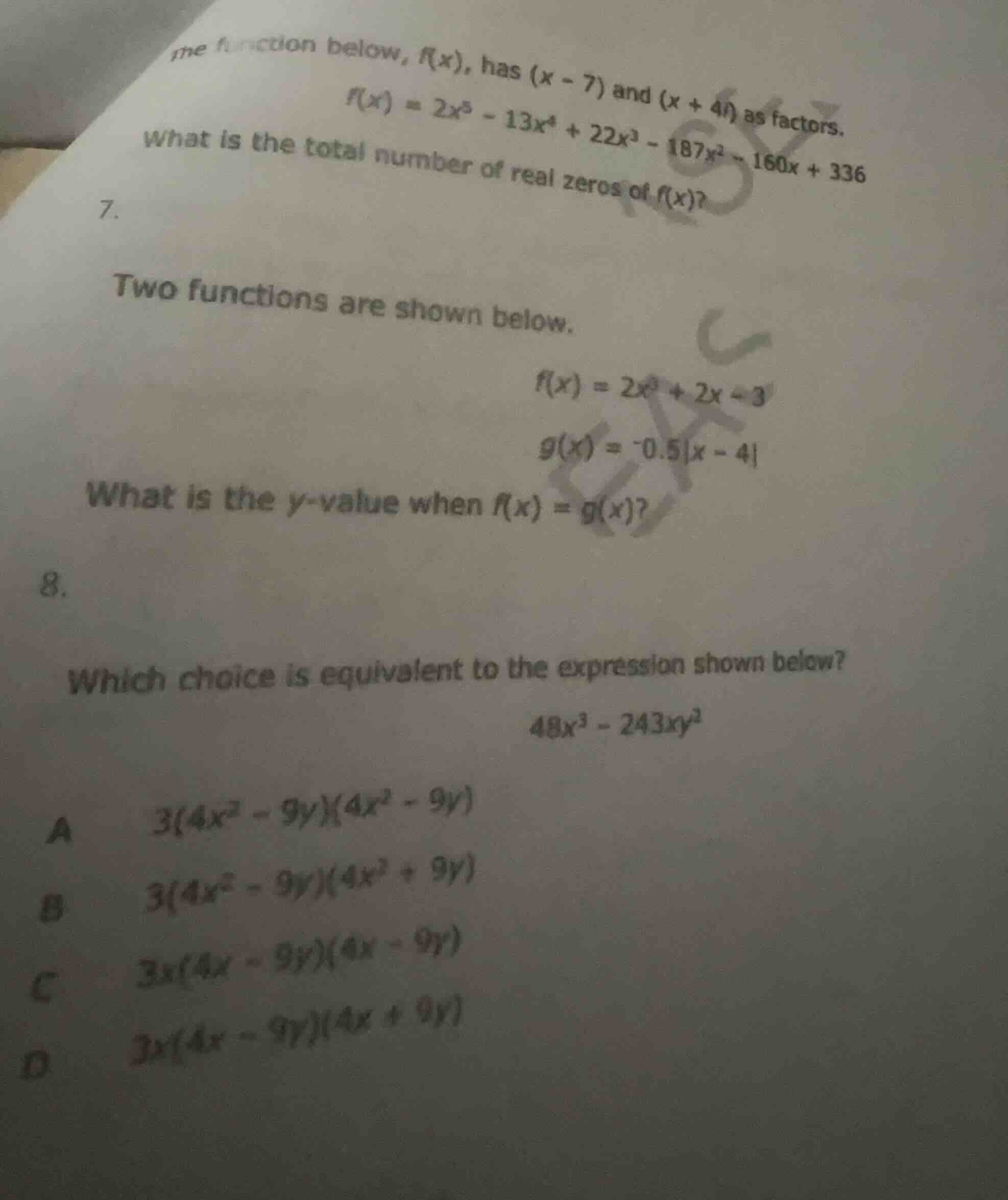
- two functions are shown below. \\( f(x) = 2x^3 + 2x - 3 \\) \\( g(x) = -0.5|x - 4| \\) what is the \\( y \\)-value when \\( f(x) = g(x) \\)? 8. which choice is equivalent to the expression shown below? \\( 48x^3 - 243xy^2 \\) a \\( 3(4x^2 - 9y)(4x^2 - 9y) \\) b \\( 3(4x^2 - 9y)(4x^2 + 9y) \\) c \\( 3x(4x - 9y)(4x - 9y) \\) d \\( 3x(4x - 9y)(4x + 9y) \\)
Problem 7:
Step1: Set \( f(x) = g(x) \)
We have \( f(x)=2x^3 + 2x-3 \) and \( g(x)=- 0.5|x - 4| \). So we set \( 2x^3+2x - 3=-0.5|x - 4| \). This is a bit complex to solve algebraically for all cases. Let's try to analyze the functions. The function \( f(x) = 2x^3+2x - 3 \) is a cubic function, and \( g(x)=-0.5|x - 4| \) is a V - shaped function opening downwards with vertex at \( (4,0) \).
We can try to find the intersection point by testing some values or by using the fact that when \( x = 1 \):
\( f(1)=2(1)^3+2(1)-3=2 + 2-3 = 1 \)
\( g(1)=-0.5|1 - 4|=-0.5\times3=-1.5 \)
When \( x = 0 \):
\( f(0)=2(0)^3+2(0)-3=-3 \)
\( g(0)=-0.5|0 - 4|=-0.5\times4=-2 \)
When \( x = 2 \):
\( f(2)=2(8)+4 - 3=16 + 4-3=17 \)
\( g(2)=-0.5|2 - 4|=-0.5\times2=-1 \)
Wait, maybe we made a mistake. Let's consider the equation \( 2x^3+2x-3=-0.5|x - 4| \). Let's rewrite it as \( 2x^3+2x-3 + 0.5|x - 4|=0 \)
Alternatively, let's assume \( x\geq4 \), then \( |x - 4|=x - 4 \), and the equation becomes \( 2x^3+2x-3=-0.5(x - 4)=-0.5x + 2 \)
\( 2x^3+2x-3 + 0.5x-2=0 \)
\( 2x^3+2.5x - 5=0 \)
Multiply by 2: \( 4x^3 + 5x-10 = 0 \)
For \( x = 1 \), \( 4 + 5-10=-1\), \( x = 2 \), \( 32+10 - 10 = 32>0 \), so there is a root between \( 1 \) and \( 2 \), but \( x\geq4 \) is not possible here.
Now assume \( x<4 \), then \( |x - 4|=4 - x \), and the equation becomes \( 2x^3+2x-3=-0.5(4 - x)=-2 + 0.5x \)
\( 2x^3+2x-3 + 2-0.5x=0 \)
\( 2x^3+1.5x - 1=0 \)
Multiply by 2: \( 4x^3+3x - 2 = 0 \)
Try \( x = 0.5 \): \( 4\times(0.125)+3\times(0.5)-2=0.5 + 1.5-2=0 \)
Ah, \( x = 0.5 \) is a root.
Step2: Find \( y \) - value
Now we find \( y=f(0.5) \) (or \( y = g(0.5) \))
\( f(0.5)=2\times(0.5)^3+2\times(0.5)-3=2\times(0.125)+1 - 3=0.25 + 1-3=-1.75=-\frac{7}{4} \)
Or \( g(0.5)=-0.5|0.5 - 4|=-0.5\times3.5=-1.75 \)
Step1: Factor out the greatest common factor (GCF)
First, find the GCF of \( 48x^3 \) and \( 243xy^2 \). The GCF of 48 and 243 is 3, and the GCF of \( x^3 \) and \( xy^2 \) is \( x \). So we factor out \( 3x \) from the expression \( 48x^3-243xy^2 \):
\( 48x^3-243xy^2=3x(16x^2 - 81y^2) \)
Step2: Apply the difference of squares formula
The expression \( 16x^2-81y^2 \) is a difference of squares, since \( 16x^2=(4x)^2 \) and \( 81y^2=(9y)^2 \). The difference of squares formula is \( a^2 - b^2=(a - b)(a + b) \). Here \( a = 4x \) and \( b = 9y \), so:
\( 16x^2-81y^2=(4x - 9y)(4x + 9y) \)
Step3: Combine the factors
Putting it all together, \( 48x^3-243xy^2=3x(4x - 9y)(4x + 9y) \)

Snap & solve any problem in the app
Get step-by-step solutions on Sovi AI
Photo-based solutions with guided steps
Explore more problems and detailed explanations
\( - 1.75 \) (or \( -\frac{7}{4} \))