QUESTION IMAGE
Question
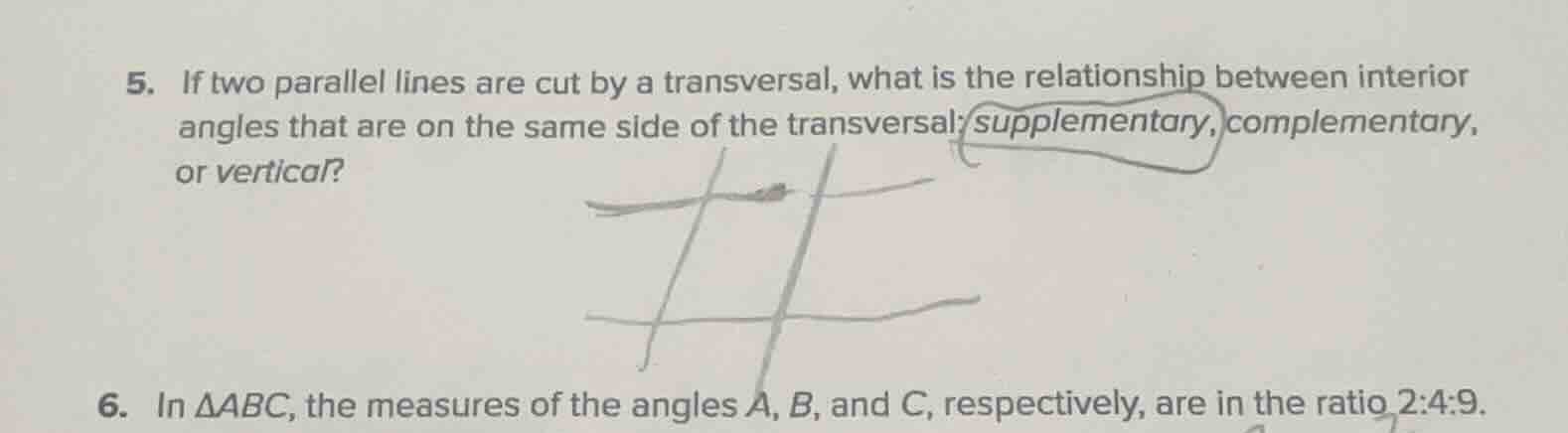
- if two parallel lines are cut by a transversal, what is the relationship between interior angles that are on the same side of the transversal: supplementary, complementary, or vertical?
- in $\triangle abc$, the measures of the angles $a$, $b$, and $c$, respectively, are in the ratio $2:4:9$.
For Question 5:
When two parallel lines are cut by a transversal, same - side interior angles are supplementary. This is a fundamental theorem in geometry. Supplementary angles are two angles whose sum is \(180^{\circ}\). When a transversal intersects two parallel lines, the same - side interior angles form a linear - pair - like relationship in terms of their sum, and their sum is \(180^{\circ}\). Complementary angles sum to \(90^{\circ}\), and vertical angles are equal and are formed by the intersection of two lines (not related to same - side interior angles in this context).
Step 1: Recall the sum of angles in a triangle
The sum of the interior angles of a triangle is \(180^{\circ}\). So, \(\angle A+\angle B+\angle C = 180^{\circ}\).
Step 2: Let the common ratio be \(x\)
Given that the ratio of the measures of angles \(A\), \(B\), and \(C\) is \(2:4:9\). So, we can represent the measures of the angles as \(\angle A = 2x\), \(\angle B=4x\), and \(\angle C = 9x\).
Step 3: Set up the equation and solve for \(x\)
Substitute the expressions for the angles into the angle - sum formula of a triangle:
\[2x + 4x+9x=180^{\circ}\]
Combine like terms:
\[15x = 180^{\circ}\]
Divide both sides by 15:
\[x=\frac{180^{\circ}}{15}=12^{\circ}\]
Step 4: Find the measures of each angle
\(\angle A = 2x=2\times12^{\circ} = 24^{\circ}\)
\(\angle B = 4x=4\times12^{\circ}=48^{\circ}\)
\(\angle C=9x = 9\times12^{\circ}=108^{\circ}\)

Snap & solve any problem in the app
Get step-by-step solutions on Sovi AI
Photo-based solutions with guided steps
Explore more problems and detailed explanations
supplementary