QUESTION IMAGE
Question
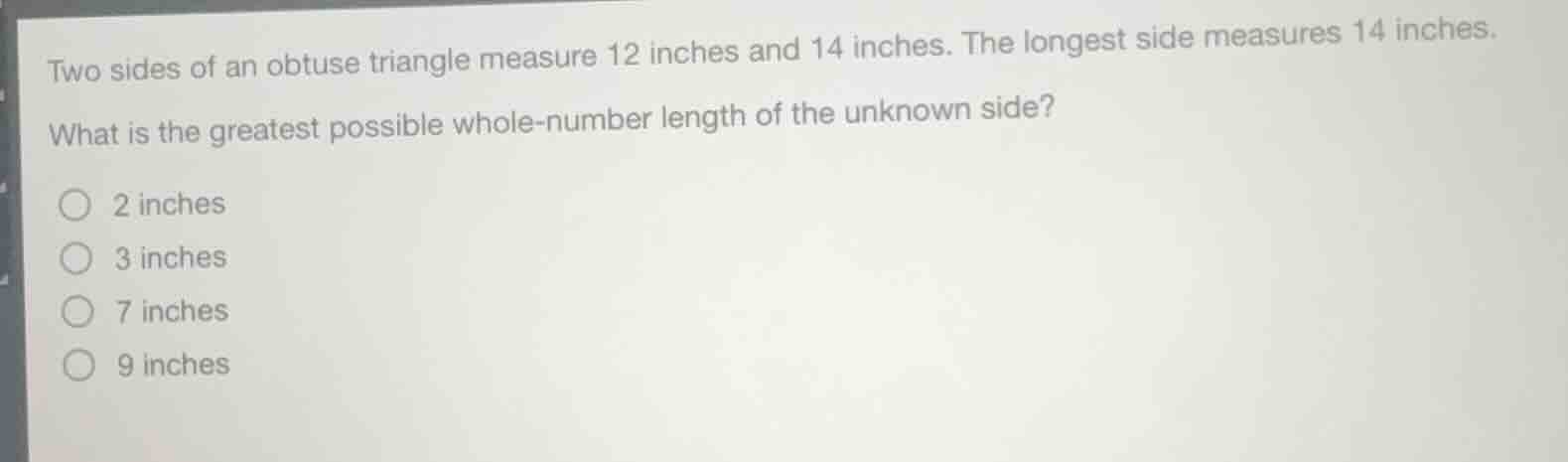
two sides of an obtuse triangle measure 12 inches and 14 inches. the longest side measures 14 inches. what is the greatest possible whole - number length of the unknown side? 2 inches, 3 inches, 7 inches, 9 inches
Step1: Recall triangle inequality and obtuse triangle condition
For a triangle with sides \(a\), \(b\), \(c\) (where \(c\) is the longest side), the triangle inequality is \(a + b>c\), \(a + c>b\), \(b + c>a\). For an obtuse triangle, if \(c\) is the longest side, then \(a^{2}+b^{2}
Case 1: 14 is the longest side (opposite obtuse angle). Then \(12^{2}+x^{2}<14^{2}\) => \(x^{2}<196 - 144=52\) => \(x<\sqrt{52}\approx7.21\).
Case 2: \(x\) is the longest side (but problem says longest is 14, so \(x\leq14\), but if \(x>14\), it contradicts. So only case 1. So \(x\) must be greater than 2 (from \(12 + x>14\)) and less than 7.21. The whole numbers in this range are 3,4,5,6,7. The greatest whole - number is 7? But wait, the options include 9. Wait, maybe I made a mistake in the obtuse angle case. Wait, maybe the obtuse angle is opposite \(x\), but then \(x\) would be longer than 14, but the problem says the longest side is 14, so that's not possible. Wait, let's check the option 9. If \(x = 9\), sides are 12,9,14. Check triangle inequality: \(12 + 9>14\) (21>14), \(12 + 14>9\) (26>9), \(9 + 14>12\) (23>12). Now check for obtuse: \(9^{2}+12^{2}=81 + 144 = 225\), \(14^{2}=196\). Since \(9^{2}+12^{2}>14^{2}\), the angle opposite 14 is acute, and…

Snap & solve any problem in the app
Get step-by-step solutions on Sovi AI
Photo-based solutions with guided steps
Explore more problems and detailed explanations
7 inches (the option corresponding to 7 inches)