QUESTION IMAGE
Question
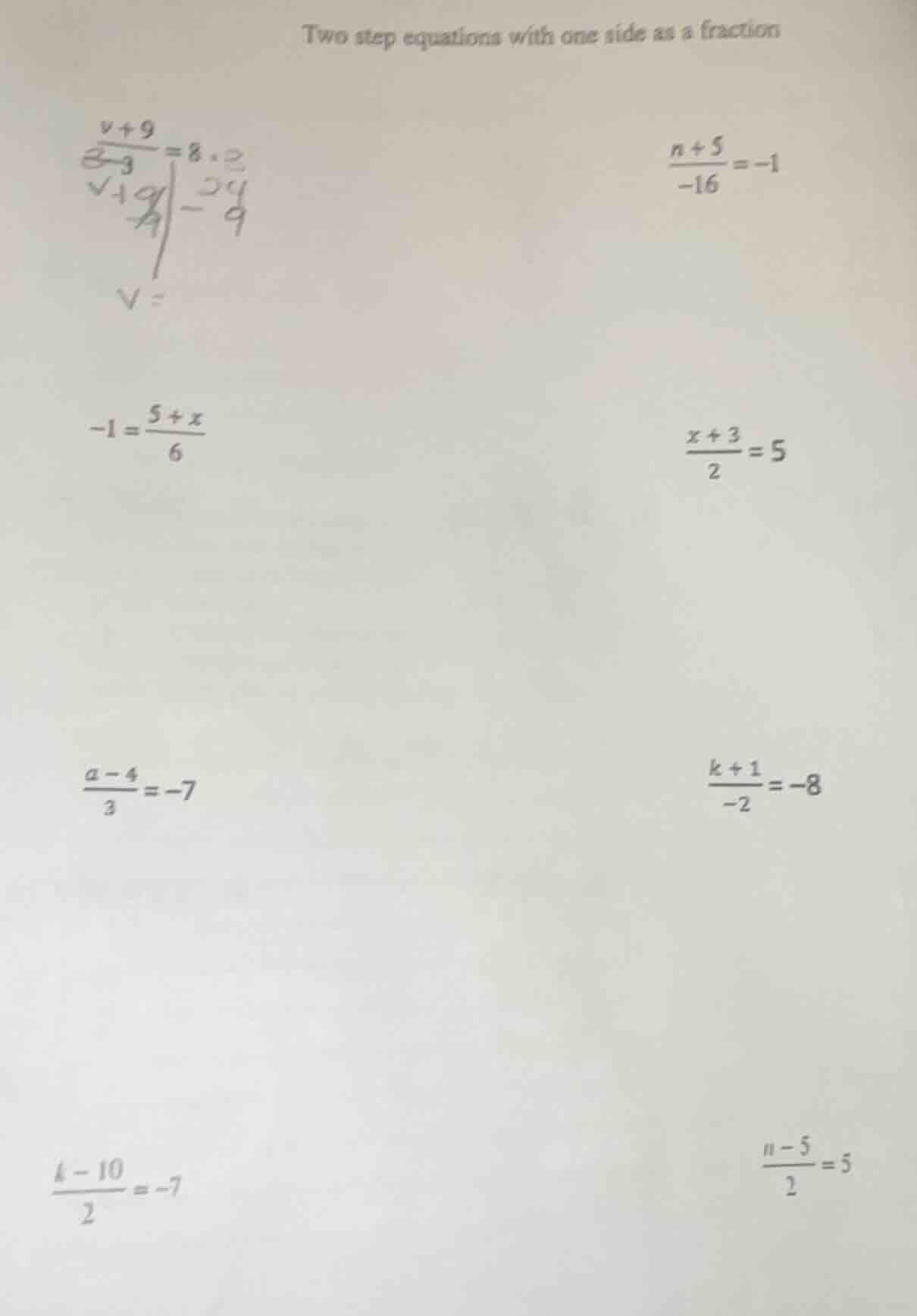
two step equations with one side as a fraction
\\(\frac{v + 9}{3}=8\\)
\\(\frac{n + 5}{-16}=-1\\)
\\(-1 = \frac{5 + x}{6}\\)
\\(\frac{x + 3}{2}=5\\)
\\(\frac{a - 4}{3}=-7\\)
\\(\frac{k + 1}{-2}=-8\\)
\\(\frac{k - 10}{2}=-7\\)
\\(\frac{n - 5}{2}=5\\)
Let's solve each equation one by one:
1. Solve \(\boldsymbol{\frac{v + 9}{3}=8}\)
Step 1: Multiply both sides by 3
To eliminate the denominator, multiply both sides of the equation by 3:
\(3\times\frac{v + 9}{3}=8\times3\)
Simplifying, we get:
\(v + 9 = 24\)
Step 2: Subtract 9 from both sides
Subtract 9 from both sides to solve for \(v\):
\(v+9 - 9=24 - 9\)
\(v = 15\)
2. Solve \(\boldsymbol{\frac{n + 5}{-16}=-1}\)
Step 1: Multiply both sides by -16
Multiply both sides by -16 to eliminate the denominator:
\(-16\times\frac{n + 5}{-16}=-1\times(-16)\)
Simplifying, we get:
\(n + 5 = 16\)
Step 2: Subtract 5 from both sides
Subtract 5 from both sides to solve for \(n\):
\(n+5 - 5=16 - 5\)
\(n = 11\)
3. Solve \(\boldsymbol{-1=\frac{5 + x}{6}}\)
Step 1: Multiply both sides by 6
Multiply both sides by 6 to eliminate the denominator:
\(6\times(-1)=6\times\frac{5 + x}{6}\)
Simplifying, we get:
\(-6 = 5 + x\)
Step 2: Subtract 5 from both sides
Subtract 5 from both sides to solve for \(x\):
\(-6 - 5=5 + x-5\)
\(-11 = x\)
Or \(x=-11\)
4. Solve \(\boldsymbol{\frac{x + 3}{2}=5}\)
Step 1: Multiply both sides by 2
Multiply both sides by 2 to eliminate the denominator:
\(2\times\frac{x + 3}{2}=5\times2\)
Simplifying, we get:
\(x + 3 = 10\)
Step 2: Subtract 3 from both sides
Subtract 3 from both sides to solve for \(x\):
\(x+3 - 3=10 - 3\)
\(x = 7\)
5. Solve \(\boldsymbol{\frac{a - 4}{3}=-7}\)
Step 1: Multiply both sides by 3
Multiply both sides by 3 to eliminate the denominator:
\(3\times\frac{a - 4}{3}=-7\times3\)
Simplifying, we get:
\(a - 4=-21\)
Step 2: Add 4 to both sides
Add 4 to both sides to solve for \(a\):
\(a-4 + 4=-21 + 4\)
\(a=-17\)
6. Solve \(\boldsymbol{\frac{k + 1}{-2}=-8}\)
Step 1: Multiply both sides by -2
Multiply both sides by -2 to eliminate the denominator:
\(-2\times\frac{k + 1}{-2}=-8\times(-2)\)
Simplifying, we get:
\(k + 1 = 16\)
Step 2: Subtract 1 from both sides
Subtract 1 from both sides to solve for \(k\):
\(k+1 - 1=16 - 1\)
\(k = 15\)
7. Solve \(\boldsymbol{\frac{k - 10}{2}=-7}\)
Step 1: Multiply both sides by 2
Multiply both sides by 2 to eliminate the denominator:
\(2\times\frac{k - 10}{2}=-7\times2\)
Simplifying, we get:
\(k - 10=-14\)
Step 2: Add 10 to both sides
Add 10 to both sides to solve for \(k\):
\(k-10 + 10=-14 + 10\)
\(k=-4\)
8. Solve \(\boldsymbol{\frac{n - 5}{2}=5}\)
Step 1: Multiply both sides by 2
Multiply both sides by 2 to eliminate the denominator:
\(2\times\frac{n - 5}{2}=5\times2\)
Simplifying, we get:
\(n - 5 = 10\)
Step 2: Add 5 to both sides
Add 5 to both sides to solve for \(n\):
\(n-5 + 5=10 + 5\)
\(n = 15\)
Final Answers:
- For \(\frac{v + 9}{3}=8\), \(v=\boldsymbol{15}\)
- For \(\frac{n + 5}{-16}=-1\), \(n=\boldsymbol{11}\)
- For \(-1=\frac{5 + x}{6}\), \(x=\boldsymbol{-11}\)
- For \(\frac{x + 3}{2}=5\), \(x=\boldsymbol{7}\)
- For \(\frac{a - 4}{3}=-7\), \(a=\boldsymbol{-17}\)
- For \(\frac{k + 1}{-2}=-8\), \(k=\boldsymbol{15}\)
- For \(\frac{k - 10}{2}=-7\), \(k=\boldsymbol{-4}\)
- For \(\frac{n - 5}{2}=5\), \(n=\boldsymbol{15}\)

Snap & solve any problem in the app
Get step-by-step solutions on Sovi AI
Photo-based solutions with guided steps
Explore more problems and detailed explanations
Let's solve each equation one by one:
1. Solve \(\boldsymbol{\frac{v + 9}{3}=8}\)
Step 1: Multiply both sides by 3
To eliminate the denominator, multiply both sides of the equation by 3:
\(3\times\frac{v + 9}{3}=8\times3\)
Simplifying, we get:
\(v + 9 = 24\)
Step 2: Subtract 9 from both sides
Subtract 9 from both sides to solve for \(v\):
\(v+9 - 9=24 - 9\)
\(v = 15\)
2. Solve \(\boldsymbol{\frac{n + 5}{-16}=-1}\)
Step 1: Multiply both sides by -16
Multiply both sides by -16 to eliminate the denominator:
\(-16\times\frac{n + 5}{-16}=-1\times(-16)\)
Simplifying, we get:
\(n + 5 = 16\)
Step 2: Subtract 5 from both sides
Subtract 5 from both sides to solve for \(n\):
\(n+5 - 5=16 - 5\)
\(n = 11\)
3. Solve \(\boldsymbol{-1=\frac{5 + x}{6}}\)
Step 1: Multiply both sides by 6
Multiply both sides by 6 to eliminate the denominator:
\(6\times(-1)=6\times\frac{5 + x}{6}\)
Simplifying, we get:
\(-6 = 5 + x\)
Step 2: Subtract 5 from both sides
Subtract 5 from both sides to solve for \(x\):
\(-6 - 5=5 + x-5\)
\(-11 = x\)
Or \(x=-11\)
4. Solve \(\boldsymbol{\frac{x + 3}{2}=5}\)
Step 1: Multiply both sides by 2
Multiply both sides by 2 to eliminate the denominator:
\(2\times\frac{x + 3}{2}=5\times2\)
Simplifying, we get:
\(x + 3 = 10\)
Step 2: Subtract 3 from both sides
Subtract 3 from both sides to solve for \(x\):
\(x+3 - 3=10 - 3\)
\(x = 7\)
5. Solve \(\boldsymbol{\frac{a - 4}{3}=-7}\)
Step 1: Multiply both sides by 3
Multiply both sides by 3 to eliminate the denominator:
\(3\times\frac{a - 4}{3}=-7\times3\)
Simplifying, we get:
\(a - 4=-21\)
Step 2: Add 4 to both sides
Add 4 to both sides to solve for \(a\):
\(a-4 + 4=-21 + 4\)
\(a=-17\)
6. Solve \(\boldsymbol{\frac{k + 1}{-2}=-8}\)
Step 1: Multiply both sides by -2
Multiply both sides by -2 to eliminate the denominator:
\(-2\times\frac{k + 1}{-2}=-8\times(-2)\)
Simplifying, we get:
\(k + 1 = 16\)
Step 2: Subtract 1 from both sides
Subtract 1 from both sides to solve for \(k\):
\(k+1 - 1=16 - 1\)
\(k = 15\)
7. Solve \(\boldsymbol{\frac{k - 10}{2}=-7}\)
Step 1: Multiply both sides by 2
Multiply both sides by 2 to eliminate the denominator:
\(2\times\frac{k - 10}{2}=-7\times2\)
Simplifying, we get:
\(k - 10=-14\)
Step 2: Add 10 to both sides
Add 10 to both sides to solve for \(k\):
\(k-10 + 10=-14 + 10\)
\(k=-4\)
8. Solve \(\boldsymbol{\frac{n - 5}{2}=5}\)
Step 1: Multiply both sides by 2
Multiply both sides by 2 to eliminate the denominator:
\(2\times\frac{n - 5}{2}=5\times2\)
Simplifying, we get:
\(n - 5 = 10\)
Step 2: Add 5 to both sides
Add 5 to both sides to solve for \(n\):
\(n-5 + 5=10 + 5\)
\(n = 15\)
Final Answers:
- For \(\frac{v + 9}{3}=8\), \(v=\boldsymbol{15}\)
- For \(\frac{n + 5}{-16}=-1\), \(n=\boldsymbol{11}\)
- For \(-1=\frac{5 + x}{6}\), \(x=\boldsymbol{-11}\)
- For \(\frac{x + 3}{2}=5\), \(x=\boldsymbol{7}\)
- For \(\frac{a - 4}{3}=-7\), \(a=\boldsymbol{-17}\)
- For \(\frac{k + 1}{-2}=-8\), \(k=\boldsymbol{15}\)
- For \(\frac{k - 10}{2}=-7\), \(k=\boldsymbol{-4}\)
- For \(\frac{n - 5}{2}=5\), \(n=\boldsymbol{15}\)