QUESTION IMAGE
Question
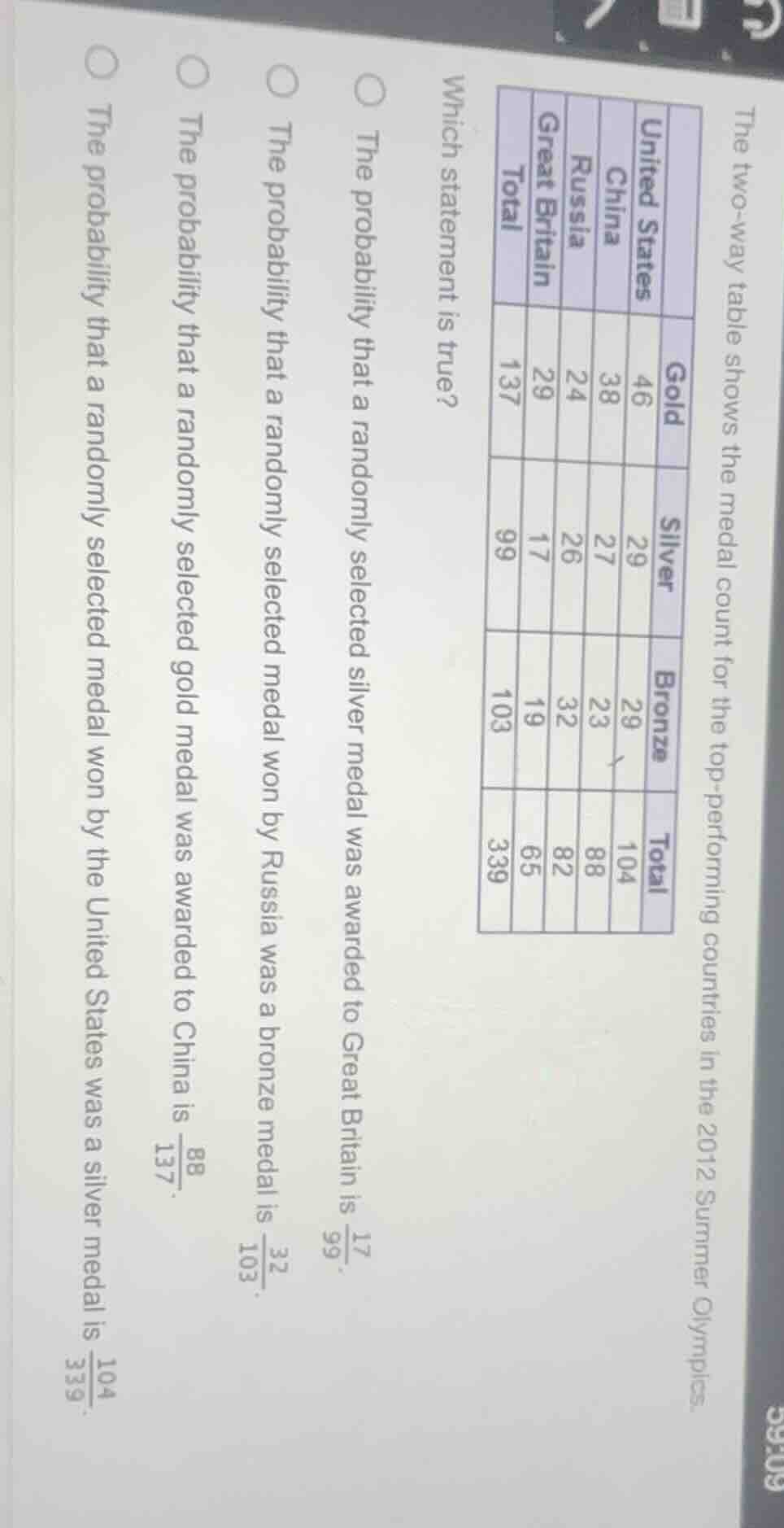
the two - way table shows the medal count for the top - performing countries in the 2012 summer olympics.
| united states | china | russia | great britain | total | |
|---|---|---|---|---|---|
| silver | 29 | 27 | 26 | 17 | 99 |
| bronze | 29 | 23 | 32 | 19 | 103 |
| total | 104 | 88 | 82 | 65 | 339 |
which statement is true?
- the probability that a randomly selected silver medal was awarded to great britain is $\frac{17}{99}$.
- the probability that a randomly selected medal won by russia was a bronze medal is $\frac{32}{103}$.
- the probability that a randomly selected gold medal was awarded to china is $\frac{88}{137}$.
- the probability that a randomly selected medal won by the united states was a silver medal is $\frac{104}{339}$.
To determine the correct statement, we analyze each option using the two - way table data:
Option 1: Probability that a randomly selected silver medal was awarded to Great Britain
- Total number of silver medals: From the "Silver" row and "Total" column, we have \(n(\text{silver}) = 99\).
- Number of silver medals awarded to Great Britain: From the "Silver" row and "Great Britain" column, we have \(n(\text{silver and Great Britain})=17\).
- The probability \(P=\frac{\text{Number of silver medals for Great Britain}}{\text{Total number of silver medals}}=\frac{17}{99}\). This statement is correct. But let's check the other options for completeness.
Option 2: Probability that a randomly selected gold medal was awarded to China
- Total number of gold medals: From the "Gold" row and "Total" column, we have \(n(\text{gold}) = 137\).
- Number of gold medals awarded to China: From the "Gold" row and "China" column, we have \(n(\text{gold and China}) = 38\).
- The probability \(P=\frac{38}{137}
eq\frac{88}{137}\). So this statement is incorrect.
Option 3: Probability that a randomly selected medal won by Russia was a bronze medal
- Total number of medals won by Russia: From the "Total" row and "Russia" column, we have \(n(\text{medals for Russia})=82\).
- Number of bronze medals won by Russia: From the "Bronze" row and "Russia" column, we have \(n(\text{bronze and Russia}) = 32\).
- The probability \(P=\frac{32}{82}
eq\frac{32}{103}\). So this statement is incorrect.
Option 4: Probability that a randomly selected medal won by the United States was a silver medal
- Total number of medals won by the United States: From the "Total" row and "United States" column, we have \(n(\text{medals for US}) = 104\).
- Number of silver medals won by the United States: From the "Silver" row and "United States" column, we have \(n(\text{silver and US})=29\).
- The probability \(P=\frac{29}{104}
eq\frac{104}{339}\). So this statement is incorrect.
The correct statement is "The probability that a randomly selected silver medal was awarded to Great Britain is \(\frac{17}{99}\)".
So the answer is the first option: "The probability that a randomly selected silver medal was awarded to Great Britain is \(\frac{17}{99}\)".

Snap & solve any problem in the app
Get step-by-step solutions on Sovi AI
Photo-based solutions with guided steps
Explore more problems and detailed explanations
To determine the correct statement, we analyze each option using the two - way table data:
Option 1: Probability that a randomly selected silver medal was awarded to Great Britain
- Total number of silver medals: From the "Silver" row and "Total" column, we have \(n(\text{silver}) = 99\).
- Number of silver medals awarded to Great Britain: From the "Silver" row and "Great Britain" column, we have \(n(\text{silver and Great Britain})=17\).
- The probability \(P=\frac{\text{Number of silver medals for Great Britain}}{\text{Total number of silver medals}}=\frac{17}{99}\). This statement is correct. But let's check the other options for completeness.
Option 2: Probability that a randomly selected gold medal was awarded to China
- Total number of gold medals: From the "Gold" row and "Total" column, we have \(n(\text{gold}) = 137\).
- Number of gold medals awarded to China: From the "Gold" row and "China" column, we have \(n(\text{gold and China}) = 38\).
- The probability \(P=\frac{38}{137}
eq\frac{88}{137}\). So this statement is incorrect.
Option 3: Probability that a randomly selected medal won by Russia was a bronze medal
- Total number of medals won by Russia: From the "Total" row and "Russia" column, we have \(n(\text{medals for Russia})=82\).
- Number of bronze medals won by Russia: From the "Bronze" row and "Russia" column, we have \(n(\text{bronze and Russia}) = 32\).
- The probability \(P=\frac{32}{82}
eq\frac{32}{103}\). So this statement is incorrect.
Option 4: Probability that a randomly selected medal won by the United States was a silver medal
- Total number of medals won by the United States: From the "Total" row and "United States" column, we have \(n(\text{medals for US}) = 104\).
- Number of silver medals won by the United States: From the "Silver" row and "United States" column, we have \(n(\text{silver and US})=29\).
- The probability \(P=\frac{29}{104}
eq\frac{104}{339}\). So this statement is incorrect.
The correct statement is "The probability that a randomly selected silver medal was awarded to Great Britain is \(\frac{17}{99}\)".
So the answer is the first option: "The probability that a randomly selected silver medal was awarded to Great Britain is \(\frac{17}{99}\)".