QUESTION IMAGE
Question
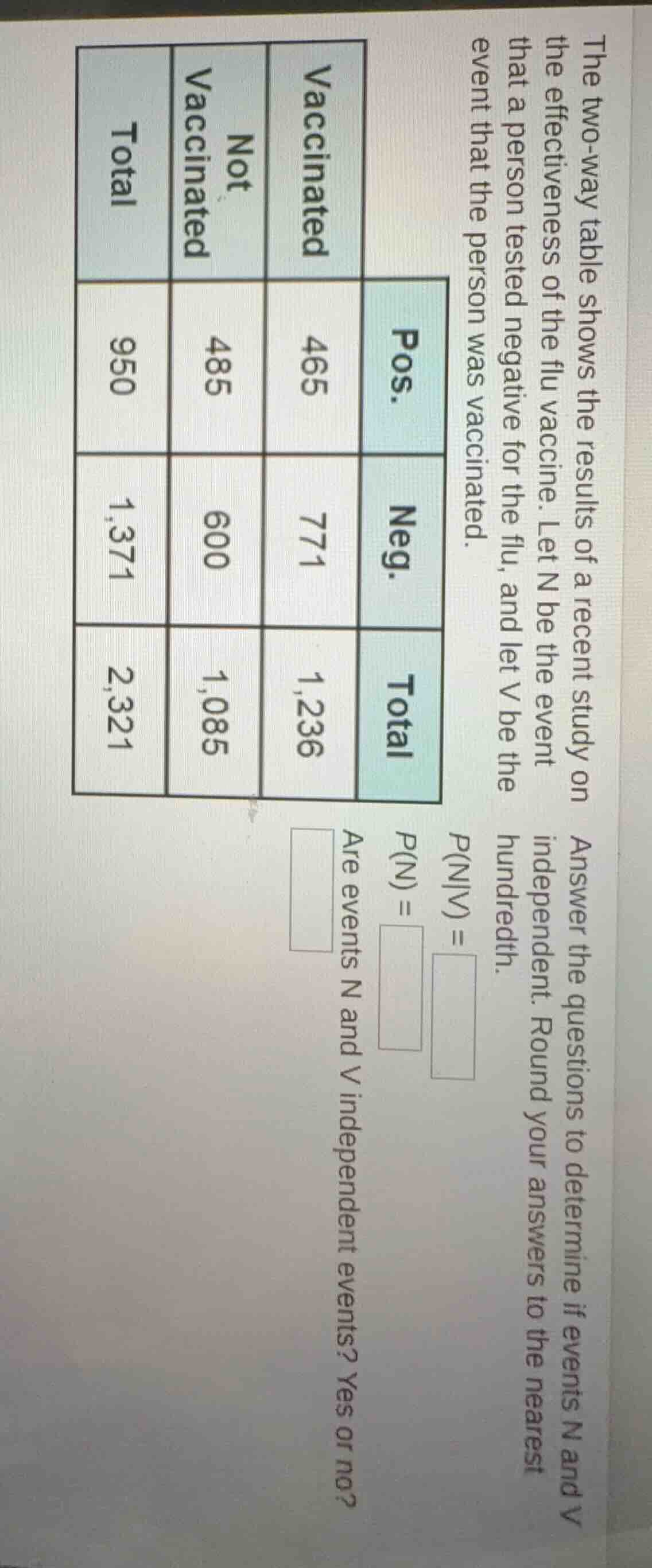
the two - way table shows the results of a recent study on the effectiveness of the flu vaccine. let n be the event that a person tested negative for the flu, and let v be the event that the person was vaccinated.
| vaccinated | not vaccinated | total | |
|---|---|---|---|
| neg. | 600 | 771 | 1371 |
| total | 1085 | 1236 | 2321 |
answer the questions to determine if events n and v are independent. round your answers to the nearest hundredth.
p(n|v) =
p(n) =
are events n and v independent events? yes or no?
Step1: Calculate \( P(N|V) \)
To find \( P(N|V) \), we use the formula for conditional probability: \( P(N|V)=\frac{\text{Number of people who are vaccinated and tested negative}}{\text{Total number of vaccinated people}} \). From the table, the number of vaccinated and negative is 600, and the total number of vaccinated people is 1085. So, \( P(N|V)=\frac{600}{1085}\approx0.55 \) (rounded to the nearest hundredth).
Step2: Calculate \( P(N) \)
To find \( P(N) \), we use the formula \( P(N)=\frac{\text{Total number of people who tested negative}}{\text{Total number of people in the study}} \). From the table, the total number of negative tests is 1371, and the total number of people is 2321. So, \( P(N)=\frac{1371}{2321}\approx0.59 \) (rounded to the nearest hundredth).
Step3: Check Independence
Two events \( N \) and \( V \) are independent if \( P(N|V) = P(N) \). Here, \( 0.55
eq0.59 \), so the events are not independent.

Snap & solve any problem in the app
Get step-by-step solutions on Sovi AI
Photo-based solutions with guided steps
Explore more problems and detailed explanations
\( P(N|V) \approx 0.55 \)
\( P(N) \approx 0.59 \)
Are events \( N \) and \( V \) independent? No