QUESTION IMAGE
Question
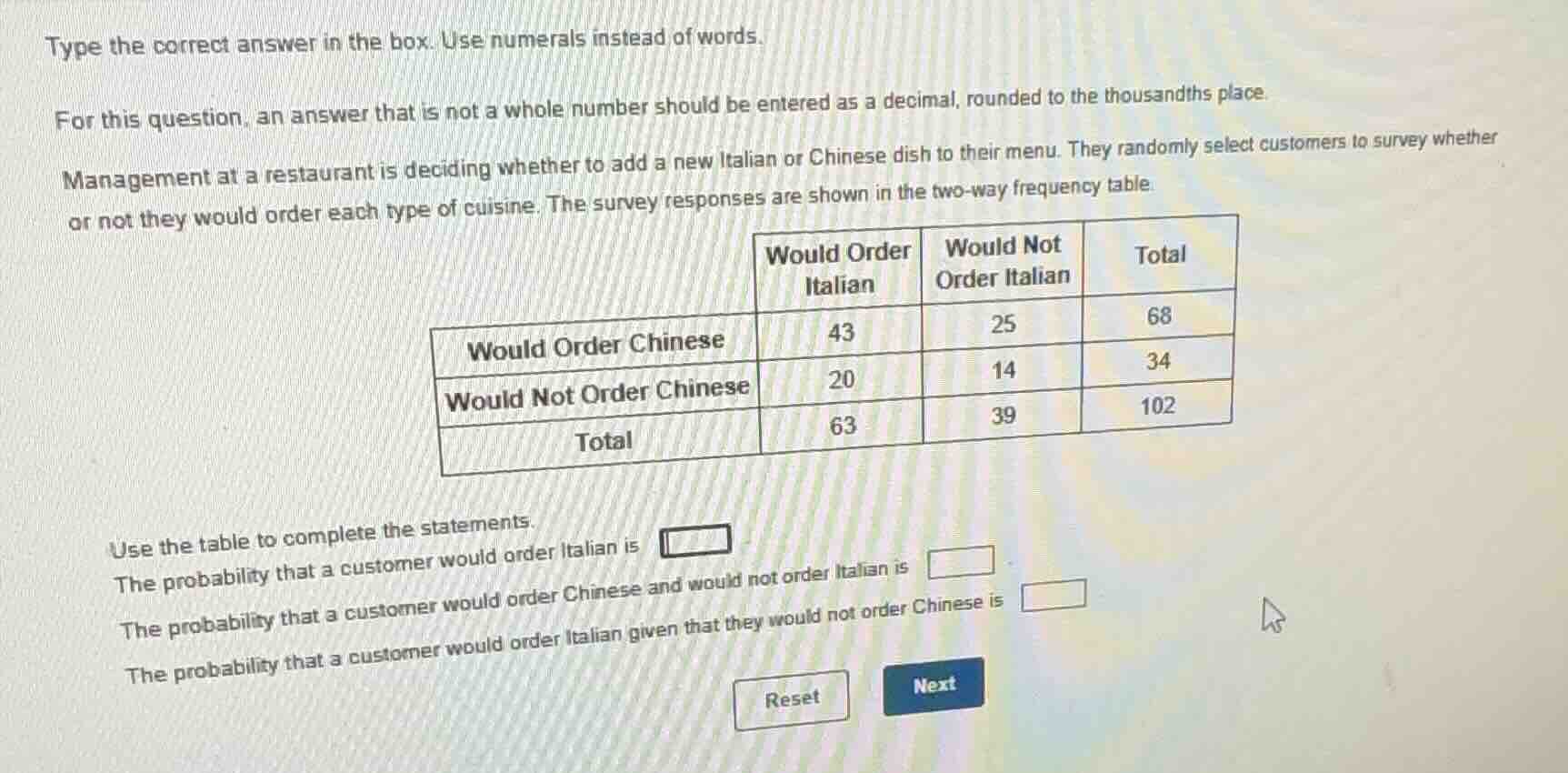
type the correct answer in the box. use numerals instead of words. for this question, an answer that is not a whole number should be entered as a decimal, rounded to the thousandths place. management at a restaurant is deciding whether to add a new italian or chinese dish to their menu. they randomly select customers to survey whether or not they would order each type of cuisine. the survey responses are shown in the two - way frequency table. two - way frequency table content: columns - would order italian, would not order italian, total; rows - would order chinese (43, 25, 68), would not order chinese (20, 14, 34), total (63, 39, 102) use the table to complete the statements. the probability that a customer would order italian is box. the probability that a customer would order chinese and would not order italian is box. the probability that a customer would order italian given that they would not order chinese is box.
Step1: Calculate P(Order Italian)
Divide total Italian orders by total customers:
$\frac{63}{102} \approx 0.618$
Step2: Calculate P(Order Chinese & No Italian)
Divide target group by total customers:
$\frac{25}{102} \approx 0.245$
Step3: Calculate P(Order Italian | No Chinese)
Divide Italian orders (no Chinese) by no Chinese total:
$\frac{20}{34} \approx 0.588$

Snap & solve any problem in the app
Get step-by-step solutions on Sovi AI
Photo-based solutions with guided steps
Explore more problems and detailed explanations
0.618
0.245
0.588