QUESTION IMAGE
Question
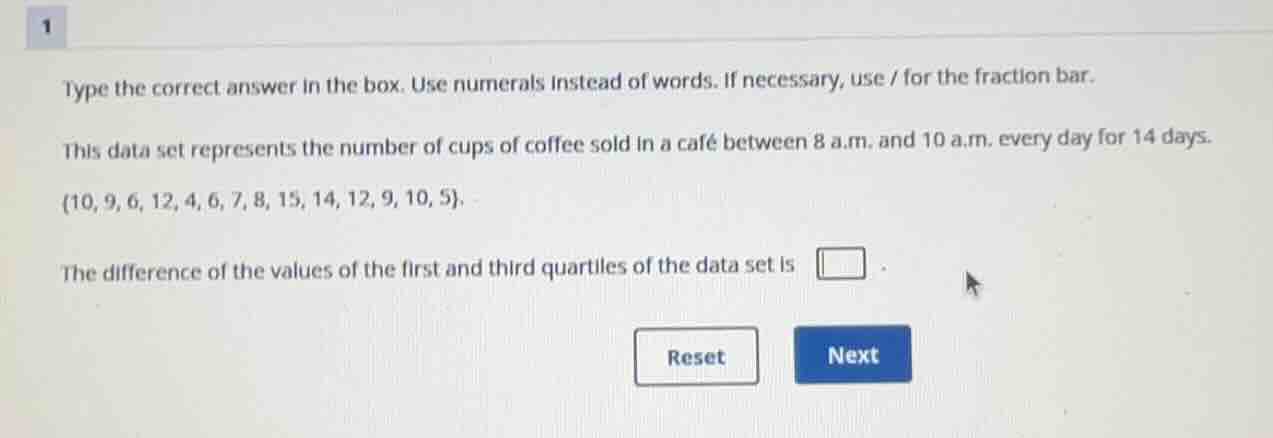
type the correct answer in the box. use numerals instead of words. if necessary, use / for the fraction bar. this data set represents the number of cups of coffee sold in a café between 8 a.m. and 10 a.m. every day for 14 days. (10, 9, 6, 12, 4, 6, 7, 8, 15, 14, 12, 9, 10, 5). the difference of the values of the first and third quartiles of the data set is
Step1: Order the data set
First, we order the given data set \((10, 9, 6, 12, 4, 6, 7, 8, 15, 14, 12, 9, 10, 5)\) from least to greatest.
The ordered data set is: \(4, 5, 6, 6, 7, 8, 9, 9, 10, 10, 12, 12, 14, 15\)
Step2: Find the median (to split the data into lower and upper halves)
The number of data points \(n = 14\) (even). The median is the average of the \(\frac{n}{2}\)-th and \((\frac{n}{2}+ 1)\)-th values.
\(\frac{n}{2}=\frac{14}{2}=7\)-th value and \((\frac{n}{2}+ 1)=8\)-th value.
From the ordered data, the 7 - th value is \(9\) and the 8 - th value is \(9\). So the median \(M=\frac{9 + 9}{2}=9\)
Step3: Find the first quartile (\(Q_1\))
The first quartile is the median of the lower half of the data. The lower half of the data (values below the median) is: \(4, 5, 6, 6, 7, 8, 9\) (since \(n = 14\), the lower half has \(7\) values).
The number of values in the lower half \(n_1=7\) (odd). The median of this lower half is the \(\frac{n_1 + 1}{2}=\frac{7+1}{2}=4\)-th value.
The 4 - th value in \(4, 5, 6, 6, 7, 8, 9\) is \(6\). So \(Q_1 = 6\)
Step4: Find the third quartile (\(Q_3\))
The third quartile is the median of the upper half of the data. The upper half of the data (values above the median) is: \(9, 10, 10, 12, 12, 14, 15\) (since \(n = 14\), the upper half has \(7\) values).
The number of values in the upper half \(n_2 = 7\) (odd). The median of this upper half is the \(\frac{n_2+1}{2}=\frac{7 + 1}{2}=4\)-th value.
The 4 - th value in \(9, 10, 10, 12, 12, 14, 15\) is \(12\). So \(Q_3=12\)
Step5: Calculate the inter - quartile range (difference between \(Q_3\) and \(Q_1\))
The inter - quartile range \(IQR=Q_3 - Q_1\)
Substitute \(Q_3 = 12\) and \(Q_1=6\) into the formula: \(IQR=12 - 6=6\)

Snap & solve any problem in the app
Get step-by-step solutions on Sovi AI
Photo-based solutions with guided steps
Explore more problems and detailed explanations
6