QUESTION IMAGE
Question
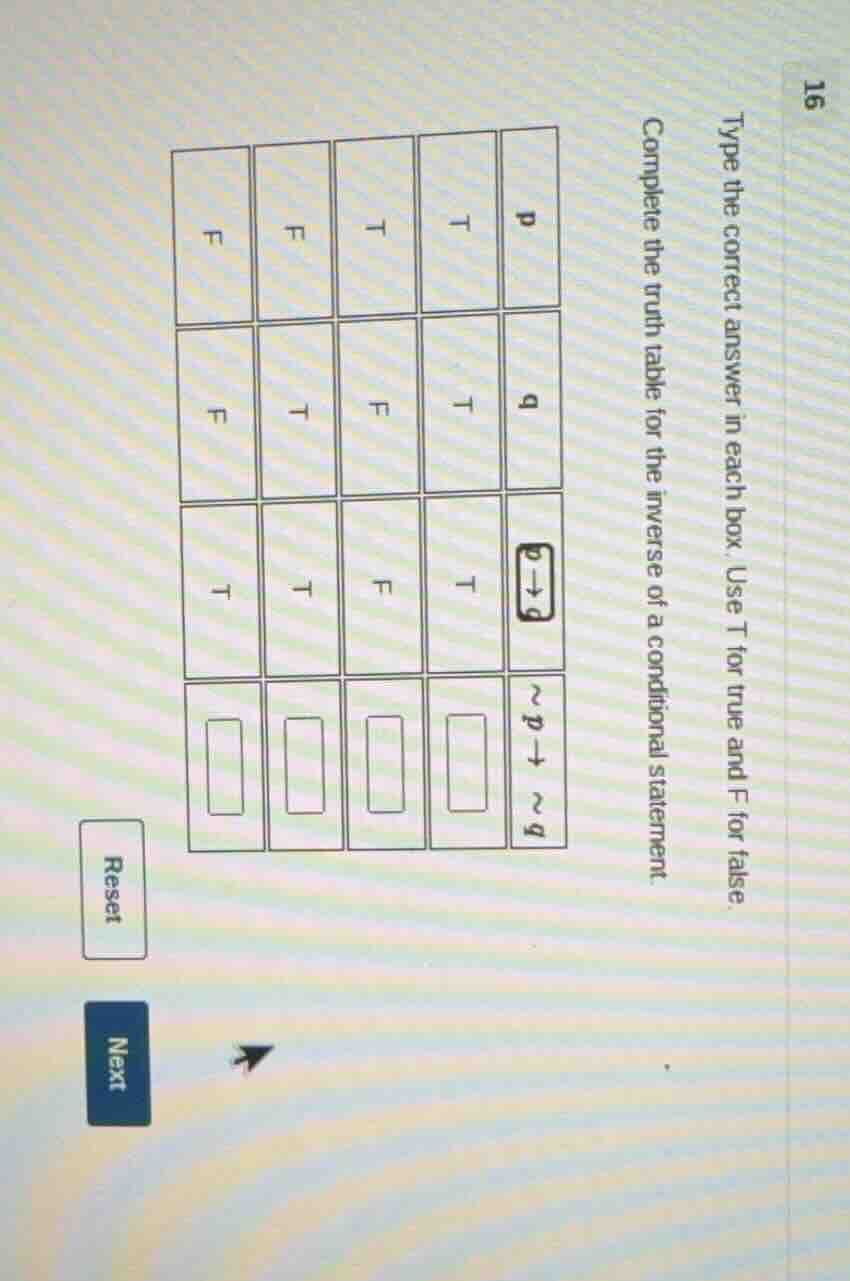
type the correct answer in each box. use t for true and f for false. complete the truth table for the inverse of a conditional statement. p | t | t | t | f | f q | t | f | t | f | f $p \to q$ | t | f | t | t | t $\sim p \to \sim q$ | | | | | reset next
Step1: Recall the definition of inverse of a conditional statement
The inverse of a conditional statement \( p
ightarrow q \) is \( \sim p
ightarrow \sim q \). The truth value of a conditional statement \( r
ightarrow s \) is false only when \( r \) is true and \( s \) is false; otherwise, it is true. Here, \( r=\sim p \) and \( s = \sim q \). So we first find \( \sim p \) and \( \sim q \) for each row, then determine the truth value of \( \sim p
ightarrow \sim q \).
Step2: Analyze each row
Row 1: \( p = T \), \( q = T \)
- Find \( \sim p \): Since \( p = T \), \( \sim p = F \)
- Find \( \sim q \): Since \( q = T \), \( \sim q = F \)
- Now, check \( \sim p
ightarrow \sim q \) (i.e., \( F
ightarrow F \)): A conditional statement with antecedent \( F \) is always true. So \( \sim p
ightarrow \sim q = T \)
Row 2: \( p = T \), \( q = F \)
- Find \( \sim p \): \( \sim p = F \) (because \( p = T \))
- Find \( \sim q \): \( \sim q = T \) (because \( q = F \))
- Check \( \sim p
ightarrow \sim q \) (i.e., \( F
ightarrow T \)): A conditional statement with antecedent \( F \) is always true. So \( \sim p
ightarrow \sim q = T \)
Row 3: \( p = F \), \( q = T \)
- Find \( \sim p \): \( \sim p = T \) (because \( p = F \))
- Find \( \sim q \): \( \sim q = F \) (because \( q = T \))
- Check \( \sim p
ightarrow \sim q \) (i.e., \( T
ightarrow F \)): A conditional statement with antecedent \( T \) and consequent \( F \) is false. So \( \sim p
ightarrow \sim q = F \)
Row 4: \( p = F \), \( q = F \)
- Find \( \sim p \): \( \sim p = T \) (because \( p = F \))
- Find \( \sim q \): \( \sim q = T \) (because \( q = F \))
- Check \( \sim p
ightarrow \sim q \) (i.e., \( T
ightarrow T \)): A conditional statement with antecedent \( T \) and consequent \( T \) is true. So \( \sim p
ightarrow \sim q = T \)

Snap & solve any problem in the app
Get step-by-step solutions on Sovi AI
Photo-based solutions with guided steps
Explore more problems and detailed explanations
The truth values for \( \sim p
ightarrow \sim q \) in each row (from left to right, top to bottom) are \( T \), \( T \), \( F \), \( T \) (corresponding to each row of the table).