QUESTION IMAGE
Question
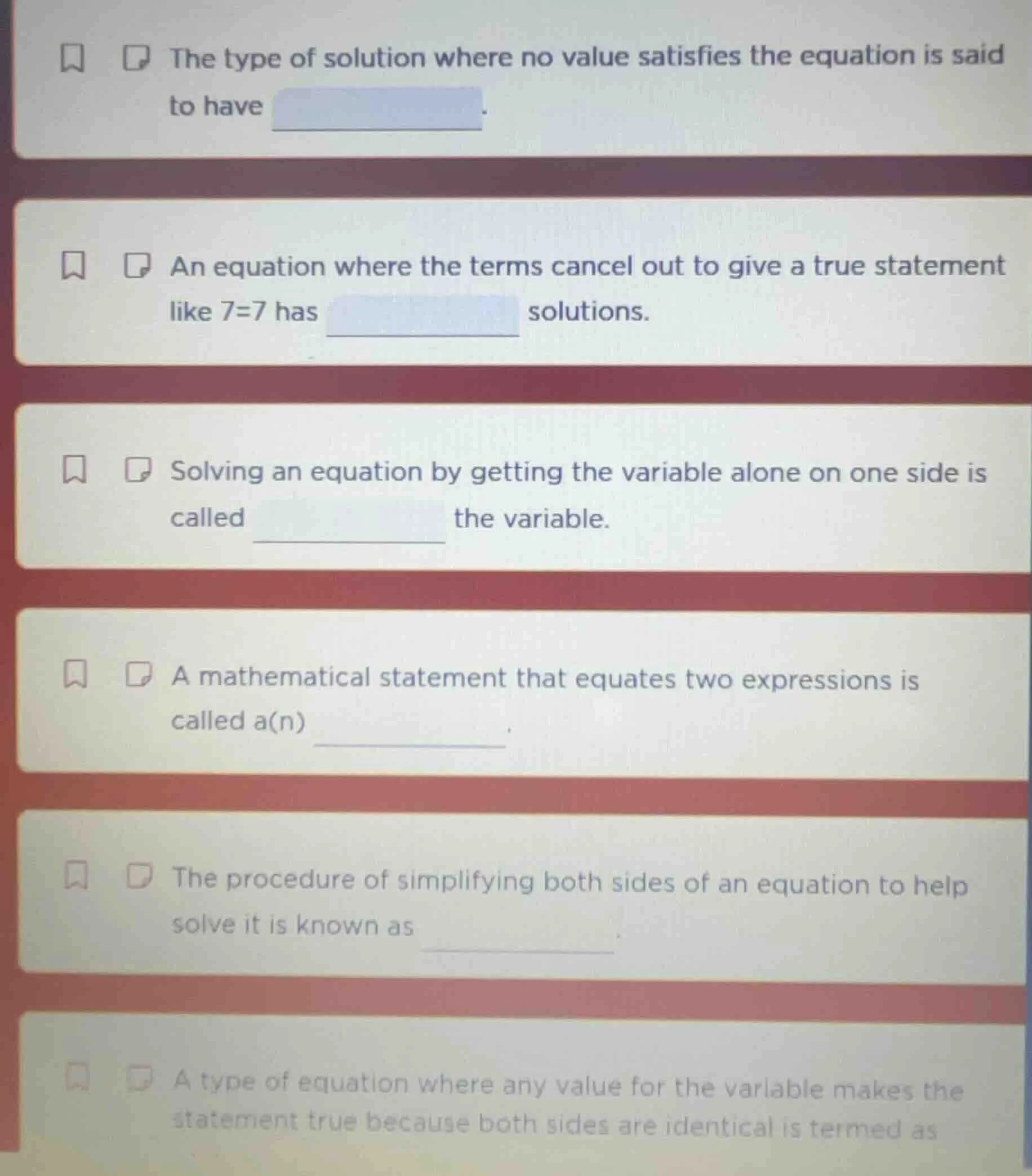
the type of solution where no value satisfies the equation is said to have ______.
an equation where the terms cancel out to give a true statement like 7=7 has ______ solutions.
solving an equation by getting the variable alone on one side is called ______ the variable.
a mathematical statement that equates two expressions is called a(n) ______.
the procedure of simplifying both sides of an equation to help solve it is known as ______.
a type of equation where any value for the variable makes the statement true because both sides are identical is termed as
First Question:
In algebra, when an equation has no solution (no value of the variable satisfies it), it's called having no solution or sometimes an empty solution set. For example, \(x + 5 = x + 7\) simplifies to \(5 = 7\), which is false, so no value of \(x\) works.
An equation where both sides simplify to the same true statement (like \(7 = 7\) or \(2x + 4 = 2(x + 2)\) which simplifies to \(2x + 4 = 2x + 4\)) is an identity and has infinitely many solutions because any value of the variable will make the equation true.
When solving an equation, the process of getting the variable by itself on one side (e.g., solving \(2x + 3 = 7\) to get \(x = 2\) by subtracting 3 and dividing by 2) is called isolating the variable. This is a key concept in solving linear equations.

Snap & solve any problem in the app
Get step-by-step solutions on Sovi AI
Photo-based solutions with guided steps
Explore more problems and detailed explanations
no solution (or empty solution set)