QUESTION IMAGE
Question
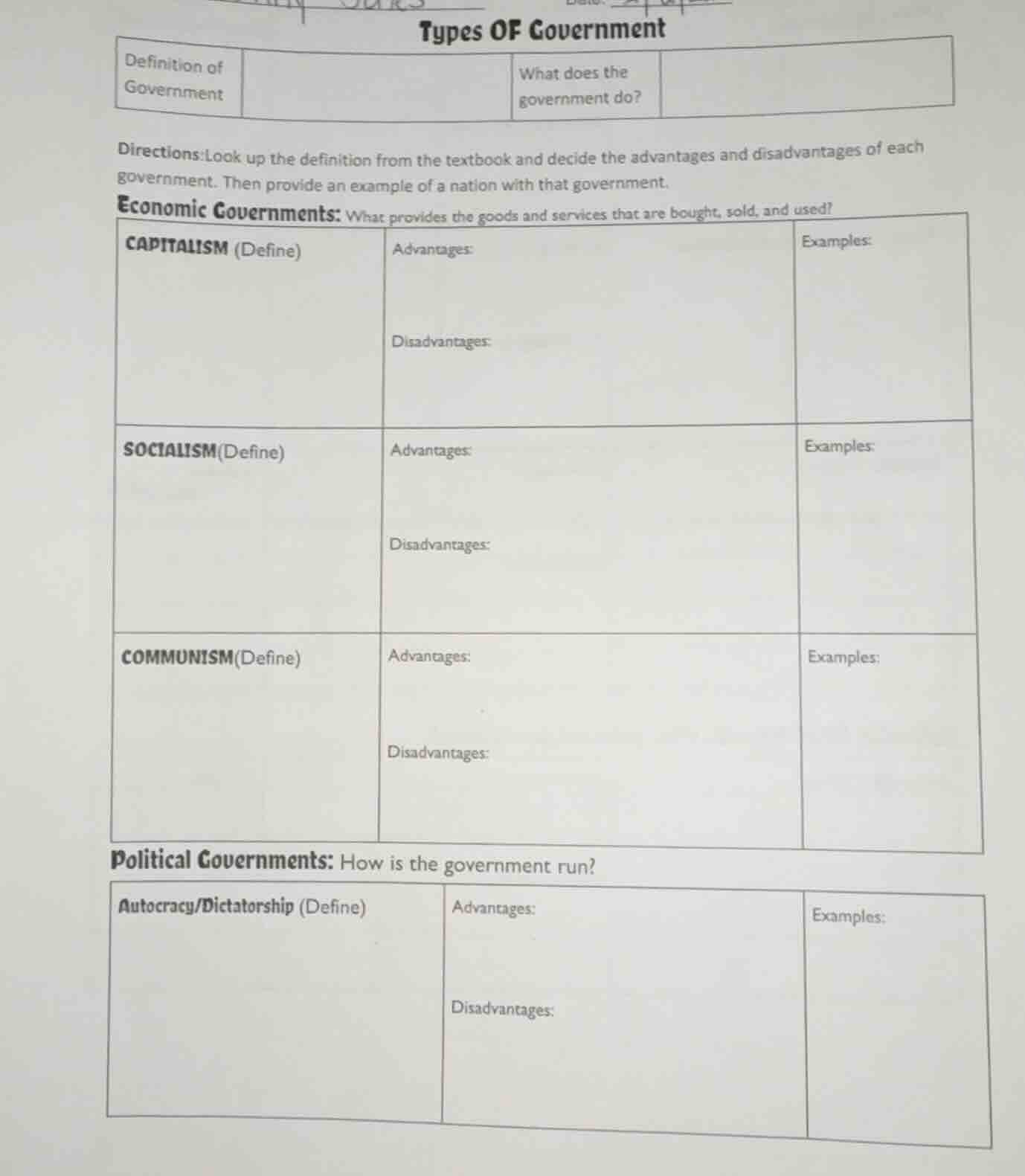
types of government
definition of government\t\twhat does the government do?\t
directions:look up the definition from the textbook and decide the advantages and disadvantages of each government. then provide an example of a nation with that government.
economic governments: what provides the goods and services that are bought, sold, and used?
capitalism (define)\tadvantages:
\t\tdisadvantages:\texamples:
socialism(define)\tadvantages:
\t\tdisadvantages:\texamples:
communism(define)\tadvantages:
\t\tdisadvantages:\texamples:
political governments: how is the government run?
autocracy/dictatorship (define)\tadvantages:
\t\tdisadvantages:\texamples:
To complete this worksheet, we analyze each economic and political system:
Capitalism
- Define: An economic system where private individuals or businesses own capital goods, and prices, production, and distribution of goods/services are determined by free-market competition, with minimal government intervention.
- Advantages: Encourages innovation and entrepreneurship due to profit motive; efficient resource allocation as per market demand; provides consumer choice.
- Disadvantages: Can lead to income inequality; may cause market failures (e.g., monopolies, externalities like pollution); lacks support for those unable to compete.
- Examples: United States, United Kingdom.
Socialism
- Define: An economic system where the means of production (factories, farms, etc.) are owned either by the state or by the community, with the goal of equitable distribution of wealth and social welfare.
- Advantages: Provides universal access to essential goods/services (e.g., healthcare, education); reduces income inequality; stabilizes economy through government planning.
- Disadvantages: Can lead to inefficiencies due to lack of competition; may limit individual economic freedom; risk of government overreach or corruption.
- Examples: Sweden (mixed socialist - capitalist), Cuba (more state - controlled socialism).
Communism
- Define: A political and economic ideology advocating for a classless society where all property is publicly owned, and each person works and is paid according to their abilities and needs. In practice, it often involves a single - party state controlling the economy.
- Advantages: Theoretical goal of eliminating class struggle and poverty; ensures basic needs are met for all citizens; promotes social unity.
- Disadvantages: In practice, lack of economic incentives; limited individual freedoms (political and economic); inefficiencies in central planning; history of authoritarian regimes.
- Examples: Former Soviet Union, People's Republic of China (has evolved with market - based reforms but still has communist ideology).
Autocracy/Dictatorship (Political Government)
- Define: A system of government where a single person (dictator) or a small group holds absolute power, with no or very limited political freedom for citizens.
- Advantages: Can make quick decisions without lengthy political processes; provides stability in times of crisis (if the leader is competent).
- Disadvantages: Violates human rights (e.g., freedom of speech, press); lack of democratic representation; power is often misused for personal gain; no accountability.
- Examples: North Korea (often considered an autocracy by some Western definitions), historical examples like Nazi Germany under Hitler.

Snap & solve any problem in the app
Get step-by-step solutions on Sovi AI
Photo-based solutions with guided steps
Explore more problems and detailed explanations
Capitalism
- Define: Economic system with private ownership of capital, market - driven production/distribution.
- Advantages: Innovation, efficient allocation, consumer choice.
- Disadvantages: Income inequality, market failures, lack of support for non - competitors.
- Examples: USA, UK.
Socialism
- Define: State/community ownership of production for equitable wealth distribution.
- Advantages: Universal access to essentials, reduced inequality, economic stability.
- Disadvantages: Inefficiencies, limited economic freedom, government overreach risk.
- Examples: Sweden, Cuba.
Communism
- Define: Classless society with public ownership, work/ pay by ability/need (single - party control in practice).
- Advantages: Eliminate class struggle/poverty, meet basic needs, promote unity.
- Disadvantages: Lack of incentives, limited freedoms, central planning inefficiencies, authoritarian history.
- Examples: Former USSR, China.
Autocracy/Dictatorship
- Define: Single person/small group with absolute power, limited political freedom.
- Advantages: Quick decisions, crisis stability (if competent leader).
- Disadvantages: Human rights violations, no democratic representation, power misuse, no accountability.
- Examples: North Korea, Nazi Germany.