QUESTION IMAGE
Question
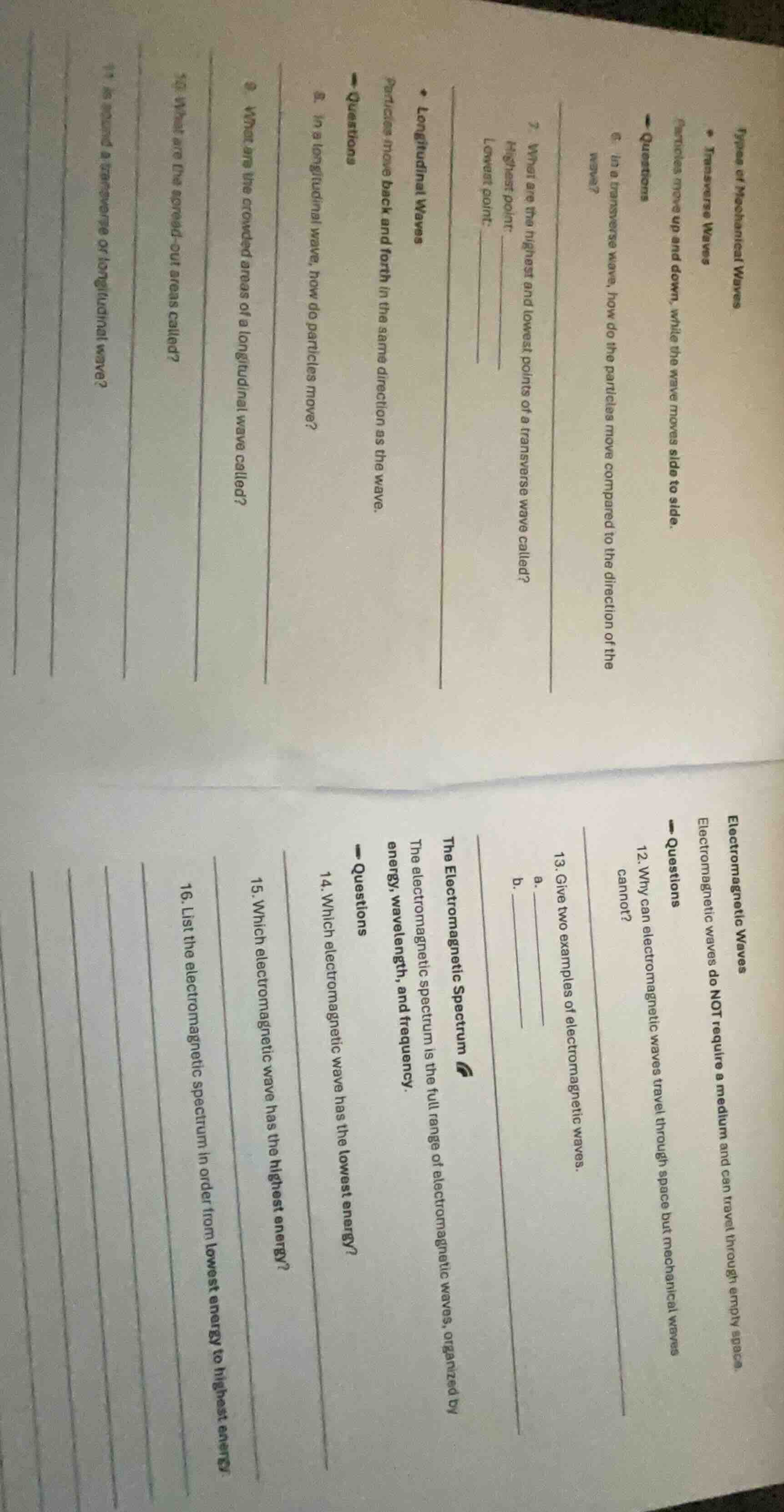
types of mechanical waves
- transverse waves
particles move up and down, while the wave moves side to side.
→ questions
- in a transverse wave, how do the particles move compared to the direction of the wave?
- what are the highest and lowest points of a transverse wave called?
highest point: ________
lowest point: ________
- longitudinal waves
particles move back and forth in the same direction as the wave.
→ questions
- in a longitudinal wave, how do particles move?
- what are the crowded areas of a longitudinal wave called?
- what are the spread - out areas called?
- is sound a transverse or longitudinal wave?
electromagnetic waves
electromagnetic waves do not require a medium and can travel through empty space.
→ questions
- why can electromagnetic waves travel through space but mechanical waves cannot?
- give two examples of electromagnetic waves.
a. ________
b. ________
the electromagnetic spectrum
the electromagnetic spectrum is the full range of electromagnetic waves, organized by energy, wavelength, and frequency.
→ questions
- which electromagnetic wave has the lowest energy?
- which electromagnetic wave has the highest energy?
- list the electromagnetic spectrum in order from lowest energy to highest energy.

Snap & solve any problem in the app
Get step-by-step solutions on Sovi AI
Photo-based solutions with guided steps
Explore more problems and detailed explanations
s are based on core physics concepts of wave types and the electromagnetic spectrum:
- For transverse waves, particle motion is perpendicular to wave direction. Their highest and lowest points have standard names.
- For longitudinal waves, particle motion aligns with wave direction, with specific terms for crowded/spread-out regions. Sound is a classic longitudinal wave example.
- Electromagnetic waves do not need a medium, unlike mechanical waves. The electromagnetic spectrum is ordered by energy, with radio waves having the lowest energy and gamma rays the highest.