QUESTION IMAGE
Question
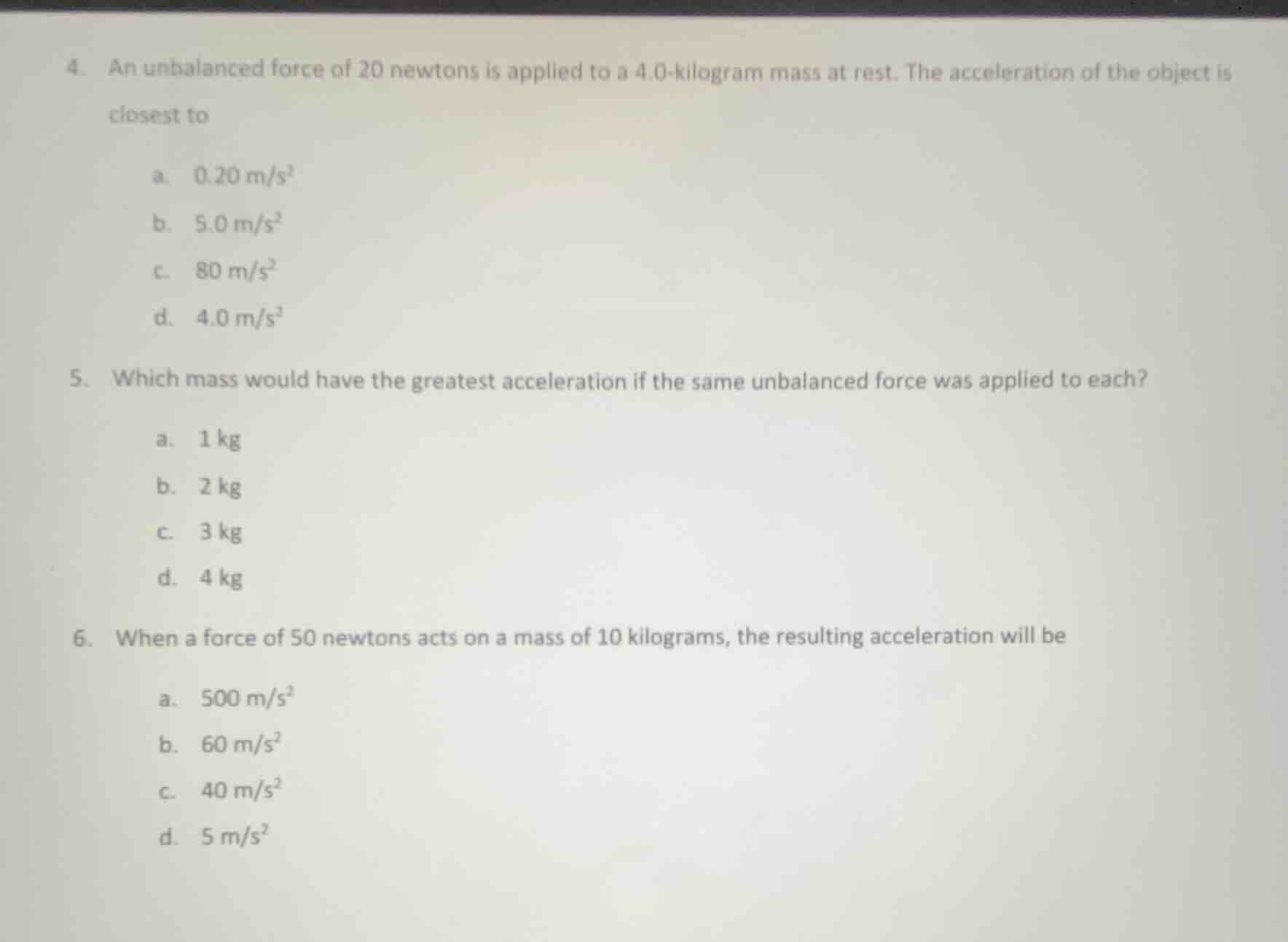
- an unbalanced force of 20 newtons is applied to a 4.0 - kilogram mass at rest. the acceleration of the object is closest to
\ta. 0.20 m/s²
\tb. 5.0 m/s²
\tc. 80 m/s²
\td. 4.0 m/s²
- which mass would have the greatest acceleration if the same unbalanced force was applied to each?
\ta. 1 kg
\tb. 2 kg
\tc. 3 kg
\td. 4 kg
- when a force of 50 newtons acts on a mass of 10 kilograms, the resulting acceleration will be
\ta. 500 m/s²
\tb. 60 m/s²
\tc. 40 m/s²
\td. 5 m/s²
Question 4
Step1: Recall Newton's Second Law
Newton's second law is \( F = ma \), where \( F \) is force, \( m \) is mass, and \( a \) is acceleration. We need to solve for \( a \), so rearrange the formula to \( a=\frac{F}{m} \).
Step2: Substitute the given values
Given \( F = 20\space N \) and \( m = 4.0\space kg \). Substitute into the formula: \( a=\frac{20\space N}{4.0\space kg} \).
Step3: Calculate the acceleration
\( \frac{20}{4.0}=5.0\space m/s^{2} \).
Step1: Recall the relationship from Newton's Second Law
From \( F = ma \), when \( F \) is constant (same unbalanced force), acceleration \( a \) is inversely proportional to mass \( m \) (\( a=\frac{F}{m} \)). So smaller mass gives greater acceleration.
Step2: Compare the masses
The masses are \( 1\space kg \), \( 2\space kg \), \( 3\space kg \), \( 4\space kg \). The smallest mass is \( 1\space kg \), so it will have the greatest acceleration.
Step1: Recall Newton's Second Law formula
Use \( a=\frac{F}{m} \) from \( F = ma \).
Step2: Substitute the values
Given \( F = 50\space N \) and \( m = 10\space kg \). Substitute: \( a=\frac{50\space N}{10\space kg} \).
Step3: Calculate the acceleration
\( \frac{50}{10}=5\space m/s^{2} \).

Snap & solve any problem in the app
Get step-by-step solutions on Sovi AI
Photo-based solutions with guided steps
Explore more problems and detailed explanations
b. \( 5.0\space m/s^{2} \)