QUESTION IMAGE
Question
understand z - scores
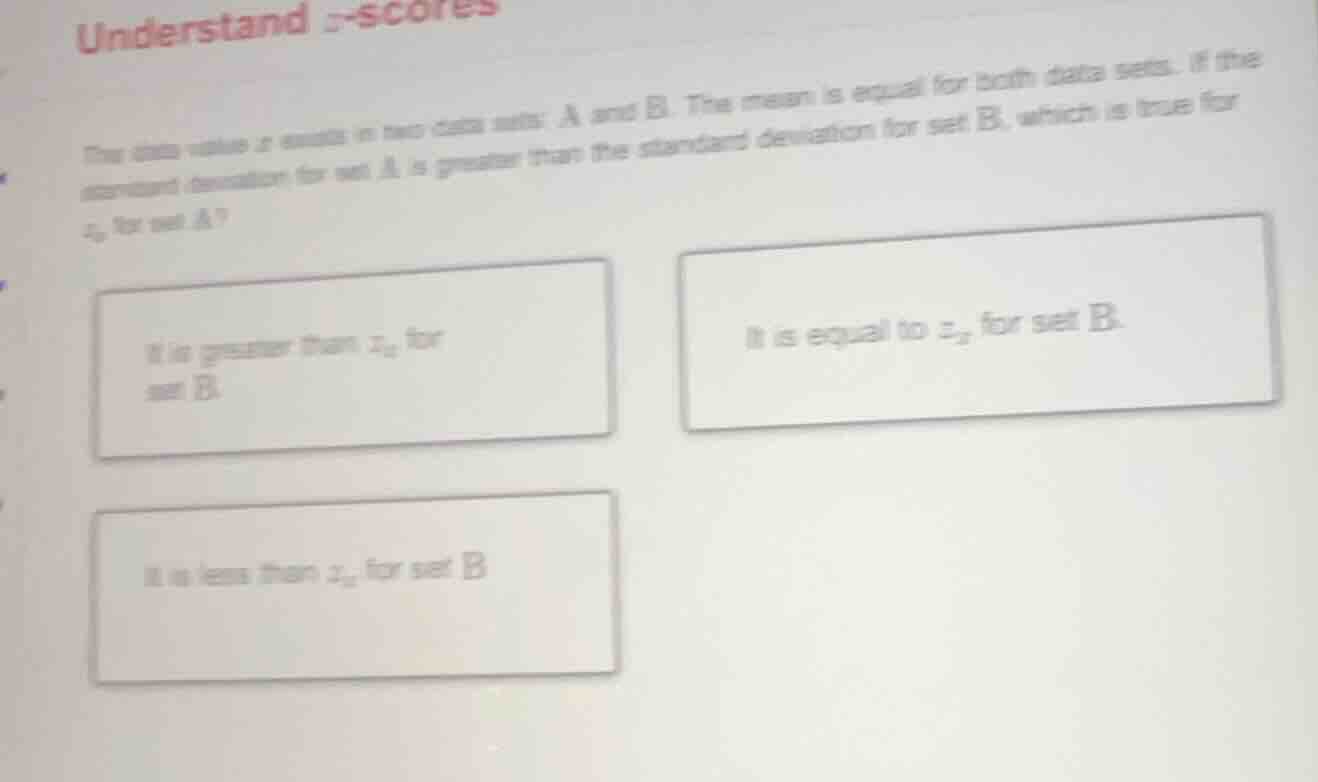
the data value ( x ) exists in two data sets: a and b. the mean is equal for both data sets. if the standard deviation for set a is greater than the standard deviation for set b, which is true for ( z_x ) for set a?
- it is greater than ( z_x ) for set b.
- it is equal to ( z_x ) for set b.
- it is less than ( z_x ) for set b
Step1: Recall z - score formula
The formula for a z - score is $z=\frac{x - \mu}{\sigma}$, where $x$ is the data value, $\mu$ is the mean, and $\sigma$ is the standard deviation.
Step2: Analyze the given information
We know that for both data sets A and B, the mean $\mu_A=\mu_B=\mu$ (since the mean is equal for both sets) and the data value $x$ is the same for both sets. Let $\sigma_A$ be the standard deviation of set A and $\sigma_B$ be the standard deviation of set B, and we know that $\sigma_A>\sigma_B$.
For set A, the z - score $z_A=\frac{x - \mu}{\sigma_A}$. For set B, the z - score $z_B=\frac{x - \mu}{\sigma_B}$.
Let's consider the numerators: since $x$ and $\mu$ are the same for both sets, the numerator $(x - \mu)$ is the same for $z_A$ and $z_B$.
Now, we have two fractions with the same numerator. When the numerator is non - zero (assuming $x
eq\mu$, otherwise the z - score is 0 for both), and we have $\sigma_A>\sigma_B>0$, then the fraction $\frac{\text{same numerator}}{\sigma_A}$ will be smaller in magnitude (if the numerator is non - zero) than the fraction $\frac{\text{same numerator}}{\sigma_B}$.
Case 1: If $x>\mu$, then $(x - \mu)>0$. So $z_A=\frac{(x - \mu)}{\sigma_A}$ and $z_B=\frac{(x - \mu)}{\sigma_B}$. Since $\sigma_A>\sigma_B$, dividing a positive number by a larger positive number gives a smaller result. So $z_A Case 2: If $x<\mu$, then $(x - \mu)<0$. So $z_A=\frac{(x - \mu)}{\sigma_A}$ and $z_B=\frac{(x - \mu)}{\sigma_B}$. Dividing a negative number by a larger positive number gives a result that is closer to zero (i.e., larger) than dividing the same negative number by a smaller positive number? Wait, no. Let's take an example. Let $(x - \mu)=- 2$, $\sigma_A = 4$, $\sigma_B = 2$. Then $z_A=\frac{-2}{4}=-0.5$ and $z_B=\frac{-2}{2}=-1$. Here, $-0.5>-1$, but wait, this seems contradictory. Wait, no, in the case of negative numerator, if $\sigma_A>\sigma_B$, then $\frac{\text{negative number}}{\sigma_A}$ is greater than $\frac{\text{negative number}}{\sigma_B}$ (because dividing a negative number by a larger positive number makes the result less negative, i.e., larger). But wait, in the first case when numerator is positive, $\frac{\text{positive number}}{\sigma_A}<\frac{\text{positive number}}{\sigma_B}$. But the problem is about a data value $x$ (the same $x$ for both sets). Let's think in terms of the formula. Since $\sigma_A>\sigma_B$, and $z=\frac{x - \mu}{\sigma}$, for the same $(x - \mu)$, as $\sigma$ increases, the absolute value of $z$ decreases. If $(x - \mu)=0$, then $z_A = z_B=0$. But in general, for a non - zero $(x - \mu)$, since $\sigma_A>\sigma_B$, $|z_A|<|z_B|$. If $(x - \mu)>0$, then $z_A Example 1: Let $x = 10$, $\mu = 5$, $\sigma_A=5$, $\sigma_B = 2$. For set A: $z_A=\frac{10 - 5}{5}=\frac{5}{5} = 1$. For set B: $z_B=\frac{10 - 5}{2}=\frac{5}{2}=2.5$. Here, $z_A = 1 Example 2: Let $x = 0$, $\mu = 5$, $\sigma_A = 5$, $\sigma_B=2$. For set A: $z_A=\frac{0 - 5}{5}=\frac{-5}{5}=-1$. For set B: $z_B=\frac{0 - 5}{2}=\frac{-5}{2}=-2.5$. Here, $z_A=-1>z_B = - 2.5$. But in both cases, the magnitude of $…

Snap & solve any problem in the app
Get step-by-step solutions on Sovi AI
Photo-based solutions with guided steps
Explore more problems and detailed explanations
It is less than $z_{x}$ for set B.