QUESTION IMAGE
Question
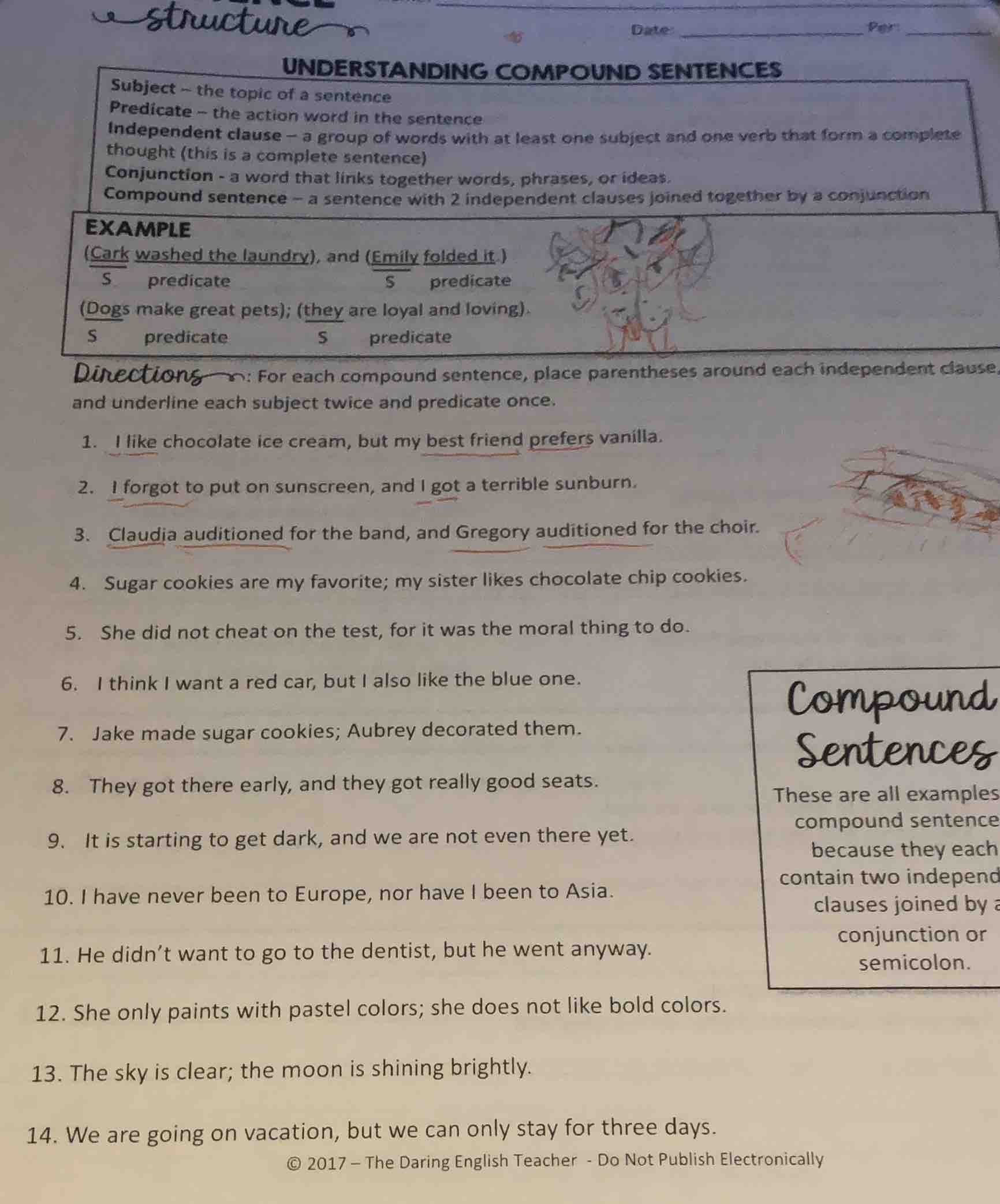
understanding compound sentences
subject ~ the topic of a sentence
predicate ~ the action word in the sentence
independent clause ~ a group of words with at least one subject and one verb that form a complete thought (this is a complete sentence)
conjunction - a word that links together words, phrases, or ideas.
compound sentence ~ a sentence with 2 independent clauses joined together by a conjunction
example
(cark washed the laundry), and (emily folded it.)
s predicate s predicate
(dogs make great pets); (they are loyal and loving).
s predicate s predicate
directions: for each compound sentence, place parentheses around each independent clause, and underline each subject twice and predicate once.
- i like chocolate ice cream, but my best friend prefers vanilla.
- i forgot to put on sunscreen, and i got a terrible sunburn.
- claudia auditioned for the band, and gregory auditioned for the choir.
- sugar cookies are my favorite; my sister likes chocolate chip cookies.
- she did not cheat on the test, for it was the moral thing to do.
- i think i want a red car, but i also like the blue one.
- jake made sugar cookies; aubrey decorated them.
- they got there early, and they got really good seats.
- it is starting to get dark, and we are not even there yet.
- i have never been to europe, nor have i been to asia.
- he didn’t want to go to the dentist, but he went anyway.
- she only paints with pastel colors; she does not like bold colors.
- the sky is clear; the moon is shining brightly.
- we are going on vacation, but we can only stay for three days.
compound sentences
these are all examples of compound sentences because they each contain two independent clauses joined by a conjunction or semicolon.
© 2017 – the daring english teacher - do not publish electronically
For each sentence, identify the two independent clauses (complete thoughts), enclose each in parentheses, underline the subject of each clause twice, and the predicate once, following the definitions and examples provided.

Snap & solve any problem in the app
Get step-by-step solutions on Sovi AI
Photo-based solutions with guided steps
Explore more problems and detailed explanations
- (I like chocolate ice cream), but (my best friend prefers vanilla.)
Double-underlined subjects: I, my best friend; Single-underlined predicates: like chocolate ice cream, prefers vanilla
- (I forgot to put on sunscreen), and (I got a terrible sunburn.)
Double-underlined subjects: I, I; Single-underlined predicates: forgot to put on sunscreen, got a terrible sunburn
- (Claudia auditioned for the band), and (Gregory auditioned for the choir.)
Double-underlined subjects: Claudia, Gregory; Single-underlined predicates: auditioned for the band, auditioned for the choir
- (Sugar cookies are my favorite); (my sister likes chocolate chip cookies.)
Double-underlined subjects: Sugar cookies, my sister; Single-underlined predicates: are my favorite, likes chocolate chip cookies
- (She did not cheat on the test), for (it was the moral thing to do.)
Double-underlined subjects: She, it; Single-underlined predicates: did not cheat on the test, was the moral thing to do
- (I think I want a red car), but (I also like the blue one.)
Double-underlined subjects: I, I; Single-underlined predicates: think I want a red car, also like the blue one
- (Jake made sugar cookies); (Aubrey decorated them.)
Double-underlined subjects: Jake, Aubrey; Single-underlined predicates: made sugar cookies, decorated them
- (They got there early), and (They got really good seats.)
Double-underlined subjects: They, They; Single-underlined predicates: got there early, got really good seats
- (It is starting to get dark), and (we are not even there yet.)
Double-underlined subjects: It, we; Single-underlined predicates: is starting to get dark, are not even there yet
- (I have never been to Europe), nor (I have been to Asia.)
Double-underlined subjects: I, I; Single-underlined predicates: have never been to Europe, have been to Asia
- (He didn’t want to go to the dentist), but (he went anyway.)
Double-underlined subjects: He, he; Single-underlined predicates: didn’t want to go to the dentist, went anyway
- (She only paints with pastel colors); (she does not like bold colors.)
Double-underlined subjects: She, she; Single-underlined predicates: only paints with pastel colors, does not like bold colors
- (The sky is clear); (the moon is shining brightly.)
Double-underlined subjects: The sky, the moon; Single-underlined predicates: is clear, is shining brightly
- (We are going on vacation), but (we can only stay for three days.)
Double-underlined subjects: We, we; Single-underlined predicates: are going on vacation, can only stay for three days
(Note: Double underlines are represented with bold text here, as standard text formatting does not support double underlining directly; in handwritten work, you would underline these subjects twice.)