QUESTION IMAGE
Question
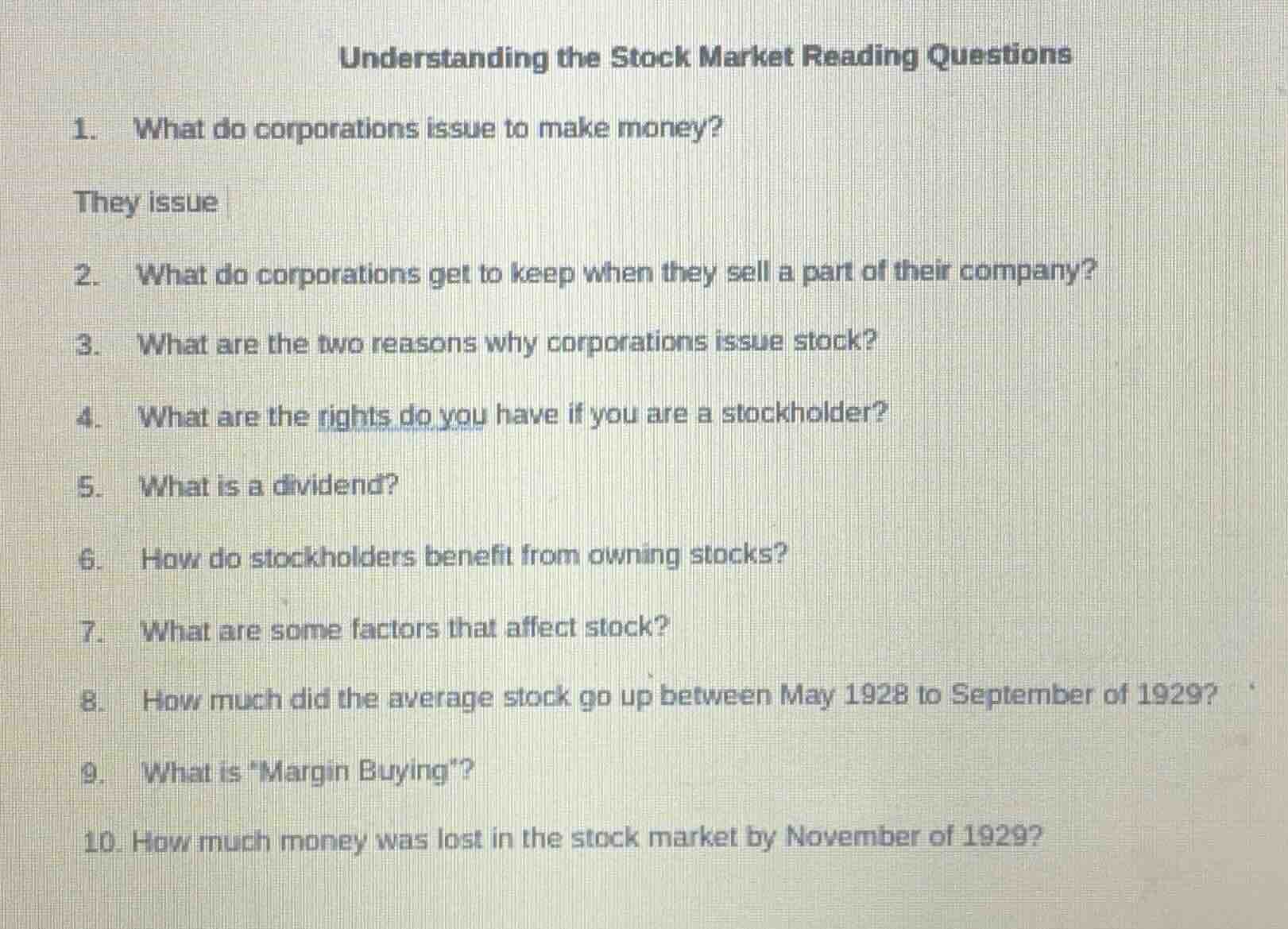
understanding the stock market reading questions
- what do corporations issue to make money?
they issue
- what do corporations get to keep when they sell a part of their company?
- what are the two reasons why corporations issue stock?
- what are the rights do you have if you are a stockholder?
- what is a dividend?
- how do stockholders benefit from owning stocks?
- what are some factors that affect stock?
- how much did the average stock go up between may 1928 to september of 1929?
- what is \margin buying\?
- how much money was lost in the stock market by november of 1929?
These questions are related to the stock market and corporate finance, which fall under the Business discipline, specifically the subfield of Finance (or Economics/Management could also be relevant, but Finance is the most direct for stock market topics). Since these are reading comprehension questions about stock market concepts (no calculations needed), we'll use the Answer - Explanation Format for each sub - question:
Question 1
In the context of the stock market, corporations issue stocks (or shares) to raise money. Stocks represent a portion of ownership in the company, and by selling them, corporations can generate capital.
When a corporation sells a part of its company (by issuing stocks), it gets to keep the money (capital) from the sale of those stocks. This capital can be used for various purposes like expanding the business, paying debts, etc.
One common reason corporations issue stock is to raise capital (money) for business operations, expansion, research and development, or paying off debts. Another reason can be to spread the ownership and risk of the company. By having more stockholders, the financial risk of the company is shared among a larger group.

Snap & solve any problem in the app
Get step-by-step solutions on Sovi AI
Photo-based solutions with guided steps
Explore more problems and detailed explanations
stocks (or shares)