QUESTION IMAGE
Question
unit 2a - cw2.7
solving - quadratic formula
algebra ii - polynomial functions
page 26
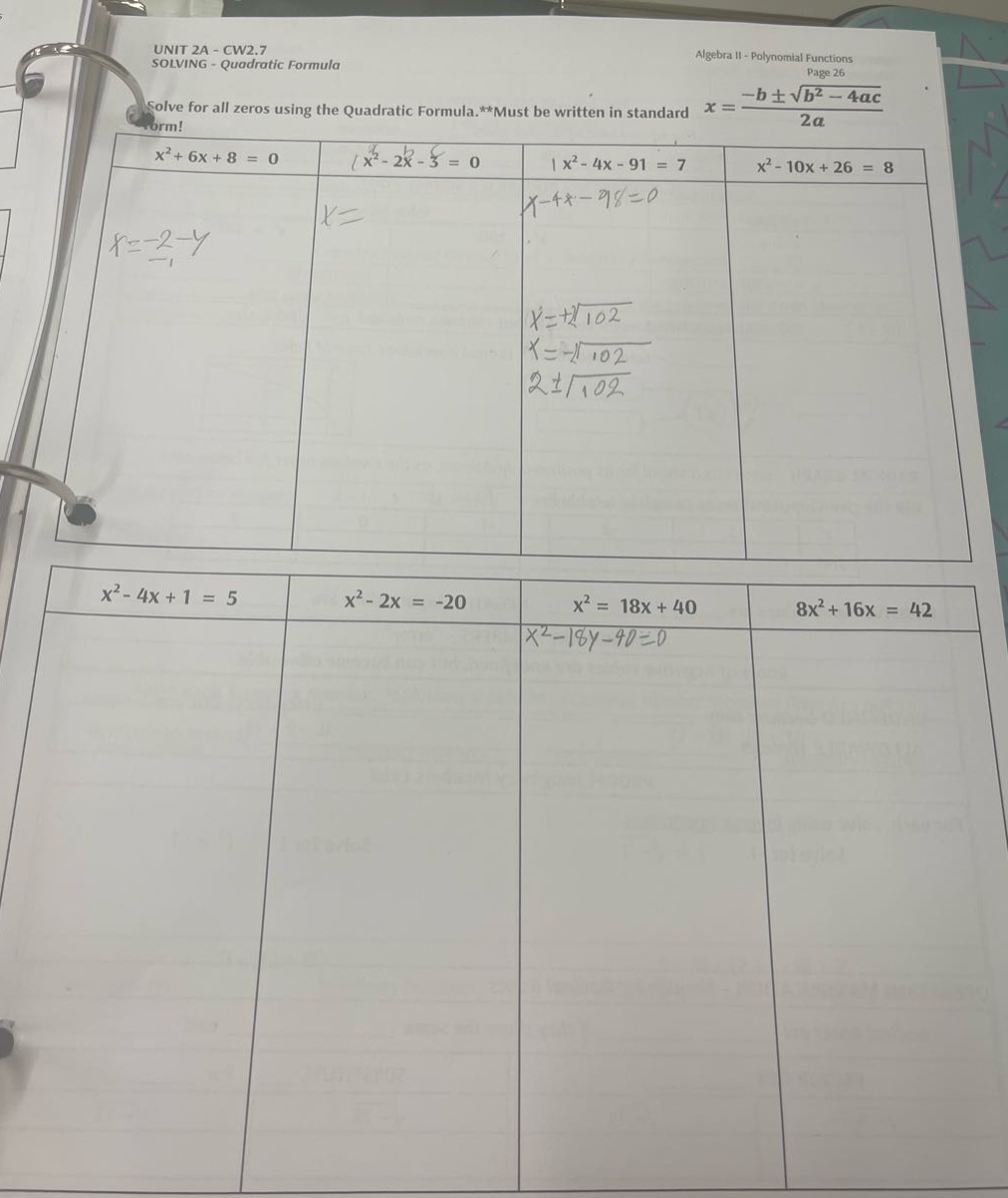
solve for all zeros using the quadratic formula.**must be written in standard form!
$x = \frac{-b \pm \sqrt{b^2 - 4ac}}{2a}$
$x^2 + 6x + 8 = 0$
$x^2 - 2x - 5 = 0$
$x^2 - 4x - 91 = 7$
$x^2 - 10x + 26 = 8$
$x^2 - 4x + 1 = 5$
$x^2 - 2x = -20$
$x^2 = 18x + 40$
$8x^2 + 16x = 42$
Let's solve the first quadratic equation \( x^2 + 6x + 8 = 0 \) using the quadratic formula \( x=\frac{-b\pm\sqrt{b^2 - 4ac}}{2a} \).
Step 1: Identify \( a \), \( b \), \( c \)
For the quadratic equation \( ax^2 + bx + c = 0 \), in \( x^2 + 6x + 8 = 0 \), we have \( a = 1 \), \( b = 6 \), \( c = 8 \).
Step 2: Calculate the discriminant \( D = b^2 - 4ac \)
Substitute \( a = 1 \), \( b = 6 \), \( c = 8 \) into the discriminant formula:
\( D=(6)^2 - 4\times1\times8 \)
\( D = 36 - 32 \)
\( D = 4 \)
Step 3: Apply the quadratic formula
Substitute \( a = 1 \), \( b = 6 \), \( D = 4 \) into the quadratic formula:
\( x=\frac{-6\pm\sqrt{4}}{2\times1} \)
Since \( \sqrt{4}=2 \), we have:
\( x=\frac{-6\pm2}{2} \)
Step 4: Find the two solutions
For the plus sign:
\( x=\frac{-6 + 2}{2}=\frac{-4}{2}=-2 \)
For the minus sign:
\( x=\frac{-6-2}{2}=\frac{-8}{2}=-4 \)
Step 1: Identify \( a \), \( b \), \( c \)
For the quadratic equation \( ax^2+bx + c = 0 \), in \( x^2-2x - 5=0 \), we have \( a = 1 \), \( b=-2 \), \( c=-5 \)
Step 2: Calculate the discriminant \( D=b^2-4ac \)
Substitute \( a = 1 \), \( b=-2 \), \( c = - 5 \) into the discriminant formula:
\( D=(-2)^2-4\times1\times(-5) \)
\( D = 4 + 20 \)
\( D=24 \)
Step 3: Apply the quadratic formula
Substitute \( a = 1 \), \( b=-2 \), \( D = 24 \) into the quadratic formula \( x=\frac{-b\pm\sqrt{b^2 - 4ac}}{2a} \)
\( x=\frac{-(-2)\pm\sqrt{24}}{2\times1} \)
Simplify \( \sqrt{24}=2\sqrt{6} \), so:
\( x=\frac{2\pm2\sqrt{6}}{2} \)
\( x = 1\pm\sqrt{6} \)
Step 1: Identify \( a \), \( b \), \( c \)
For the quadratic equation \( ax^2+bx + c = 0 \), in \( x^2-4x - 98=0 \), we have \( a = 1 \), \( b=-4 \), \( c=-98 \)
Step 2: Calculate the discriminant \( D=b^2-4ac \)
Substitute \( a = 1 \), \( b=-4 \), \( c=-98 \) into the discriminant formula:
\( D=(-4)^2-4\times1\times(-98) \)
\( D = 16 + 392 \)
\( D = 408 \)
Step 3: Apply the quadratic formula
Substitute \( a = 1 \), \( b=-4 \), \( D = 408 \) into the quadratic formula \( x=\frac{-b\pm\sqrt{b^2 - 4ac}}{2a} \)
\( x=\frac{-(-4)\pm\sqrt{408}}{2\times1} \)
Simplify \( \sqrt{408}=\sqrt{4\times102}=2\sqrt{102} \), so:
\( x=\frac{4\pm2\sqrt{102}}{2} \)
\( x = 2\pm\sqrt{102} \)

Snap & solve any problem in the app
Get step-by-step solutions on Sovi AI
Photo-based solutions with guided steps
Explore more problems and detailed explanations
The zeros of the quadratic equation \( x^2 + 6x + 8 = 0 \) are \( x=-2 \) and \( x = - 4 \)
We can also solve the second quadratic equation \( x^2-2x - 5=0 \) using the quadratic formula.