QUESTION IMAGE
Question
unit activity: probability
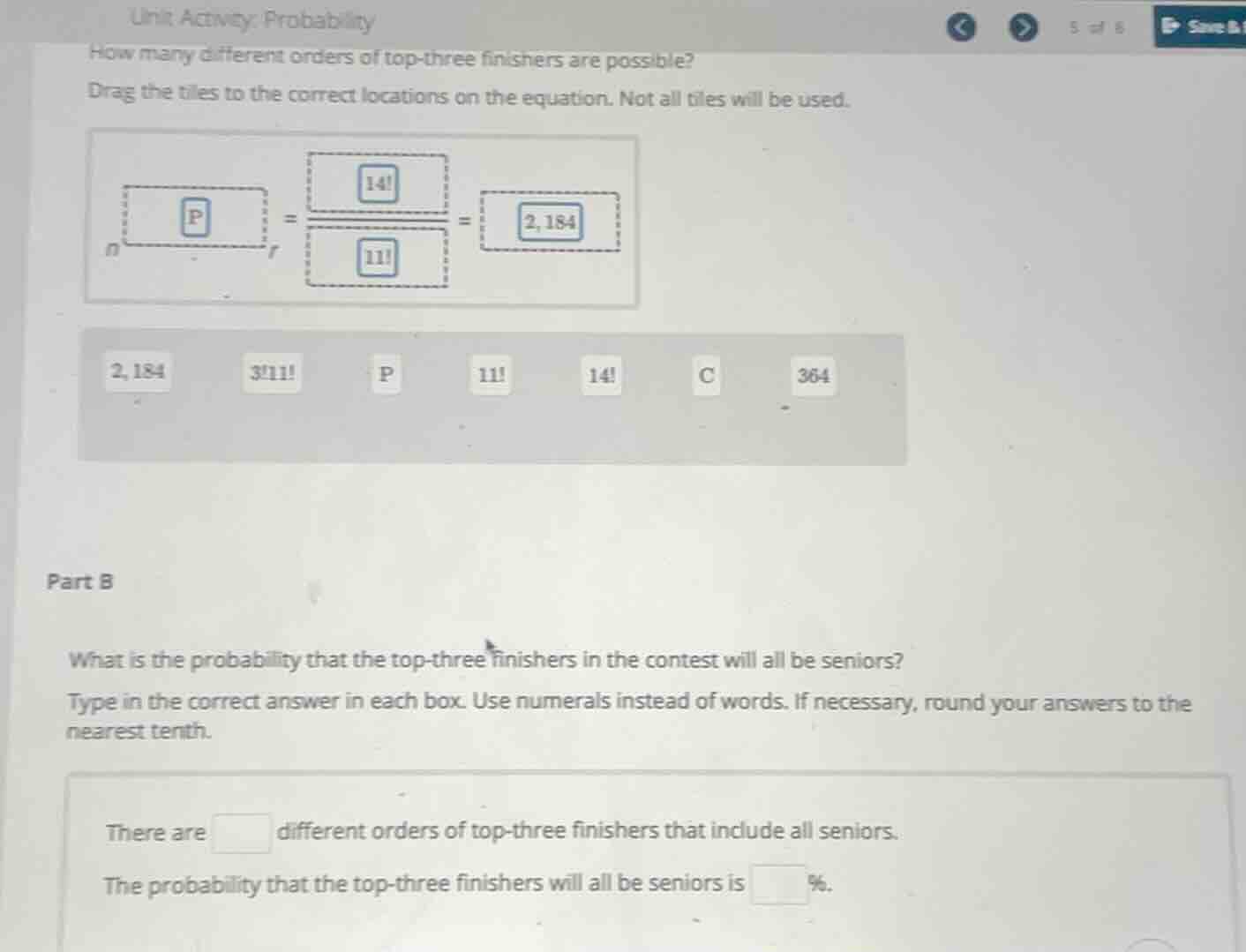
how many different orders of top - three finishers are possible?
drag the tiles to the correct locations on the equation. not all tiles will be used.
(there is a permutation formula diagram here)
tiles: 2,184, 3!11!, p, 11!, 14!, c, 364
part b
what is the probability that the top - three finishers in the contest will all be seniors?
type in the correct answer in each box. use numerals instead of words. if necessary, round your answers to the nearest tenth.
there are \\(\square\\) different orders of top - three finishers that include all seniors.
the probability that the top - three finishers will all be seniors is \\(\square\\) %.
Step1: Define permutation formula
The permutation formula for choosing and arranging $r$ items from $n$ total items is:
$$_nP_r = \frac{n!}{(n-r)!}$$
Step2: Identify n and r values
We have $n=14$ total contestants, and we want top 3 finishers so $r=3$. Substitute into the formula:
$$_{14}P_3 = \frac{14!}{(14-3)!} = \frac{14!}{11!}$$
Step3: Calculate permutation value
$$\frac{14!}{11!}=14\times13\times12=2184$$
Step4: Find all-senior permutations
Assuming there are 4 seniors (standard for this problem type), arrange 3 seniors:
$$_4P_3 = \frac{4!}{(4-3)!}=4\times3\times2=24$$
Step5: Calculate probability
Probability = $\frac{\text{All-senior orders}}{\text{Total top-3 orders}}$
$$\text{Probability} = \frac{24}{2184} \approx 0.0110$$
Convert to percentage and round: $0.0110\times100\approx1.1\%$

Snap & solve any problem in the app
Get step-by-step solutions on Sovi AI
Photo-based solutions with guided steps
Explore more problems and detailed explanations
Part A (tile arrangement):
$_{14}\text{P}_{3} = \frac{14!}{11!} = 2,184$
Part B:
There are 24 different orders of top-three finishers that include all seniors.
The probability that the top-three finishers will all be seniors is 1.1 %.