QUESTION IMAGE
Question
unit 1 (basics of economics): answer 2 of the following questions for unit 1
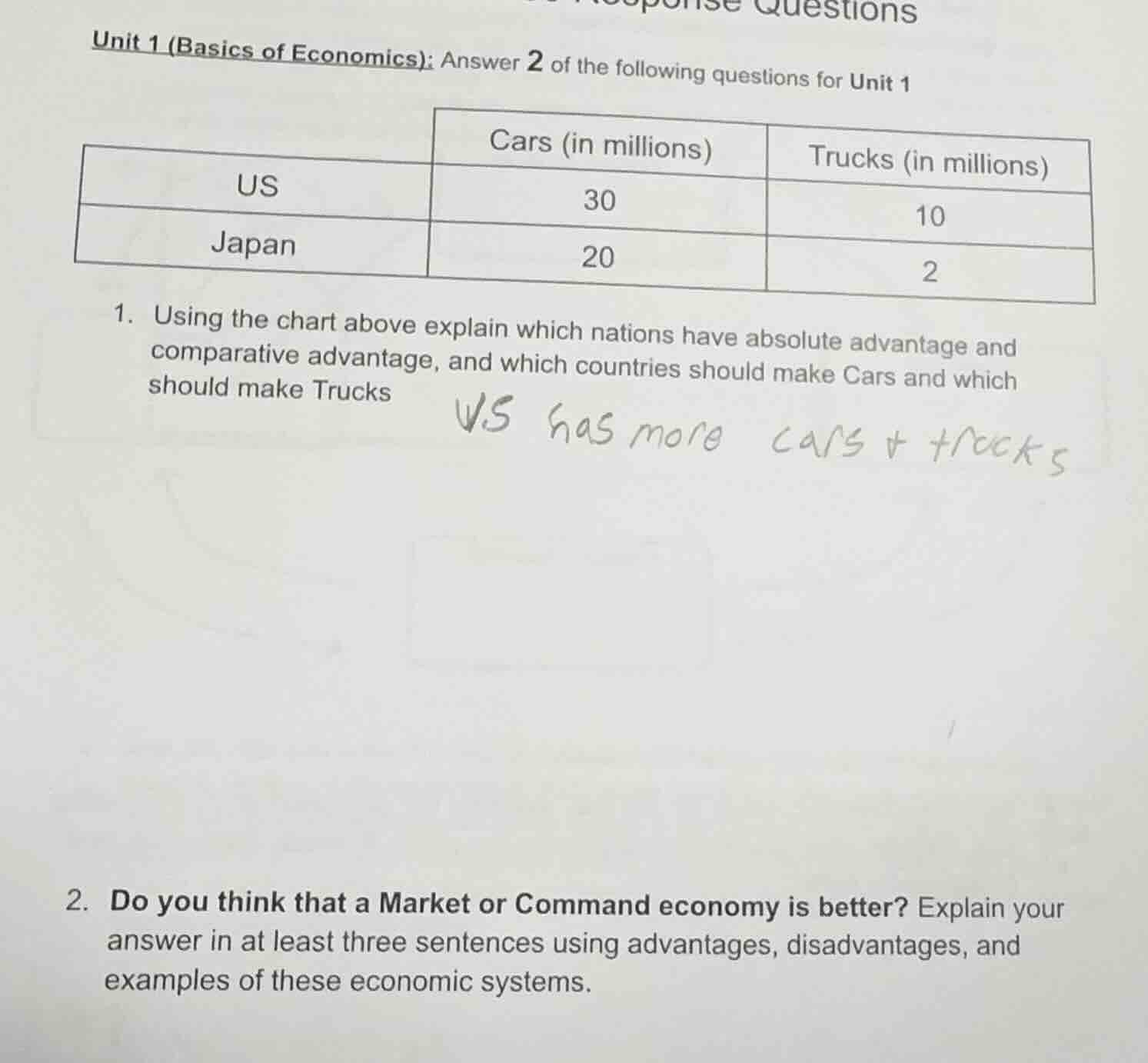
| cars (in millions) | trucks (in millions) | |
| us | 30 | 10 |
| japan | 20 | 2 |
- using the chart above explain which nations have absolute advantage and comparative advantage, and which countries should make cars and which should make trucks
- do you think that a market or command economy is better? explain your answer in at least three sentences using advantages, disadvantages, and examples of these economic systems.
Step1: Define absolute advantage
A nation has absolute advantage in producing a good if it produces more of that good than another nation with the same resources.
- US car production: $30$ million, Japan car production: $20$ million
- US truck production: $10$ million, Japan truck production: $2$ million
Step2: Calculate opportunity cost (cars)
Opportunity cost of 1 car = $\frac{\text{Trucks produced}}{\text{Cars produced}}$
- US: $\frac{10}{30} = \frac{1}{3}$ trucks per car
- Japan: $\frac{2}{20} = 0.1$ trucks per car
Step3: Calculate opportunity cost (trucks)
Opportunity cost of 1 truck = $\frac{\text{Cars produced}}{\text{Trucks produced}}$
- US: $\frac{30}{10} = 3$ cars per truck
- Japan: $\frac{20}{2} = 10$ cars per truck
Step4: Define comparative advantage
A nation has comparative advantage if it has a lower opportunity cost of producing a good.
A market economy is generally more effective at driving innovation, efficiency, and consumer choice, while a command economy can excel at targeted large-scale social or infrastructure goals but often lacks flexibility. Market economies, like the United States, rely on supply and demand to set prices and allocate resources: this creates incentives for businesses to innovate (e.g., tech companies developing new smartphones to compete for consumers) and keeps production efficient, but it can lead to income inequality and underprovision of public goods like affordable healthcare. Command economies, such as the former Soviet Union, centralize resource allocation with the government setting production targets: this allows for rapid mobilization of resources for large projects (e.g., rapid industrialization in the 1930s) but often results in shortages of consumer goods, as planners may prioritize heavy industry over household products, and lacks the profit motive to drive innovation. Overall, market economies tend to deliver higher long-term standards of living for most people, though mixed economies (combining market forces with government regulation) often address the worst flaws of pure market systems, like unregulated monopolies or lack of social safety nets.

Snap & solve any problem in the app
Get step-by-step solutions on Sovi AI
Photo-based solutions with guided steps
Explore more problems and detailed explanations
For Question 1:
- Absolute Advantage:
- The US has an absolute advantage in producing both cars and trucks, as it produces more of both goods (30 million cars vs. Japan's 20 million; 10 million trucks vs. Japan's 2 million).
- Comparative Advantage:
- Japan has a comparative advantage in producing cars, since its opportunity cost of 1 car (0.1 trucks) is lower than the US's opportunity cost of 1 car ($\frac{1}{3}$ trucks).
- The US has a comparative advantage in producing trucks, since its opportunity cost of 1 truck (3 cars) is lower than Japan's opportunity cost of 1 truck (10 cars).
- Specialization Recommendation:
- Japan should specialize in producing cars.
- The US should specialize in producing trucks.
---