QUESTION IMAGE
Question
unit 6 imperialism short answer review
define forms of imperialism
colony\tsphere of influence
protectorate\teconomic imperialism
- describe the scramble for africa
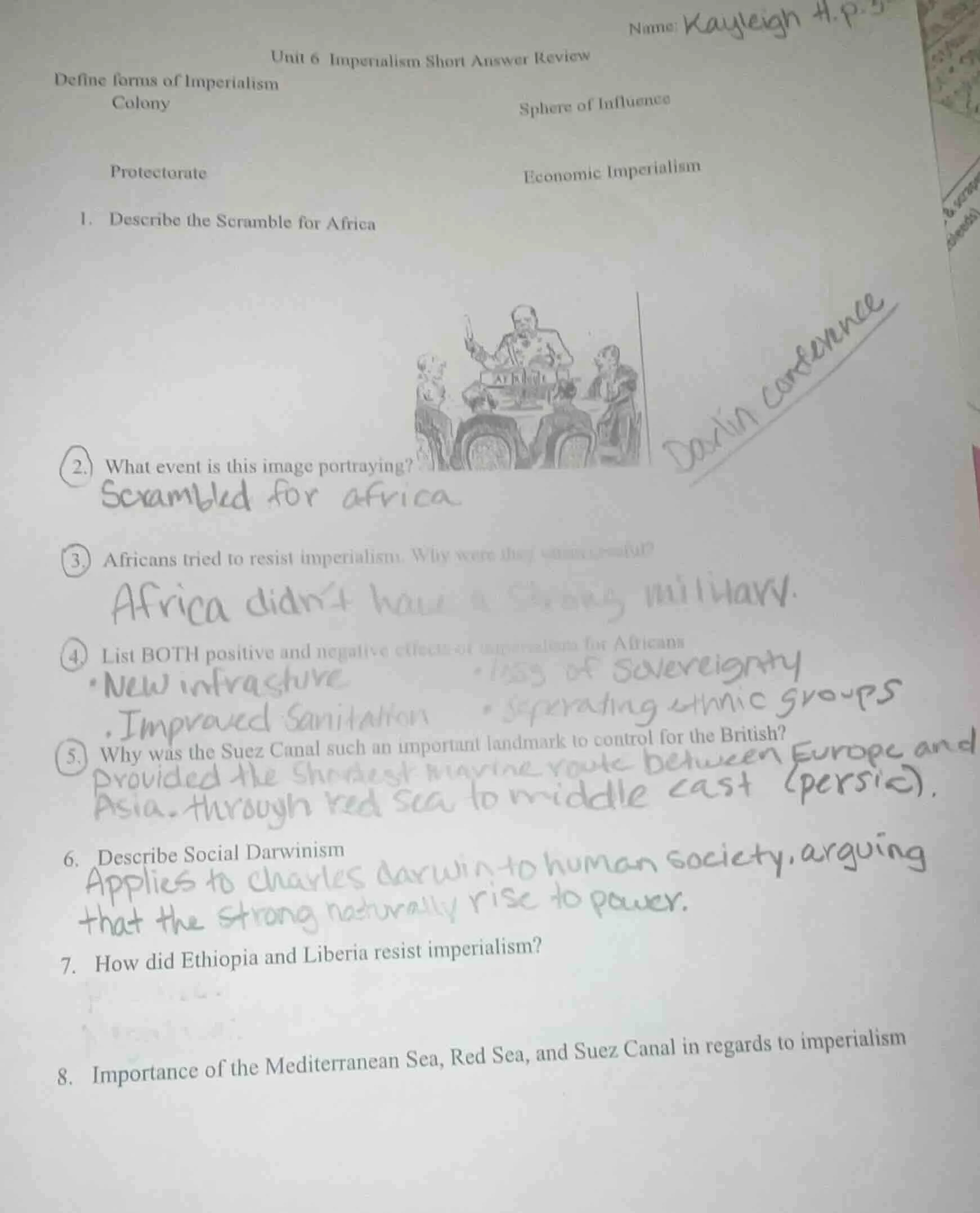
- what event is this image portraying?
- africans tried to resist imperialism. why were they unsuccessful?
- list both positive and negative effects of imperialism for africans
- why was the suez canal such an important landmark to control for the british?
- describe social darwinism
- how did ethiopia and liberia resist imperialism?
- importance of the mediterranean sea, red sea, and suez canal in regards to imperialism
Define forms of Imperialism
- Colony: A territory controlled by a foreign power, with the ruling power directly governing the land and its people, replacing local systems.
- Sphere of Influence: A region where an external power has exclusive economic, political, or military privileges, without formal direct rule, often dividing control with other powers.
- Protectorate: A territory that retains local leaders but is controlled by an external power for defense and foreign policy, ceding key authority to the imperial power.
- Economic Imperialism: Dominance over a region's economy by an external power, through control of trade, resources, or financial systems, without formal political rule.
1. Describe the Scramble for Africa
A period (late 19th–early 20th century) where European powers rapidly invaded, divided, and colonized nearly all of Africa, driven by resource extraction, strategic competition, and ideological justifications, with no African input in territorial division.
2. What event is this image portraying?
The image shows European leaders dividing Africa, which depicts the Berlin Conference (1884–1885), the meeting where European powers formalized the rules for colonizing Africa, enabling the Scramble for Africa.
3. Africans tried to resist imperialism. Why were they unsuccessful?
Most African groups lacked modern, unified military forces, faced advanced European weaponry (like machine guns), were divided by ethnic rivalries exploited by colonizers, and had limited access to industrial resources to sustain resistance.
4. List BOTH positive and negative effects of imperialism for Africans
- Positive: Construction of infrastructure (roads, railways, ports), improved public health and sanitation systems, access to formal education systems.
- Negative: Loss of political sovereignty, forced labor and resource extraction, arbitrary border creation that split ethnic groups, cultural erasure and suppression of local traditions.
5. Why was the Suez Canal such an important landmark to control for the British?
It provided the shortest maritime trade route between Europe and Asia (including British colonies in South Asia and the Middle East), cutting travel time drastically, reducing costs for resource transport, and strengthening British military and economic control over its empire.
6. Describe Social Darwinism
An ideology that applied Charles Darwin's theories of natural selection and "survival of the fittest" to human societies, arguing that powerful, wealthy nations were "naturally" destined to dominate weaker societies, justifying imperialism and social inequality.
7. How did Ethiopia and Liberia resist imperialism?
- Ethiopia: Maintained a unified, modernized military, defeated Italian invaders at the Battle of Adwa (1896), and used diplomatic alliances with other European powers to preserve independence.
- Liberia: Founded by freed American slaves, it maintained formal recognition by the U.S. and other Western nations, which deterred European colonization, though it faced indirect economic influence.
8. Importance of the Mediterranean Sea, Red Sea, and Suez Canal in regards to imperialism
- Mediterranean Sea: A central trade and military hub connecting European powers to their colonial territories in Africa and the Middle East, enabling quick troop and resource movement.
- Red Sea: A critical link between the Mediterranean (via the Suez Canal) and the Indian Ocean, granting access to South Asian colonies and Middle Eastern resources.
- **Suez…

Snap & solve any problem in the app
Get step-by-step solutions on Sovi AI
Photo-based solutions with guided steps
Explore more problems and detailed explanations
Define forms of Imperialism
- Colony: Directly governed foreign territory
- Sphere of Influence: Exclusive external power privileges
- Protectorate: Local rule with external control
- Economic Imperialism: Economic dominance without formal rule
1.
A late 19th–early 20th century period of rapid European colonization and division of nearly all of Africa, without African input.
2.
The Berlin Conference (1884–1885), which formalized the Scramble for Africa.
3.
Lack of modern unified militaries, advanced European weaponry, ethnic divisions exploited by colonizers, and limited industrial resources.
4.
- Positive: New infrastructure, improved sanitation, formal education access
- Negative: Loss of sovereignty, ethnic group division, cultural erasure
5.
It created the shortest maritime route between Europe and British Asian/Middle Eastern colonies, cutting travel time and boosting trade/military control.
6.
An ideology applying Darwin's "survival of the fittest" to human societies, justifying imperial domination of "weaker" groups.
7.
- Ethiopia: Unified modern military defeated Italy at Adwa (1896) and used diplomacy.
- Liberia: Gained Western recognition (especially from the U.S.) to deter colonization.
8.
- Mediterranean Sea: Hub for connecting Europe to African/Middle Eastern colonies.
- Red Sea: Link between the Mediterranean and Indian Ocean for colonial trade.
- Suez Canal: Shortened imperial trade/military routes, enabling global control of supply lines.