QUESTION IMAGE
Question
6 from unit 1, lesson 14
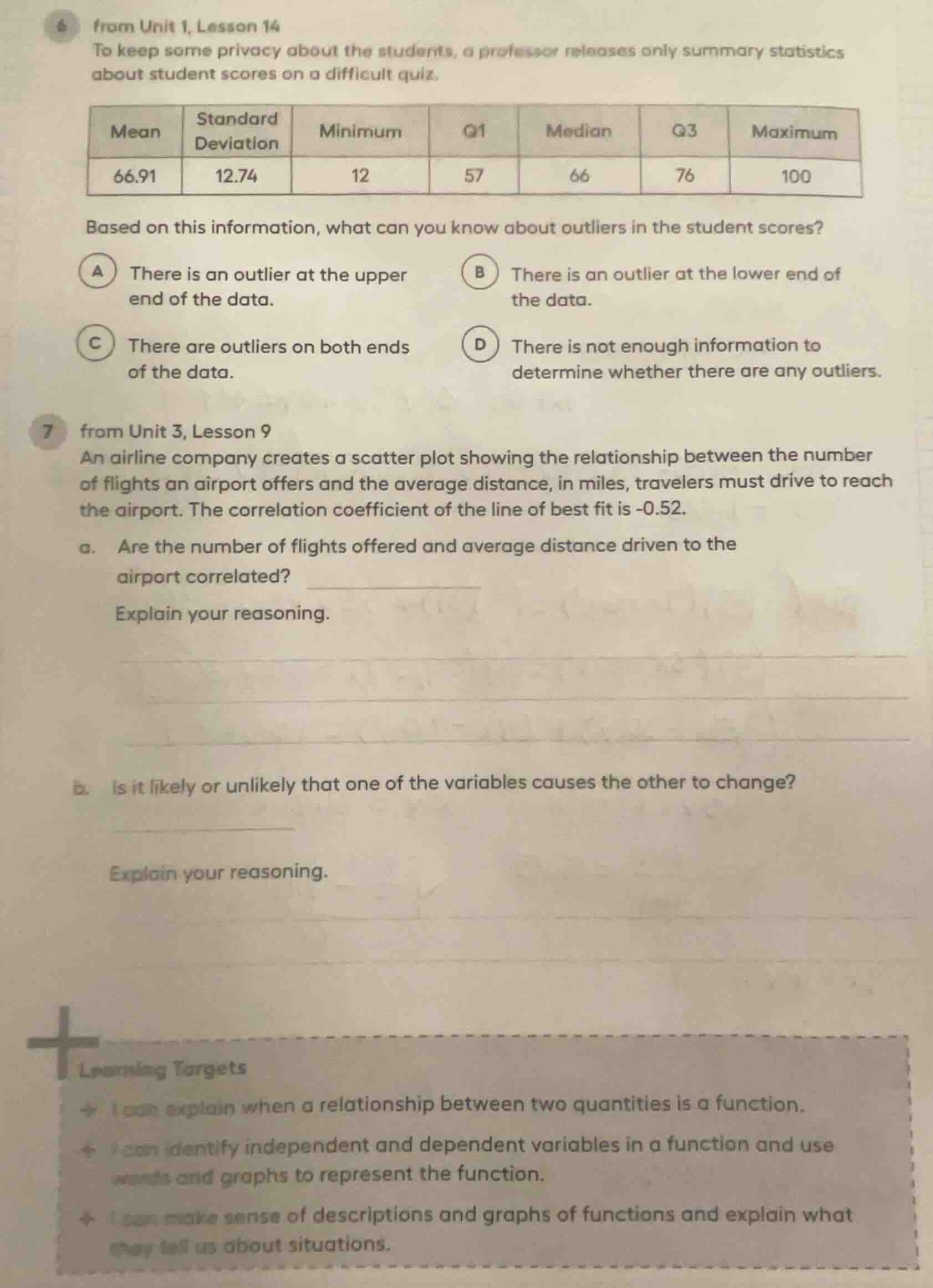
to keep some privacy about the students, a professor releases only summary statistics about student scores on a difficult quiz.
| mean | standard deviation | minimum | q1 | median | q3 | maximum |
|---|
based on this information, what can you know about outliers in the student scores?
a there is an outlier at the upper end of the data.
b there is an outlier at the lower end of the data.
c there are outliers on both ends of the data.
d there is not enough information to determine whether there are any outliers.
7 from unit 3, lesson 9
an airline company creates a scatter plot showing the relationship between the number of flights an airport offers and the average distance, in miles, travelers must drive to reach the airport. the correlation coefficient of the line of best fit is -0.52.
a. are the number of flights offered and average distance driven to the airport correlated?
explain your reasoning.
b. is it likely or unlikely that one of the variables causes the other to change?
explain your reasoning.
learning targets
- i can explain when a relationship between two quantities is a function.
- i can identify independent and dependent variables in a function and use words and graphs to represent the function.
- i can make sense of descriptions and graphs of functions and explain what they tell us about situations.
Question 6
Step1: Recall the IQR method for outliers
The interquartile range (IQR) is calculated as \( IQR = Q3 - Q1 \). First, find \( IQR \) using the given \( Q1 = 57 \) and \( Q3 = 76 \).
\( IQR = 76 - 57 = 19 \)
Step2: Calculate lower and upper bounds for outliers
The lower bound for outliers is \( Q1 - 1.5 \times IQR \), and the upper bound is \( Q3 + 1.5 \times IQR \).
- Lower bound: \( 57 - 1.5 \times 19 = 57 - 28.5 = 28.5 \)
- Upper bound: \( 76 + 1.5 \times 19 = 76 + 28.5 = 104.5 \)
Step3: Check for outliers
The minimum value is 12, which is less than the lower bound (28.5). The maximum value is 100, which is less than the upper bound (104.5). So, there is an outlier at the lower end.
A correlation coefficient measures the strength and direction of a linear relationship between two variables. The value -0.52 is not zero, so there is a linear relationship. Since the absolute value (0.52) is between 0 and 1, it's a moderate negative correlation. So, the two variables are correlated (negatively).
Correlation does not imply causation. Even if two variables are correlated, there could be other factors (lurking variables) influencing both, or the relationship could be coincidental. Just because more flights or a longer drive distance is observed together doesn't mean one causes the other. For example, population density near the airport might affect both flight availability and drive distance.

Snap & solve any problem in the app
Get step-by-step solutions on Sovi AI
Photo-based solutions with guided steps
Explore more problems and detailed explanations
B. There is an outlier at the lower end of the data.