QUESTION IMAGE
Question
unit 1 lesson 6 practice problems
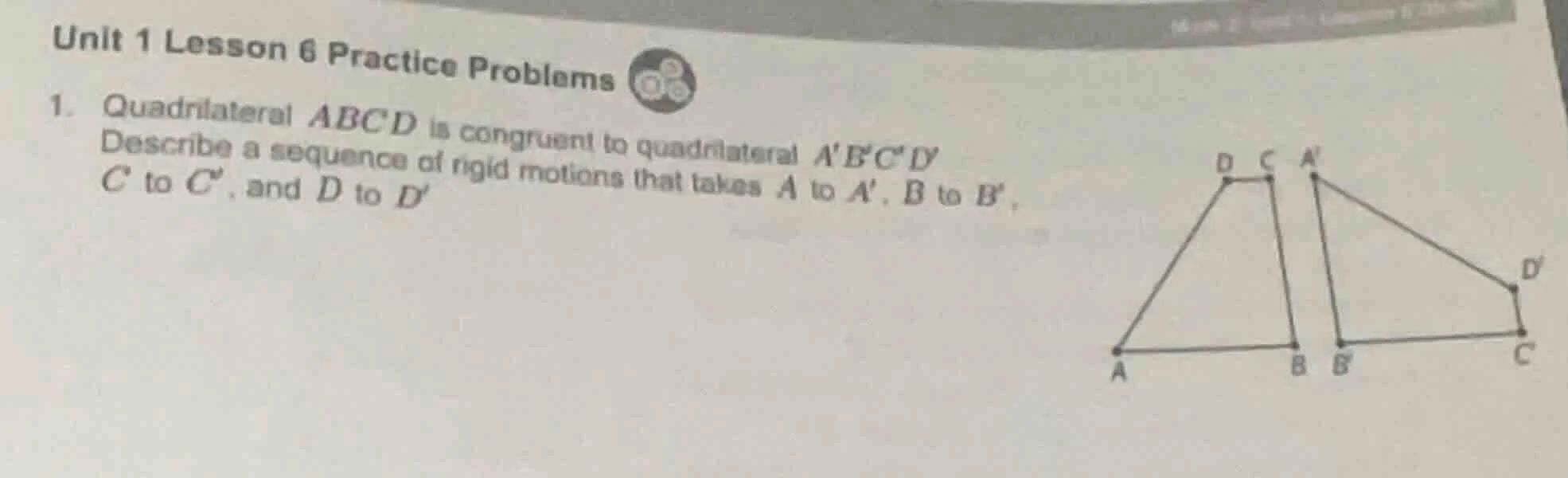
- quadrilateral abcd is congruent to quadrilateral abcd
describe a sequence of rigid motions that takes a to a, b to b,
c to c, and d to d
Step1: Identify Translation or Rotation
First, observe the position of quadrilateral \(ABCD\) and \(A'B'C'D'\). Notice that a rotation might be involved. Let's consider rotating \(ABCD\) 90 degrees clockwise (or counter-clockwise, but clockwise seems to align) around a point, or a translation followed by rotation. Alternatively, a rotation about point \(B\) (or a suitable center) and then translation. Wait, looking at the figure, \(ABCD\) is a trapezoid (or quadrilateral) with \(AB\) horizontal, \(BC\) vertical. \(A'B'C'D'\) has \(B'\) horizontal, \(B'C'\) vertical? Wait, no, let's check the coordinates (mentally). Let's assume \(AB\) is horizontal, \(BC\) is vertical. Then \(A'B'\) is vertical? Wait, no, the figure: \(A\) to \(B\) is horizontal, \(B\) to \(C\) is vertical up? Wait, no, the right figure: \(B'\) to \(C'\) is horizontal, \(C'\) to \(D'\) is vertical up, \(D'\) to \(A'\) is slant. Wait, maybe first, translate \(ABCD\) so that \(B\) maps to \(B'\). Then rotate 90 degrees clockwise around \(B'\). Let's verify:
Step2: Translate to Align \(B\) to \(B'\)
First, translate quadrilateral \(ABCD\) horizontally so that point \(B\) moves to point \(B'\). The vector from \(B\) to \(B'\) is (let's say) horizontal right (or left? Wait, in the figure, \(B\) is to the left of \(B'\), so translate \(ABCD\) to the right by the distance \(BB'\).
Step3: Rotate 90 Degrees Clockwise
After translating \(B\) to \(B'\), rotate the translated quadrilateral 90 degrees clockwise around point \(B'\). This will map \(A\) to \(A'\), \(C\) to \(C'\), \(D\) to \(D'\) because the shape of \(ABCD\) (with \(AB\) horizontal, \(BC\) vertical) when rotated 90 degrees clockwise around \(B\) (now \(B'\)) will have \(A'\) above \(B'\), \(C'\) to the right of \(B'\), etc., matching \(A'B'C'D'\).
Alternatively, another sequence: Rotate \(ABCD\) 90 degrees clockwise around point \(B\), then translate so that \(B\) (after rotation) maps to \(B'\).
Wait, let's think again. The key is rigid motions: translation, rotation, reflection.
Looking at the two quadrilaterals: \(ABCD\) has \(AB\) horizontal, \(BC\) vertical (down? Wait, no, the left figure: \(A\) at bottom left, \(B\) at bottom right, \(C\) at top right, \(D\) at top left. So \(AB\) is horizontal (bottom), \(BC\) is vertical up, \(CD\) is horizontal left, \(DA\) is slant up left. Then \(A'B'C'D'\): \(B'\) at bottom left, \(C'\) at bottom right, \(D'\) at top right, \(A'\) at top left. Wait, no, the right figure: \(A'\) at top left, \(B'\) at bottom left, \(C'\) at bottom right, \(D'\) at top right. So \(A'B'\) is vertical, \(B'C'\) is horizontal, \(C'D'\) is vertical, \(D'A'\) is slant.
So the first quadrilateral \(ABCD\): \(A\) (bottom left), \(B\) (bottom right), \(C\) (top right), \(D\) (top left). So it's a rectangle? No, \(DA\) is slant, so it's a trapezoid with \(AB\) and \(CD\) horizontal, \(BC\) vertical.
The second quadrilateral \(A'B'C'D'\): \(A'\) (top left), \(B'\) (bottom left), \(C'\) (bottom right), \(D'\) (top right). So it's a trapezoid with \(A'B'\) and \(C'D'\) vertical, \(B'C'\) horizontal.
So to map \(ABCD\) to \(A'B'C'D'\):
- Rotate \(ABCD\) 90 degrees clockwise around point \(B\). This will make \(AB\) vertical (up), \(BC\) horizontal (right), \(CD\) vertical (down), \(DA\) slant. Then:
- Translate the rotated quadrilateral so that point \(B\) (after rotation) moves to point \(B'\).
Let's check: After rotating \(ABCD\) 90 degrees clockwise around \(B\), point \(A\) (which was to the left of \(B\)) will be above \(B\) (since rotating 90 degrees clockwise: (x,y) -> (…

Snap & solve any problem in the app
Get step-by-step solutions on Sovi AI
Photo-based solutions with guided steps
Explore more problems and detailed explanations
A sequence of rigid motions is: First, translate quadrilateral \(ABCD\) horizontally to map point \(B\) to point \(B'\). Then, rotate the translated quadrilateral \(90^\circ\) clockwise about point \(B'\). This sequence maps \(A\) to \(A'\), \(B\) to \(B'\), \(C\) to \(C'\), and \(D\) to \(D'\). (Alternative: Rotate \(ABCD\) \(90^\circ\) clockwise about \(B\), then translate to map \(B\) to \(B'\).)