QUESTION IMAGE
Question
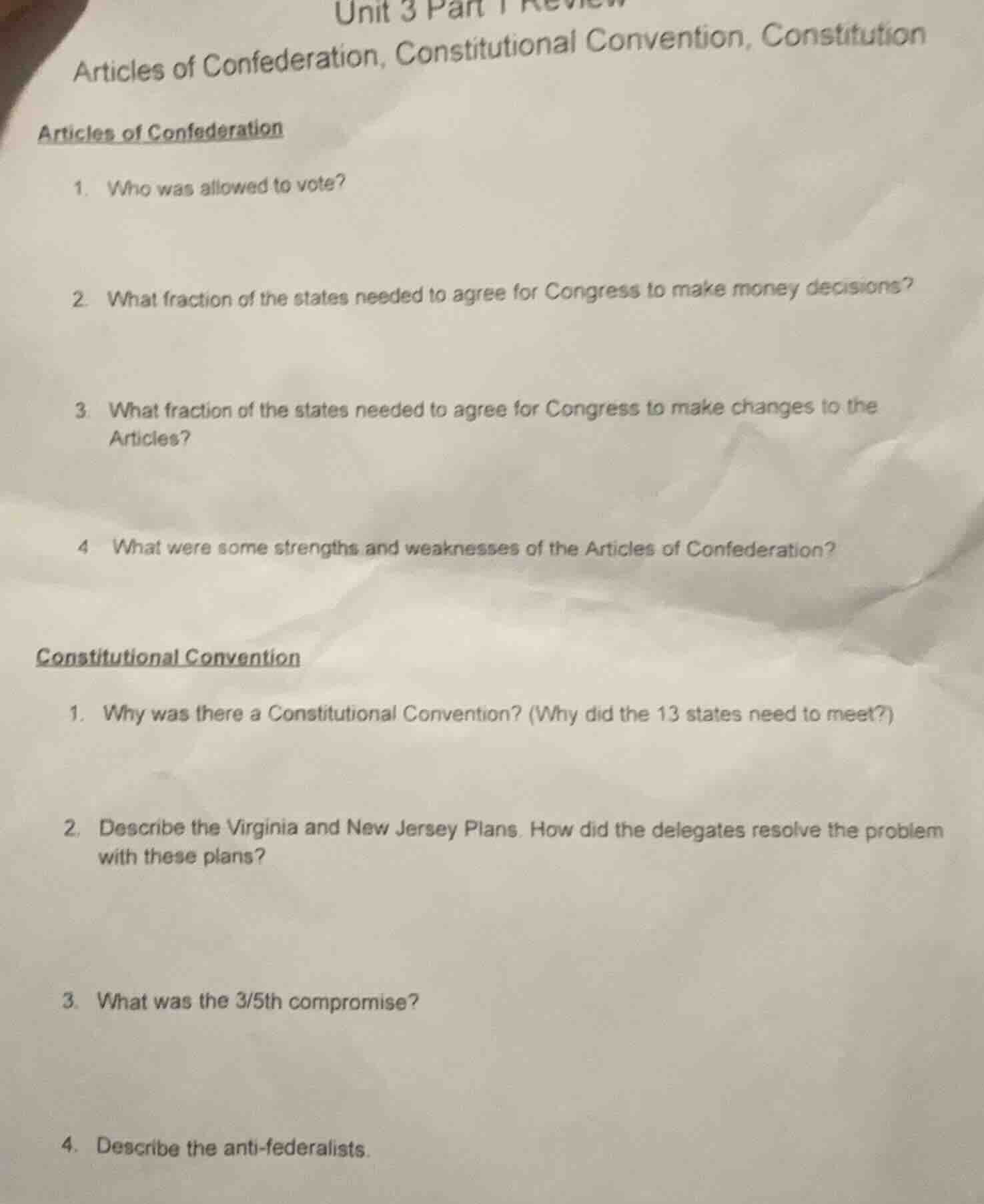
unit 3 part 1 review
articles of confederation, constitutional convention, constitution
articles of confederation
- who was allowed to vote?
- what fraction of the states needed to agree for congress to make money decisions?
- what fraction of the states needed to agree for congress to make changes to the articles?
- what were some strengths and weaknesses of the articles of confederation?
constitutional convention
- why was there a constitutional convention? (why did the 13 states need to meet?)
- describe the virginia and new jersey plans. how did the delegates resolve the problem with these plans?
- what was the 3/5th compromise?
- describe the anti - federalists.
Response
Articles of Confederation
- Brief Explanations: Under the Articles of Confederation, voting rights for the national (Continental) Congress were held by state legislatures, and within states, typically only white male property - owners (varies by state) could vote. So the answer depends on the level (state or national). For national vote (Congress), each state's delegation voted as a unit, with state legislatures choosing their delegates, and at the state level, it was often white male property - owners.

Snap & solve any problem in the app
Get step-by-step solutions on Sovi AI
Photo-based solutions with guided steps
Explore more problems and detailed explanations
At the national (Continental Congress) level, state delegations voted (state legislatures chose delegates); at the state level, typically white male property - owners (varied by state).
- Brief Explanations: To make money - related decisions (like issuing currency, borrowing money), Congress needed the agreement of $\frac{9}{13}$ of the states (since there were 13 states under the Articles).