QUESTION IMAGE
Question
unit 7 & 8 the postclassical world quiz
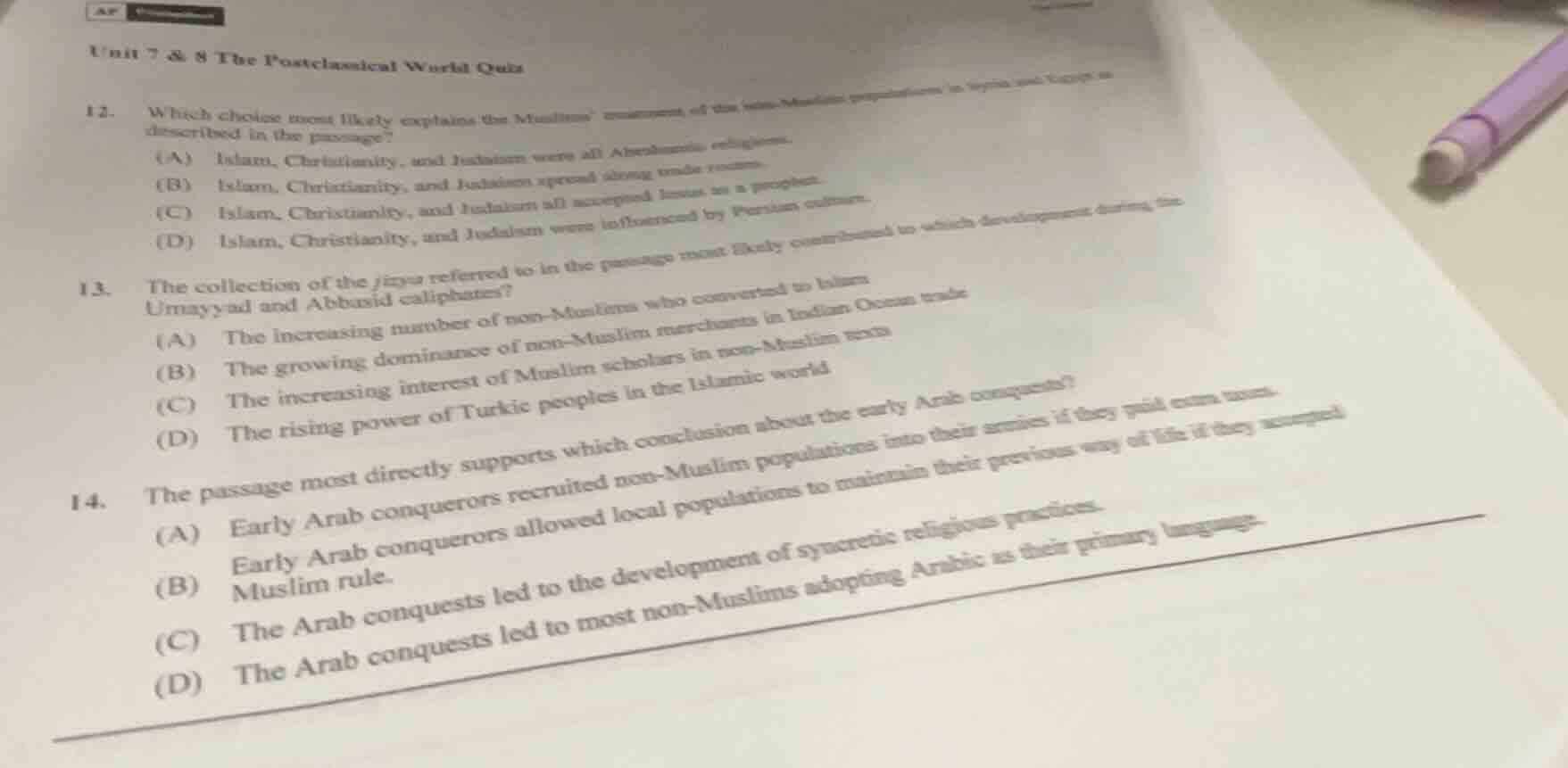
- which choice most likely explains the muslims treatment of the non-muslim populations in syria and egypt as described in the passage?
(a) islam, christianity, and judaism were all abrahamic religions.
(b) islam, christianity, and judaism spread along trade routes.
(c) islam, christianity, and judaism all accepted jesus as a prophet.
(d) islam, christianity, and judaism were influenced by persian culture.
- the collection of the jizya referred to in the passage most likely contributed to which development during the umayyad and abbasid caliphates?
(a) the increasing number of non-muslims who converted to islam
(b) the growing dominance of non-muslim merchants in indian ocean trade
(c) the increasing interest of muslim scholars in non-muslim texts
(d) the rising power of turkic peoples in the islamic world
- the passage most directly supports which conclusion about the early arab conquests?
(a) early arab conquerors recruited non-muslim populations into their armies if they paid extra taxes.
(b) early arab conquerors allowed local populations to maintain their previous way of life if they accepted muslim rule.
(c) the arab conquests led to the development of syncretic religious practices.
(d) the arab conquests led to most non-muslims adopting arabic as their primary language.
- The jizya was a tax paid by non-Muslims (People of the Book, which included Christians and Jews, fellow Abrahamic faiths) in Islamic states in exchange for protection and the right to practice their religion. The shared Abrahamic framework was a key reason for this specific treatment of non-Muslim populations in Syria and Egypt.
- The jizya was a tax imposed on non-Muslims who did not convert to Islam. As more non-Muslims converted to avoid this tax, their numbers within the Islamic community increased.
- The jizya system allowed non-Muslims to retain their religious and cultural practices, as long as they paid the tax and acknowledged Muslim rule. This directly supports the idea that local populations could maintain their previous way of life under Muslim rule.

Snap & solve any problem in the app
Get step-by-step solutions on Sovi AI
Photo-based solutions with guided steps
Explore more problems and detailed explanations
- (A) Islam, Christianity, and Judaism were all Abrahamic religions.
- (A) The increasing number of non-Muslims who converted to Islam
- (B) Early Arab conquerors allowed local populations to maintain their previous way of life if they accepted Muslim rule.