QUESTION IMAGE
Question
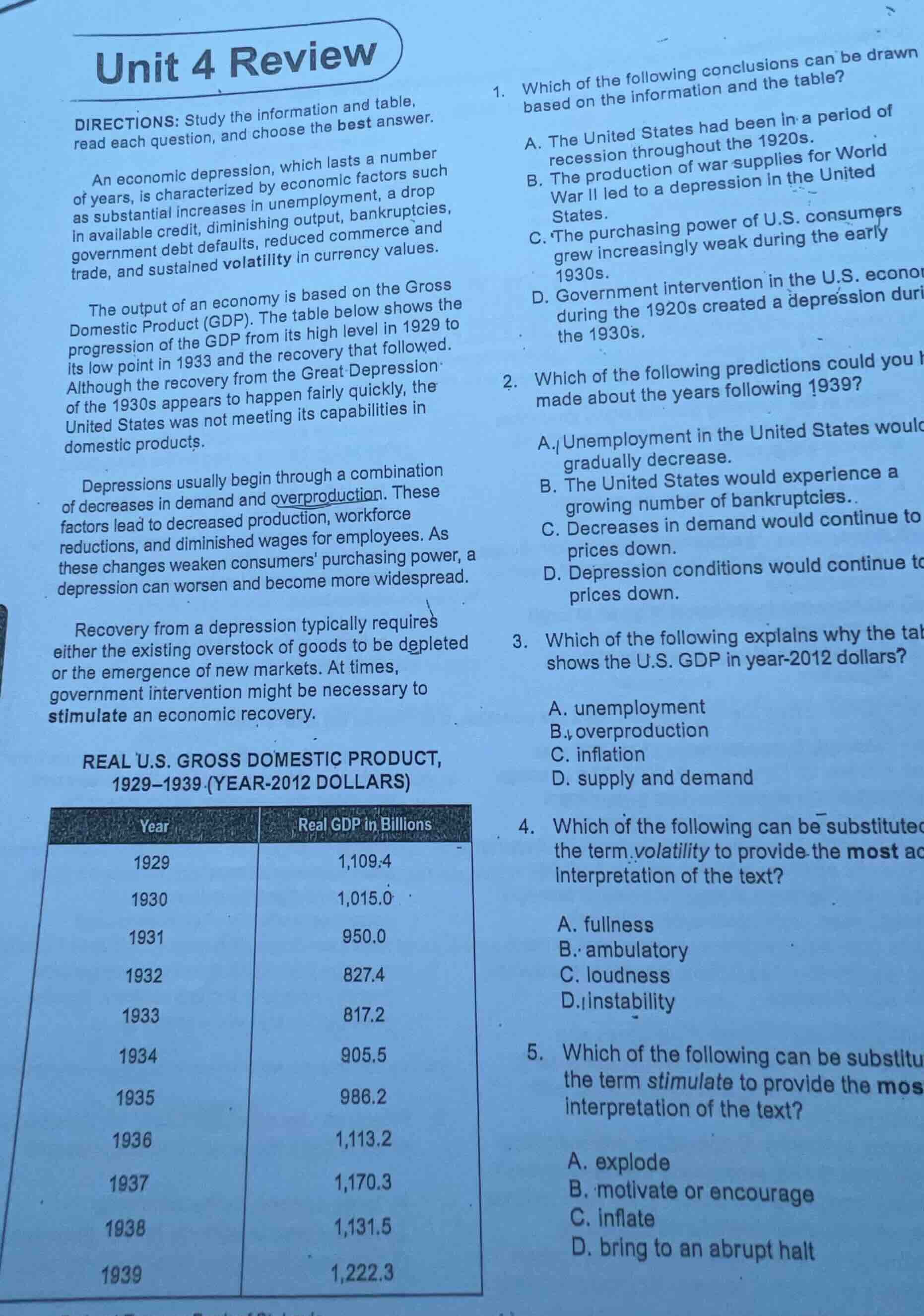
unit 4 reviewdirections: study the information and table,read each question, and choose the best answer.an economic depression, which lasts a numberof years, is characterized by economic factors suchas substantial increases in unemployment, a dropin available credit, diminishing output, bankruptcies,government debt defaults, reduced commerce andtrade, and sustained volatility in currency values.the output of an economy is based on the grossdomestic product (gdp). the table below shows theprogression of the gdp from its high level in 1929 toits low point in 1933 and the recovery that followed.although the recovery from the great depressionof the 1930s appears to happen fairly quickly, theunited states was not meeting its capabilities indomestic products.depressions usually begin through a combinationof decreases in demand and overproduction. thesefactors lead to decreased production, workforcereductions, and diminished wages for employees. asthese changes weaken consumers purchasing power, adepression can worsen and become more widespread.recovery from a depression typically requireseither the existing overstock of goods to be depletedor the emergence of new markets. at times,government intervention might be necessary tostimulate an economic recovery.real u.s. gross domestic product,1929-1939 (year-2012 dollars)| year | real gdp in billions || ---- | ---- || 1929 | 1,109.4 || 1930 | 1,015.0 || 1931 | 950.0 || 1932 | 827.4 || 1933 | 817.2 || 1934 | 905.5 || 1935 | 986.2 || 1936 | 1,113.2 || 1937 | 1,170.3 || 1938 | 1,131.5 || 1939 | 1,222.3 |1. which of the following conclusions can be drawnbased on the information and the table?a. the united states had been in a period ofrecession throughout the 1920s.b. the production of war supplies for worldwar ii led to a depression in the unitedstates.c. the purchasing power of u.s. consumersgrew increasingly weak during the early1930s.d. government intervention in the u.s. economduring the 1920s created a depression durithe 1930s.2. which of the following predictions could youmade about the years following 1939?a. unemployment in the united states wouldgradually decrease.b. the united states would experience agrowing number of bankruptcies.c. decreases in demand would continue toprices down.d. depression conditions would continue toprices down.3. which of the following explains why the tabshows the u.s. gdp in year-2012 dollars?a. unemploymentb. overproductionc. inflationd. supply and demand4. which of the following can be substitutedthe term volatility to provide the most acinterpretation of the text?a. fullnessb. ambulatoryc. loudnessd. instability5. which of the following can be substituthe term stimulate to provide the mosinterpretation of the text?a. explodeb. motivate or encouragec. inflated. bring to an abrupt halt
- For question 1: The table shows GDP dropped sharply 1929-1933, matching depression traits (weak consumer purchasing power). Option A is wrong (1929 GDP was high, no full 1920s recession). B is wrong (WWII ended depression, not caused it). D is wrong (1920s government intervention was low, depression stemmed from overproduction/demand drops).
- For question 2: 1939 GDP was rising, signaling recovery. WWII created new demand, so unemployment would fall. B, C, D describe continued depression, which contradicts the upward GDP trend.
- For question 3: Real GDP uses constant dollars (2012 here) to account for inflation, which changes the value of money over time.
- For question 4: In economic context, "volatility" refers to instability, especially for currency values as noted.
- For question 5: "Stimulate an economic recovery" means to motivate/encourage growth, which fits the context of government action for recovery.

Snap & solve any problem in the app
Get step-by-step solutions on Sovi AI
Photo-based solutions with guided steps
Explore more problems and detailed explanations
- C. The purchasing power of U.S. consumers grew increasingly weak during the early 1930s.
- A. Unemployment in the United States would gradually decrease.
- C. inflation
- D. instability
- B. motivate or encourage