QUESTION IMAGE
Question
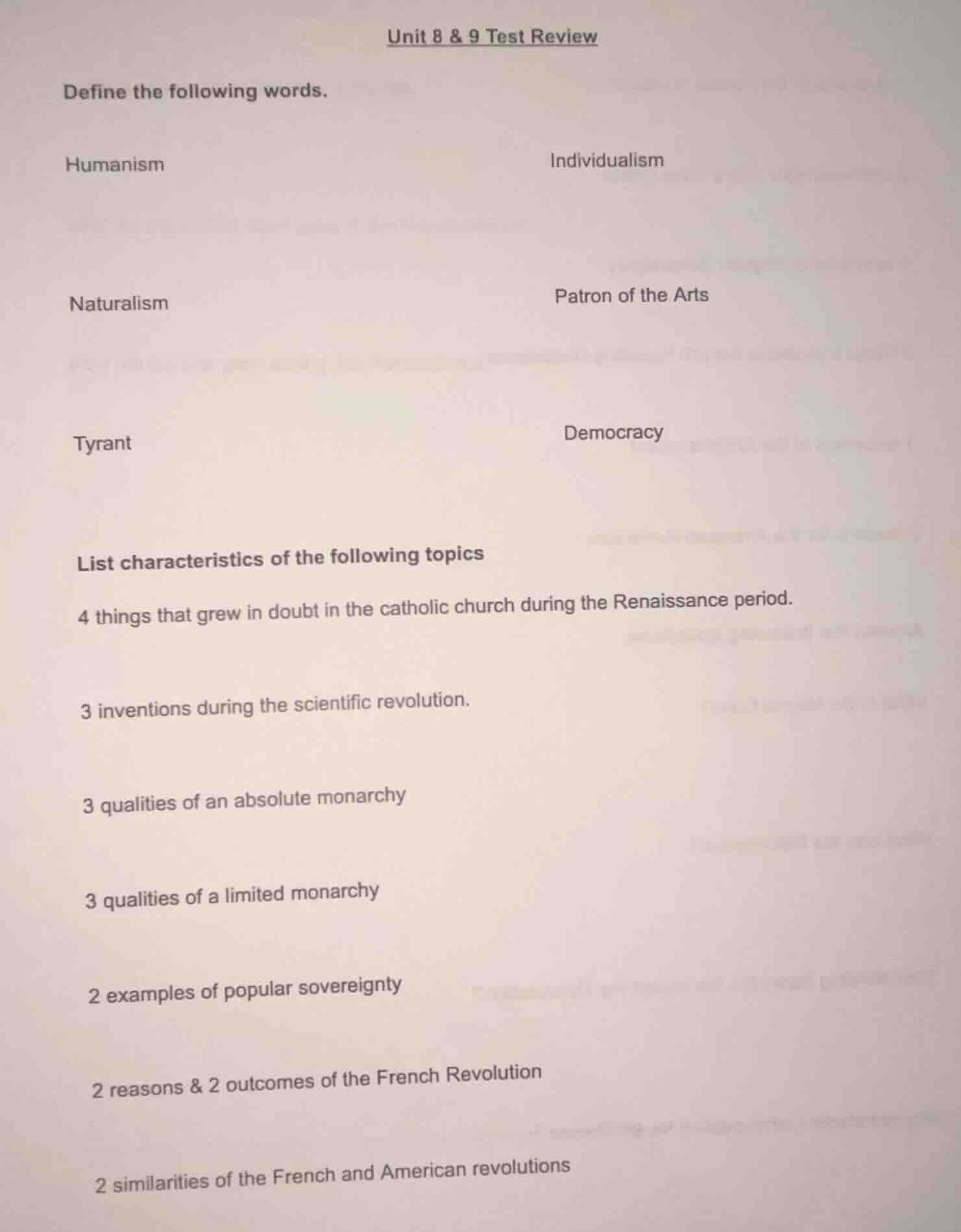
unit 8 & 9 test review
define the following words.
humanism
individualism
naturalism
patron of the arts
tyrant
democracy
list characteristics of the following topics
4 things that grew in doubt in the catholic church during the renaissance period.
3 inventions during the scientific revolution.
3 qualities of an absolute monarchy
3 qualities of a limited monarchy
2 examples of popular sovereignty
2 reasons & 2 outcomes of the french revolution
2 similarities of the french and american revolutions
Brief Explanations
Definitions:
- Humanism: A philosophical stance centered on human values, potential, and critical thinking, emphasizing individual achievement and secular study of classical texts, prominent in the Renaissance.
- Individualism: A social value prioritizing the autonomy, rights, and unique identity of the individual over collective or group interests.
- Naturalism: An artistic/literary movement focused on representing subjects realistically, based on observable nature and scientific principles, avoiding idealization.
- Patron of the Arts: A person (often wealthy, noble, or religious figure) who financially supports artists, writers, and creators, enabling their work.
- Tyrant: An oppressive, absolute ruler who seizes or holds power through cruel, unjust means, without legitimate popular consent.
- Democracy: A system of government where political power rests with the people, who exercise it directly or through elected representatives.
Characteristics & Lists:
- Doubts about the Catholic Church (Renaissance):
- Corruption of clergy (e.g., simony, nepotism)
- Sale of indulgences for forgiveness of sin
- Lack of religious education among lower clergy
- Disconnect between Church teachings and clergy behavior
- Scientific Revolution Inventions:
- Telescope (enabled astronomical observations)
- Microscope (revealed microscopic life forms)
- Printing Press (spread scientific texts widely)
- Absolute Monarchy Qualities:
- Ruler has unlimited, unchallenged power
- Ruler claims authority from divine right
- No formal constitution or legislative body restricting the ruler
- Limited Monarchy Qualities:
- Ruler's power is restricted by a constitution or laws
- Elected legislative body holds significant governing power
- Ruler serves primarily as a symbolic or ceremonial figure (in many cases)
- Popular Sovereignty Examples:
- U.S. Constitution, which derives its authority from the consent of the governed
- French Revolution's Declaration of the Rights of Man, which asserts the people as the source of political power
- French Revolution: Reasons & Outcomes:
- Reasons: Inequitable tax burden on the Third Estate; Absolute monarchy's corruption and financial mismanagement
- Outcomes: Abolition of the French monarchy; Rise of secular, democratic political ideals in Europe
- French & American Revolution Similarities:
- Both were driven by ideals of liberty, equality, and opposition to oppressive, unelected rule
- Both resulted in the establishment of constitutional governments based on popular sovereignty

Snap & solve any problem in the app
Get step-by-step solutions on Sovi AI
Photo-based solutions with guided steps
Explore more problems and detailed explanations
Definitions:
- Humanism: A philosophy focused on human potential, secular learning, and individual achievement, core to the Renaissance.
- Individualism: A value prioritizing individual autonomy and rights over collective groups.
- Naturalism: An artistic/literary movement emphasizing realistic, unidealized depictions of nature and human life.
- Patron of the Arts: A wealthy or influential figure who financially supports artists and creators.
- Tyrant: An oppressive, unjust ruler who holds power through cruel, illegitimate means.
- Democracy: A government system where power rests with the people, via direct or representative participation.
Characteristics & Lists:
- Renaissance Catholic Church Doubts:
- Clerical corruption (simony, nepotism)
- Sale of indulgences
- Uneducated lower clergy
- Clergy ignoring Church teachings
- Scientific Revolution Inventions:
- Telescope
- Microscope
- Printing Press
- Absolute Monarchy Qualities:
- Unlimited, unchallenged ruler power
- Divine right authority claim
- No restricting constitution/legislature
- Limited Monarchy Qualities:
- Ruler power restricted by constitution/laws
- Elected legislature holds key power
- Often symbolic ruler role
- Popular Sovereignty Examples:
- U.S. Constitution (governed by people's consent)
- French Declaration of the Rights of Man
- French Revolution:
- Reasons: Third Estate tax inequality; Monarchical financial corruption
- Outcomes: Abolition of French monarchy; Spread of democratic ideals in Europe
- Revolution Similarities:
- Driven by liberty/equality ideals against oppression
- Established constitutional, people-centered governments