QUESTION IMAGE
Question
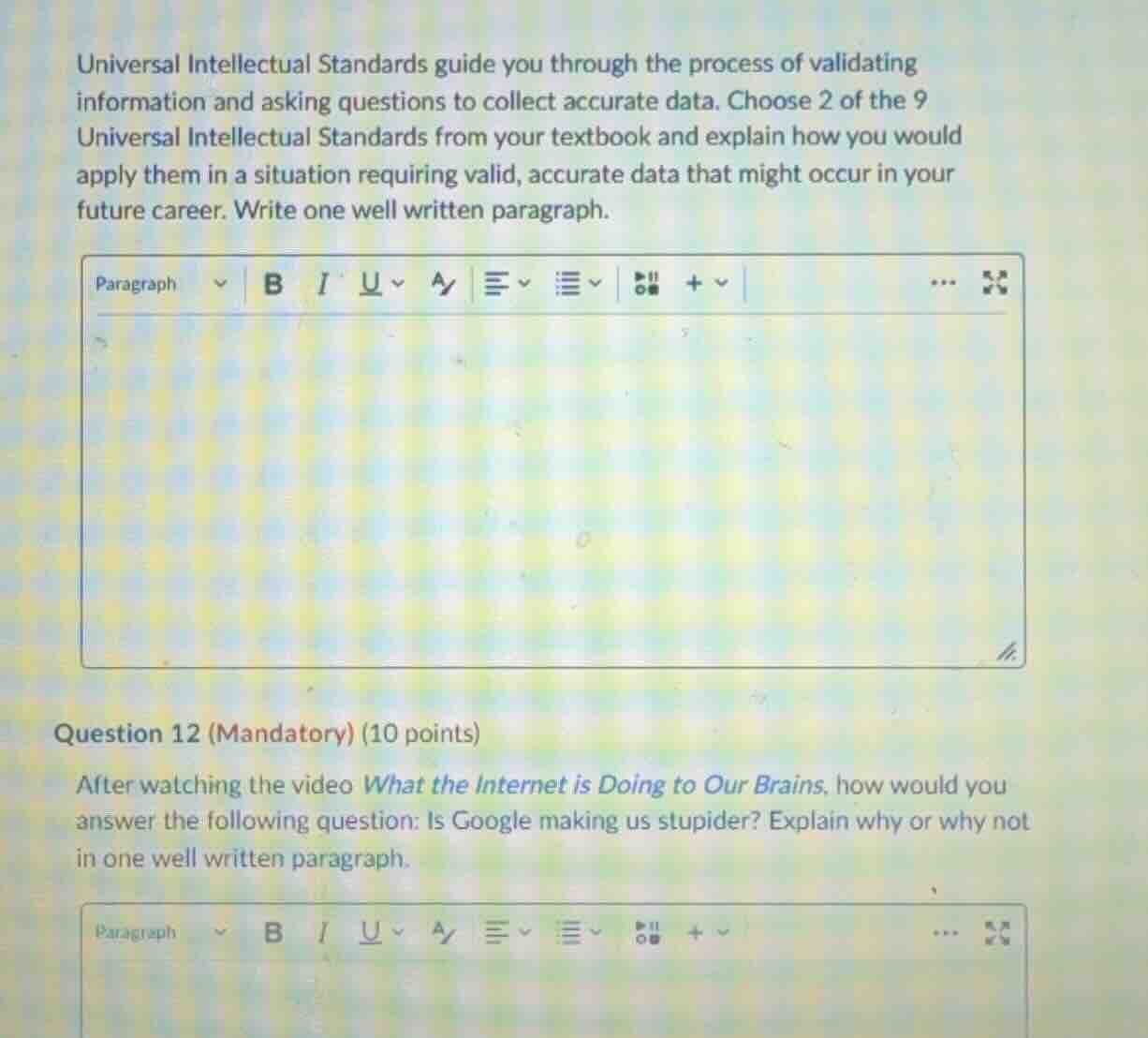
universal intellectual standards guide you through the process of validating information and asking questions to collect accurate data. choose 2 of the 9 universal intellectual standards from your textbook and explain how you would apply them in a situation requiring valid, accurate data that might occur in your future career. write one well written paragraph.
question 12 (mandatory) (10 points)
after watching the video what the internet is doing to our brains, how would you answer the following question: is google making us stupider? explain why or why not in one well written paragraph.
First Part (Universal Intellectual Standards Application)
Let's choose "Clarity" and "Accuracy" as two Universal Intellectual Standards. In a future career as a market researcher, when collecting data on consumer preferences, clarity would be applied by formulating questions in the survey (like "How often do you purchase organic food?" instead of ambiguous ones) so that respondents understand exactly what's being asked, ensuring the data collected is relevant. Accuracy would be ensured by cross - verifying the survey responses with sales data from local organic stores. For example, if the survey says 60% of people buy organic food weekly, but store sales show only 30% of the local population's purchases are organic, we'd re - examine the survey methodology (maybe the sample was biased towards health - conscious groups) to make the data accurate.
Google is not making us stupider. While it's true that we can access information easily, this doesn't reduce our intelligence. Instead, it changes how we use our cognitive abilities. For example, in the past, we had to memorize a lot of facts (like historical dates or mathematical formulas) to have access to knowledge. Now, with Google, we can focus on higher - order thinking skills such as analyzing the information we find (e.g., evaluating the credibility of a scientific study on climate change found via Google) or synthesizing information from multiple sources (like combining data from different medical research papers to understand a disease better). Our brains are adapting to use Google as a tool for extending our knowledge base, rather than becoming less intelligent.

Snap & solve any problem in the app
Get step-by-step solutions on Sovi AI
Photo-based solutions with guided steps
Explore more problems and detailed explanations
In a future career as a market researcher, two Universal Intellectual Standards, Clarity and Accuracy, can be applied when collecting consumer preference data. Clarity is used by crafting unambiguous survey questions (e.g., “How often do you purchase organic food?”) to ensure respondents provide relevant answers. Accuracy is ensured by cross - verifying survey responses with local organic store sales data; if there's a discrepancy (e.g., survey claims 60% buy organic weekly but store data shows 30%), the survey methodology (like sample bias) is re - examined to refine the data.