QUESTION IMAGE
Question
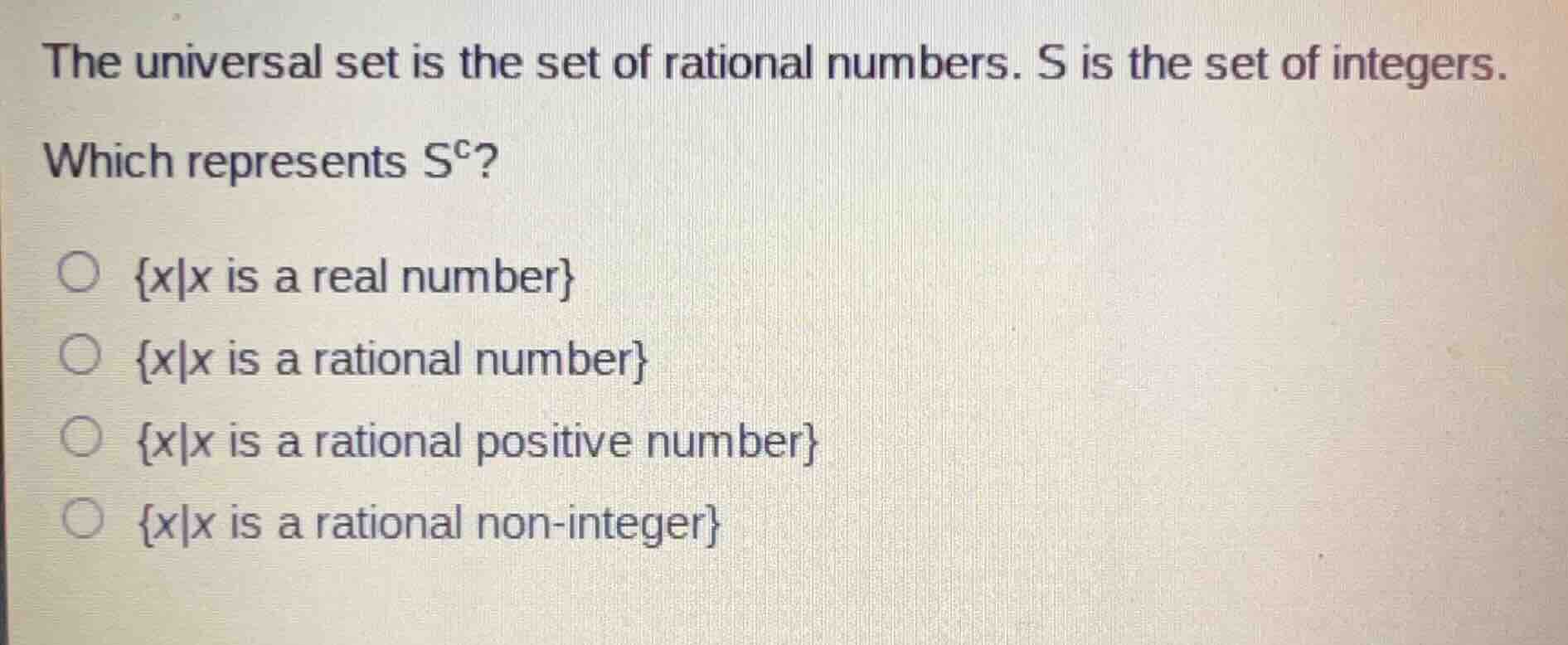
the universal set is the set of rational numbers. s is the set of integers. which represents ( s^c )?
( {x|x \text{ is a real number}} )
( {x|x \text{ is a rational number}} )
( {x|x \text{ is a rational positive number}} )
( {x|x \text{ is a rational non - integer}} )
Step1: Recall Complement Definition
The complement of a set \( S \) (denoted \( S^c \)) within a universal set \( U \) is the set of all elements in \( U \) that are not in \( S \). Here, \( U \) (universal set) is the set of rational numbers, and \( S \) is the set of integers.
Step2: Determine Elements of \( S^c \)
We need to find all rational numbers that are not integers. So, \( S^c \) should be the set of rational non - integers.
- Option 1: \(\{x|x \text{ is a real number}\}\) is incorrect because the universal set is rational numbers, not all real numbers.
- Option 2: \(\{x|x \text{ is a rational number}\}\) is incorrect because this is the universal set, not the complement of the integers (since the integers are a subset of rational numbers).
- Option 3: \(\{x|x \text{ is a rational positive number}\}\) is incorrect as it only considers positive rational numbers, not related to being the complement of integers.
- Option 4: \(\{x|x \text{ is a rational non - integer}\}\) is correct as it represents all rational numbers that are not in the set of integers (which is \( S \)).

Snap & solve any problem in the app
Get step-by-step solutions on Sovi AI
Photo-based solutions with guided steps
Explore more problems and detailed explanations
\(\{x|x \text{ is a rational non - integer}\}\) (the fourth option)