QUESTION IMAGE
Question
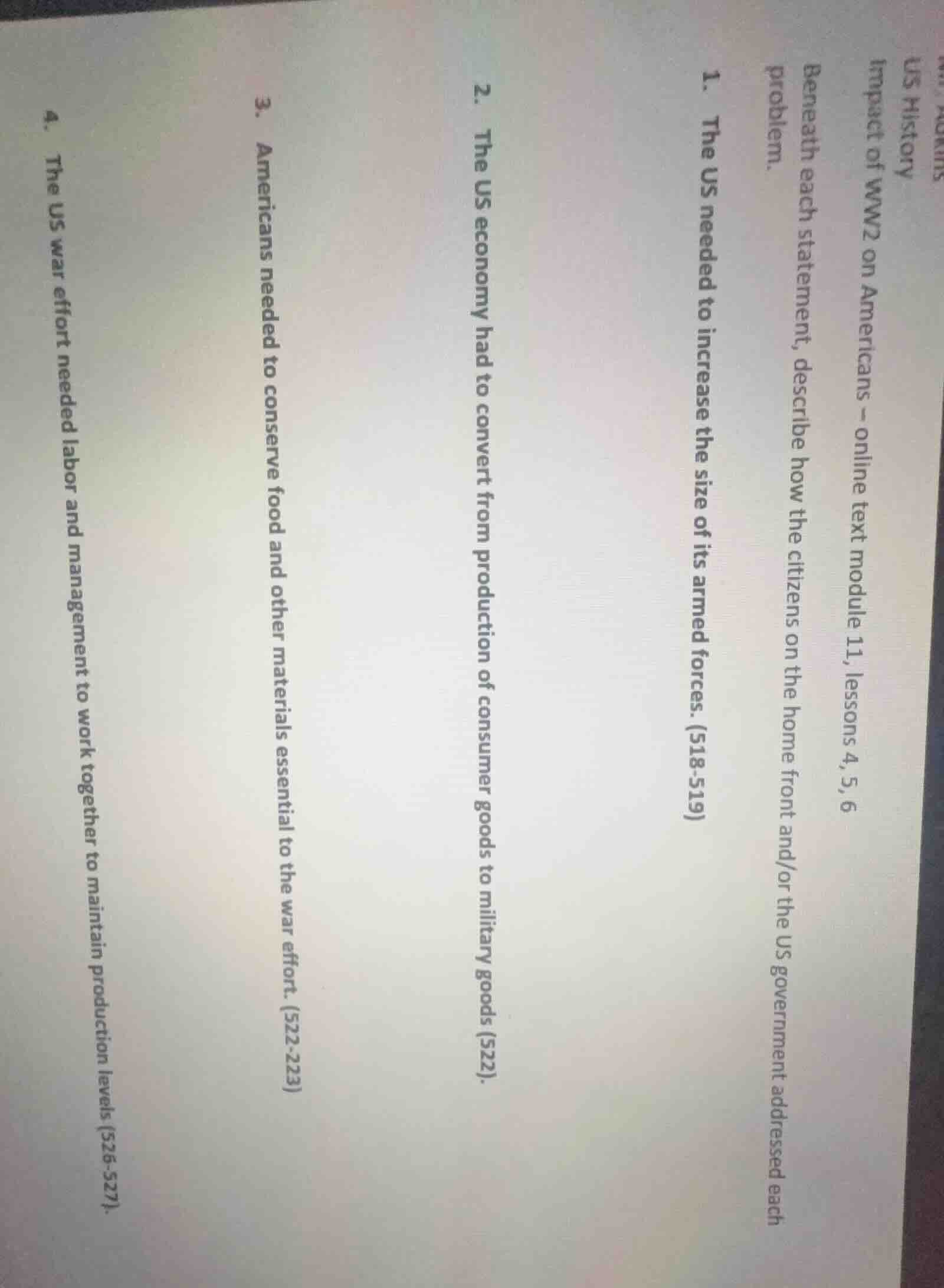
us history
impact of ww2 on americans – online module 11, lessons 4, 5, 6
beneath each statement, describe how the citizens on the home front and/or the us government addressed each problem.
- the us needed to increase the size of its armed forces. (518 - 519)
- the us economy had to convert from production of consumer goods to military goods (522).
- americans needed to conserve food and other materials essential to the war effort. (522 - 223)
- the us war effort needed labor and management to work together to maintain production levels (526 - 527).
Brief Explanations
- To expand the armed forces, the U.S. government launched large-scale recruitment drives (including the draft via the Selective Service System) and promoted voluntary enlistment, also creating training programs to prepare new recruits for combat and support roles.
- The U.S. government established agencies like the War Production Board (WPB) to prioritize military production, allocate raw materials to defense contractors, and convert civilian factories to make tanks, planes, and weapons, while rationing consumer goods to redirect resources.
- The government promoted conservation through campaigns (e.g., "Food Fights for Freedom") that encouraged rationing via coupon books for items like sugar, meat, and gasoline, and scrap drives for metal, rubber, and paper to reuse materials for the war.
- The government addressed labor shortages by recruiting women (via the "Rosie the Riveter" campaign) to work in factories, bringing in minority workers, and creating the War Manpower Commission to coordinate labor allocation, while the National War Labor Board mediated labor disputes to keep production steady.

Snap & solve any problem in the app
Get step-by-step solutions on Sovi AI
Photo-based solutions with guided steps
Explore more problems and detailed explanations
- The government used the Selective Service System to draft millions of men, alongside voluntary enlistment campaigns, and set up training facilities to rapidly expand and prepare the armed forces.
- The War Production Board (WPB) directed the shift: it halted non-essential consumer production, allocated critical raw materials to military contractors, and retooled civilian factories to produce military hardware like aircraft and artillery.
- The government implemented nationwide rationing (using coupon systems for food and fuel) and ran public campaigns to encourage citizens to grow victory gardens, save waste fats, and participate in scrap drives for war materials.
- The government recruited women, minority groups, and even retired workers into the workforce via targeted propaganda, created the War Manpower Commission to manage labor distribution, and enforced policies to prevent labor strikes that would disrupt production.