QUESTION IMAGE
Question
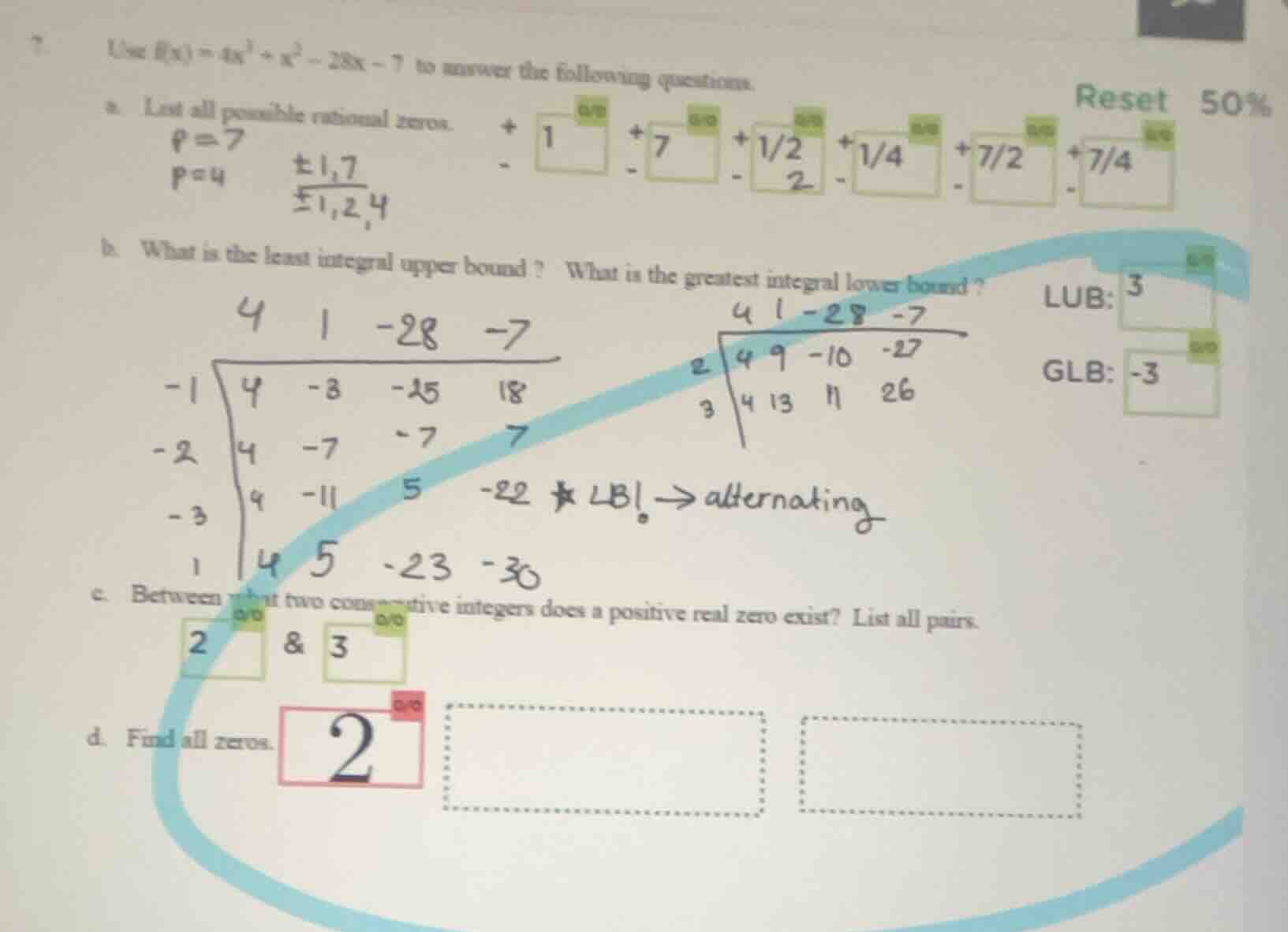
- use ( f(x) = 4x^3 + x^2 - 28x - 7 ) to answer the following questions.
a. list all possible rational zeros.
b. what is the least integral upper bound? what is the greatest integral lower bound?
c. between what two consecutive integers does a positive real zero exist? list all pairs.
d. find all zeros.
Part a: List all possible rational zeros
Step1: Identify \( p \) and \( q \)
For the polynomial \( f(x) = 4x^3 + x^2 - 28x - 7 \), the constant term \( p=-7 \) (we consider factors of the absolute value, so \( \pm1, \pm7 \)) and the leading coefficient \( q = 4 \) (factors are \( \pm1, \pm2, \pm4 \)).
Step2: Apply Rational Root Theorem
The possible rational zeros are \( \frac{\text{factors of } p}{\text{factors of } q} \), so we calculate \( \frac{\pm1, \pm7}{\pm1, \pm2, \pm4} \), which gives \( \pm1, \pm7, \pm\frac{1}{2}, \pm\frac{7}{2}, \pm\frac{1}{4}, \pm\frac{7}{4} \).
Step1: Test for upper bound
Using synthetic division, when we test \( x = 3 \), the coefficients of the quotient and remainder are all non - negative (from the synthetic division shown: \( 4, 13, 11, 26 \) are all non - negative). For \( x = 2 \), we had a negative remainder. So the least integral upper bound is \( 3 \).
Step2: Test for lower bound
Using synthetic division, when we test \( x=-3 \), the signs of the coefficients of the quotient and remainder alternate (from the synthetic division: \( 4, - 11, 5, -22 \) have alternating signs). For \( x=-2 \), the signs do not alternate. So the greatest integral lower bound is \( - 3 \).
Step1: Evaluate \( f(x) \) at integers
We evaluate \( f(2)=4(2)^3+(2)^2 - 28(2)-7=32 + 4-56 - 7=-27 \) and \( f(3)=4(3)^3+(3)^2 - 28(3)-7 = 108+9 - 84 - 7 = 26 \). Since \( f(2)<0 \) and \( f(3)>0 \), by the Intermediate Value Theorem, there is a zero between \( 2 \) and \( 3 \).

Snap & solve any problem in the app
Get step-by-step solutions on Sovi AI
Photo-based solutions with guided steps
Explore more problems and detailed explanations
\( \pm1, \pm7, \pm\frac{1}{2}, \pm\frac{7}{2}, \pm\frac{1}{4}, \pm\frac{7}{4} \)