QUESTION IMAGE
Question
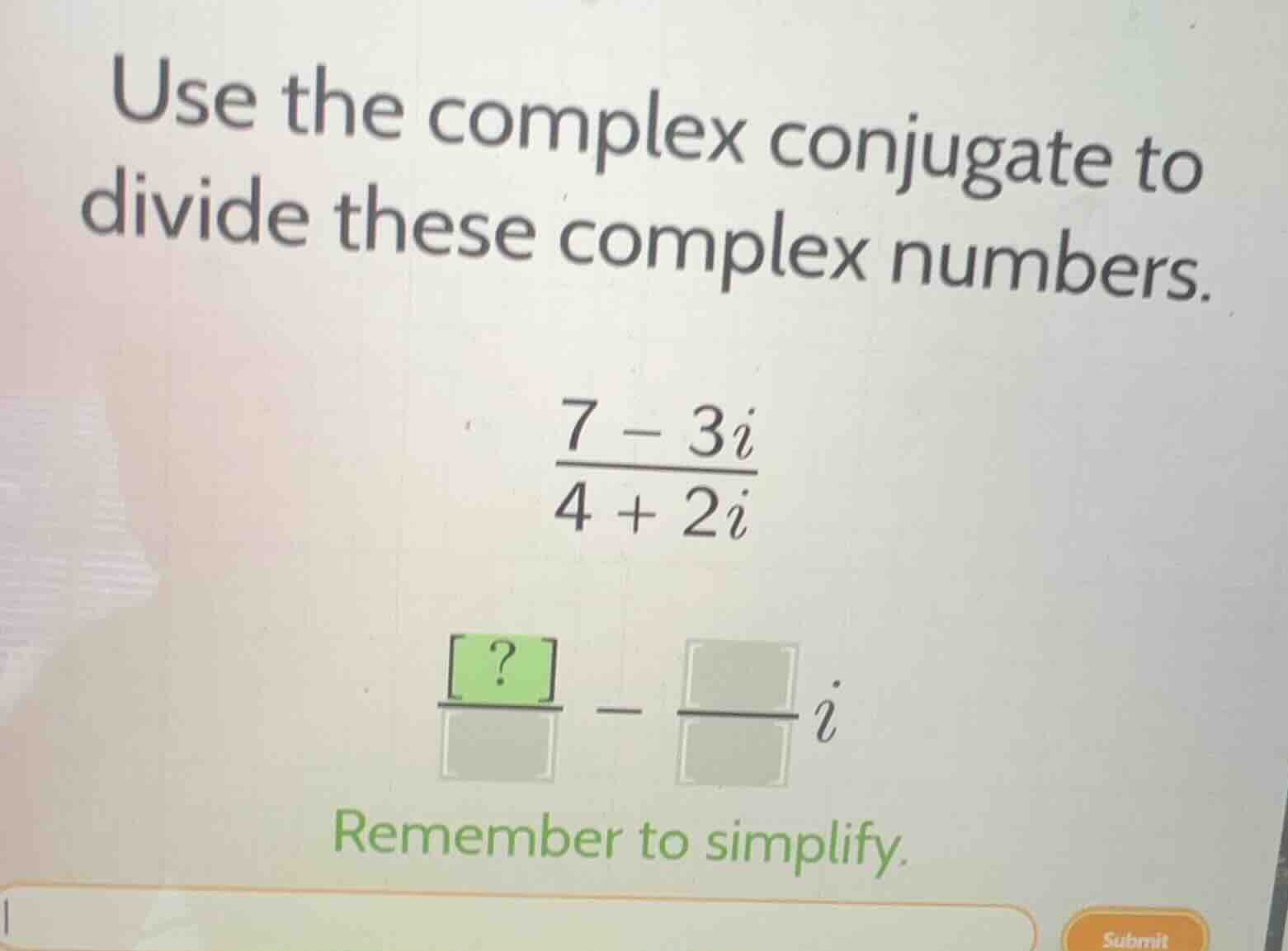
use the complex conjugate to divide these complex numbers.\\(\frac{7 - 3i}{4 + 2i}\\)\\(\frac{?}{\square} - \frac{\square}{\square}i\\)remember to simplify.
Step1: Multiply numerator and denominator by the complex conjugate of the denominator.
The complex conjugate of \(4 + 2i\) is \(4 - 2i\). So we multiply the numerator and denominator by \(4 - 2i\):
\[
\frac{(7 - 3i)(4 - 2i)}{(4 + 2i)(4 - 2i)}
\]
Step2: Expand the numerator and the denominator.
First, expand the numerator using the distributive property (FOIL method):
\[
\]
Since \(i^2=- 1\), we have:
\[
28 - 14i - 12i + 6\times(-1)=28 - 26i - 6 = 22 - 26i
\]
Now, expand the denominator using the difference of squares formula \((a + b)(a - b)=a^2 - b^2\):
\[
(4 + 2i)(4 - 2i)=4^2-(2i)^2 = 16 - 4i^2
\]
Again, using \(i^2 = - 1\), we get:
\[
16-4\times(-1)=16 + 4=20
\]
So now our fraction is \(\frac{22 - 26i}{20}\)
Step3: Simplify the fraction.
We can split the fraction into two parts:
\[
\frac{22}{20}-\frac{26}{20}i
\]
Simplify the fractions:
\[
\frac{11}{10}-\frac{13}{10}i
\]

Snap & solve any problem in the app
Get step-by-step solutions on Sovi AI
Photo-based solutions with guided steps
Explore more problems and detailed explanations
The real part is \(\frac{11}{10}\) (with denominator \(10\)) and the coefficient of \(i\) is \(\frac{13}{10}\) (with denominator \(10\)). So the answer is \(\frac{11}{10}-\frac{13}{10}i\), and filling in the boxes: the numerator of the real part is \(11\), denominator of the real part is \(10\), numerator of the imaginary part is \(13\), denominator of the imaginary part is \(10\). So the first box (numerator of real part) is \(11\), denominator of real part is \(10\), numerator of imaginary part is \(13\), denominator of imaginary part is \(10\). If we just consider the first fraction (the real part fraction) as \(\frac{11}{10}\), so the answer for the first box (the numerator of the real part fraction) is \(11\) and the denominator is \(10\), and for the imaginary part fraction, numerator is \(13\) and denominator is \(10\). But the question asks for the first fraction (the real part) as \(\frac{?}{?}\), so the first fraction is \(\frac{11}{10}\) (so numerator \(11\), denominator \(10\)) and the second fraction (for the imaginary part) is \(\frac{13}{10}\) (numerator \(13\), denominator \(10\)). So the answer for the first box (the numerator of the real part) is \(11\), denominator of real part is \(10\), numerator of imaginary part is \(13\), denominator of imaginary part is \(10\). If we are to fill the first green box (the numerator of the real part) and its denominator, and the numerator and denominator of the imaginary part:
The real part fraction: \(\frac{11}{10}\), so numerator \(11\), denominator \(10\).
The imaginary part fraction: \(\frac{13}{10}\), so numerator \(13\), denominator \(10\).
So the answer for the first box (the numerator of the real part) is \(11\), denominator of real part is \(10\), numerator of imaginary part is \(13\), denominator of imaginary part is \(10\). So in the format \(\frac{11}{10}-\frac{13}{10}i\), the first fraction is \(\frac{11}{10}\) (so numerator \(11\), denominator \(10\)) and the second fraction is \(\frac{13}{10}\) (numerator \(13\), denominator \(10\)).