QUESTION IMAGE
Question
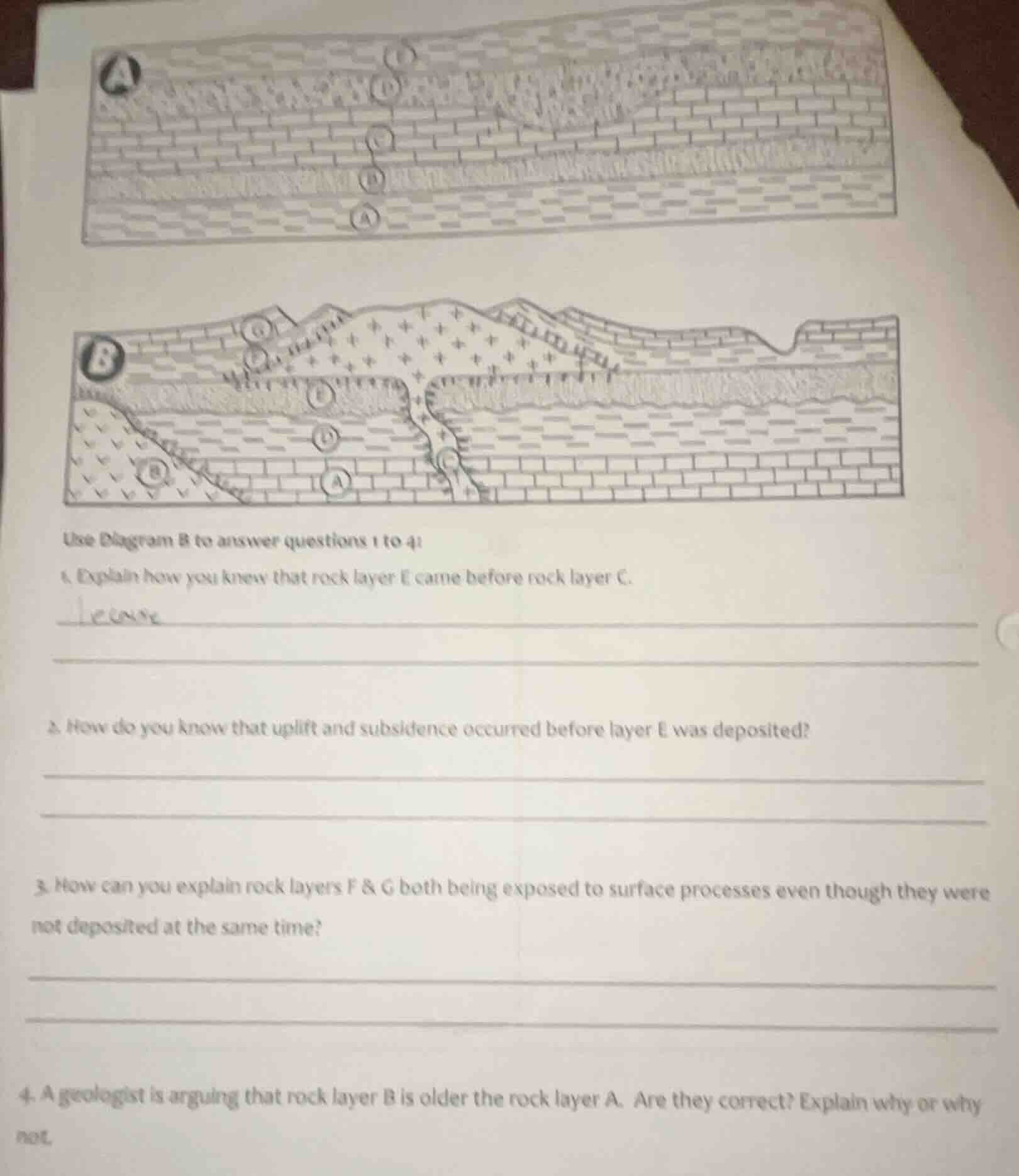
use diagram b to answer questions 1 to 4:
- explain how you knew that rock layer e came before rock layer c.
- how do you know that uplift and subsidence occurred before layer e was deposited?
- how can you explain rock layers f & g both being exposed to surface processes even though they were not deposited at the same time?
- a geologist is arguing that rock layer b is older the rock layer a. are they correct? explain why or why not.
Brief Explanations
- Rock layer C is an igneous intrusion that cuts through layer E. The principle of cross-cutting relationships states that a feature cutting through rock layers is younger than the layers it intrudes. Since C cuts E, E must have existed first, so E is older (came before C).
- Layers A, B, C, and D show signs of erosion (an unconformity) below layer E. Uplift would have raised these layers to the surface where erosion occurred, and subsidence later allowed new sediment (forming layer E) to be deposited on top of the eroded surface. This erosion surface between older layers and E proves uplift/subsidence happened before E was laid down.
- After layers F and G were deposited, tectonic uplift raised the entire area, exposing both layers at the Earth's surface. Subsequent erosion (a surface process) wore away overlying material, leaving both F and G exposed even though they formed at different times.
- The geologist is incorrect. Layer B is an igneous intrusion that cuts through layer A. Using the principle of cross-cutting relationships, the intruding feature (B) is younger than the rock layer it cuts through (A). Therefore, layer A is older than layer B.

Snap & solve any problem in the app
Get step-by-step solutions on Sovi AI
Photo-based solutions with guided steps
Explore more problems and detailed explanations
- Layer C is an intrusion cutting E; per cross-cutting relationships, the intruded layer (E) is older, so E formed before C.
- An eroded unconformity exists below layer E (on top of A-D). Uplift exposed these layers to erosion, then subsidence allowed E to deposit on the eroded surface, so uplift/subsidence preceded E.
- Tectonic uplift raised the entire region after F and G formed, bringing both layers to the surface where erosion exposed them.
- No, they are not correct. Layer B is an igneous intrusion that cuts through layer A. By cross-cutting relationships, the intrusion (B) is younger than the rock it cuts (A), so A is older than B.