QUESTION IMAGE
Question
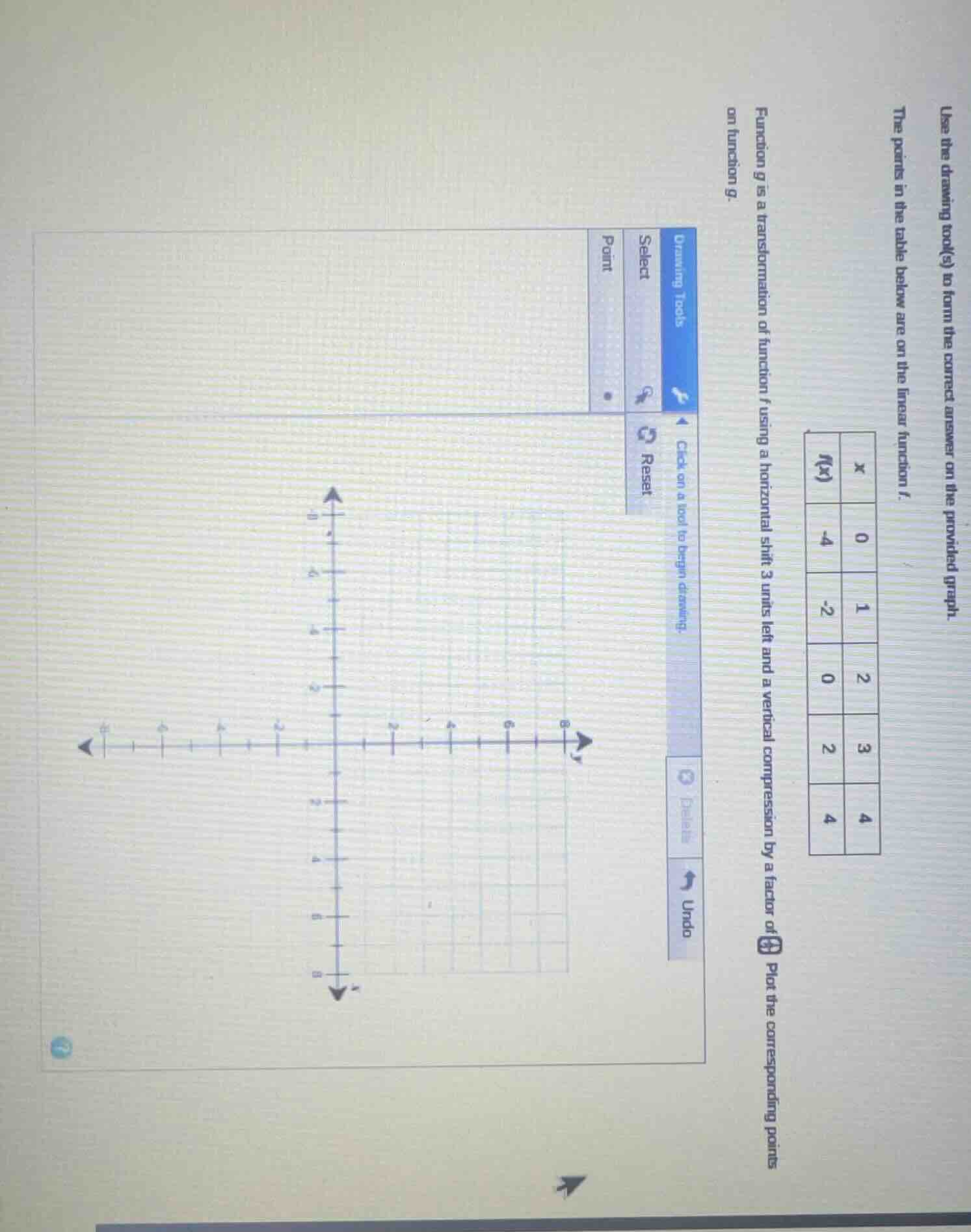
use the drawing tool(s) to form the correct answer on the provided graph. the points in the table below are on the linear function f. \
function g is a transformation of function f using a horizontal shift 3 units left and a vertical compression by a factor of \\( \frac{1}{2} \\). plot the corresponding points on function g. drawing tools select point click on a tool to begin drawing. reset delete undo
Step1: Analyze function \( f \)
First, find the equation of linear function \( f \). The table has points \((0, -4)\), \((1, -2)\), \((2, 0)\), \((3, 2)\), \((4, 4)\). The slope \( m \) is \( \frac{-2 - (-4)}{1 - 0} = 2 \). So \( f(x)=2x - 4 \) (using \( y - y_1 = m(x - x_1) \) with \((0, -4)\)).
Step2: Apply horizontal shift
A horizontal shift 3 units left means replace \( x \) with \( x + 3 \) in \( f(x) \). So \( f(x + 3)=2(x + 3)-4 = 2x + 6 - 4 = 2x + 2 \).
Step3: Apply vertical compression
A vertical compression by a factor of \( \frac{1}{2} \) means multiply the function by \( \frac{1}{2} \). So \( g(x)=\frac{1}{2}(2x + 2)=x + 1 \).
Step4: Find transformed points
For each point \((x, f(x))\) on \( f \), the transformed point on \( g \) is \((x - 3, \frac{1}{2}f(x))\) (since horizontal shift left 3: \( x \to x - 3 \) (wait, correction: horizontal shift left 3 means \( x \) in \( f \) becomes \( x + 3 \) in \( g \)'s input, so to get the \( x \)-coordinate of \( g \), if original \( x \) for \( f \) is \( x_0 \), then \( x_0 + 3 = x_g \)? No, wait: transformation rules: \( g(x)= \frac{1}{2}f(x + 3) \). So for a point \((x_0, y_0)\) on \( f \) (where \( y_0 = f(x_0) \)), the corresponding point on \( g \) is \((x_0 - 3, \frac{1}{2}y_0)\) (because \( x + 3 = x_0 \implies x = x_0 - 3 \), and \( y = \frac{1}{2}y_0 \)).
Now apply to each point:
- For \((0, -4)\): \( x = 0 - 3 = -3 \), \( y = \frac{1}{2}(-4)= -2 \). So point \((-3, -2)\).
- For \((1, -2)\): \( x = 1 - 3 = -2 \), \( y = \frac{1}{2}(-2)= -1 \). Point \((-2, -1)\).
- For \((2, 0)\): \( x = 2 - 3 = -1 \), \( y = \frac{1}{2}(0)= 0 \). Point \((-1, 0)\).
- For \((3, 2)\): \( x = 3 - 3 = 0 \), \( y = \frac{1}{2}(2)= 1 \). Point \((0, 1)\).
- For \((4, 4)\): \( x = 4 - 3 = 1 \), \( y = \frac{1}{2}(4)= 2 \). Point \((1, 2)\).

Snap & solve any problem in the app
Get step-by-step solutions on Sovi AI
Photo-based solutions with guided steps
Explore more problems and detailed explanations
The transformed points for \( g \) are \((-3, -2)\), \((-2, -1)\), \((-1, 0)\), \((0, 1)\), \((1, 2)\). To plot, use these coordinates.