QUESTION IMAGE
Question
use the drop - down menus to identify the type of energy each phrase describes. the shortest wavelength of visible light energy that can be felt as heat but not seen short, invisible rays that can cause eye damage visible light with the longest wavelength
1. The shortest wavelength of visible light
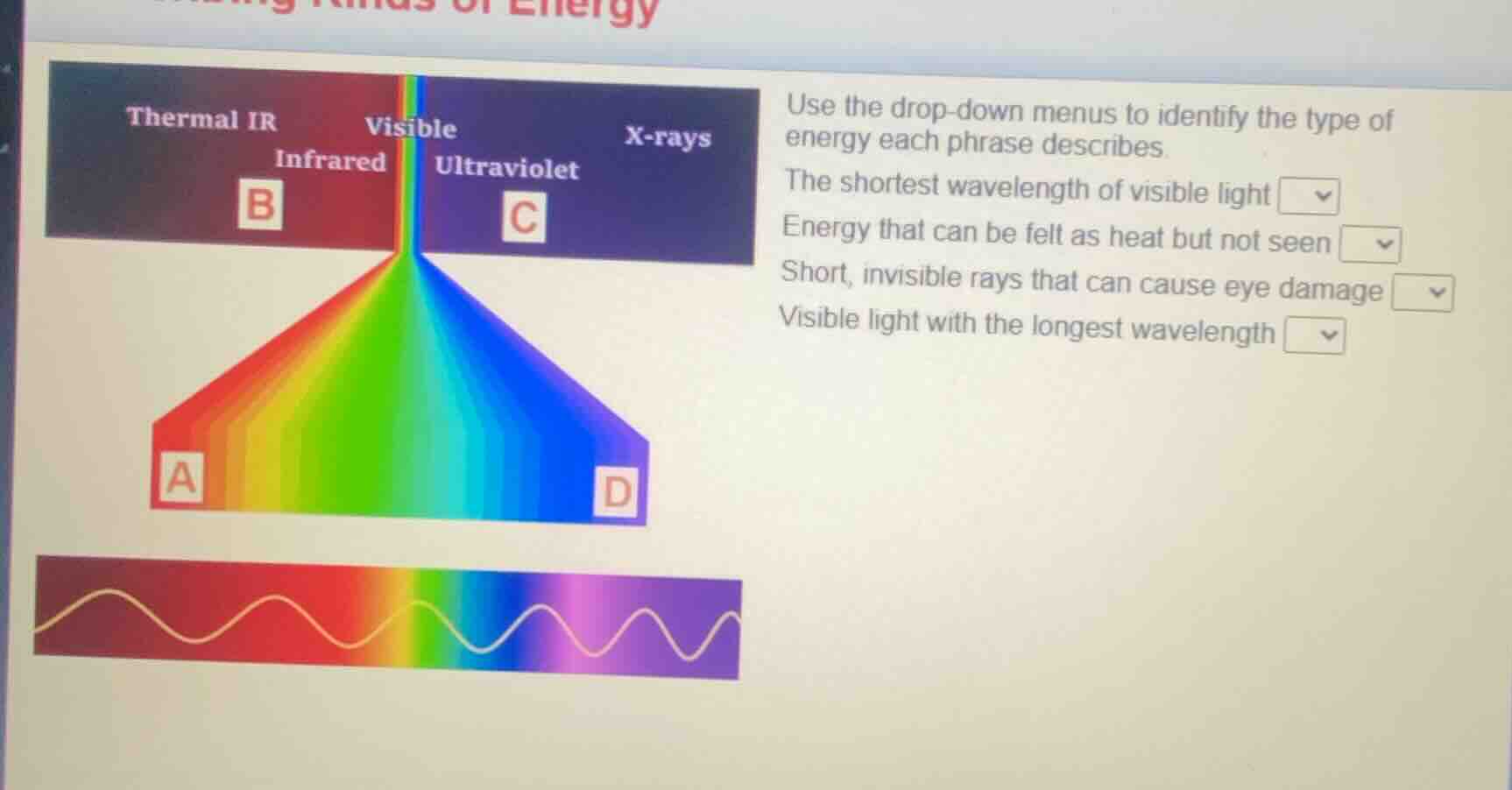
In the visible light spectrum, wavelengths increase from violet to red. So the shortest wavelength in visible light is violet (or the blue - violet end). Looking at the diagram, the region D is on the blue - violet end of visible light. So this should correspond to the shortest wavelength of visible light.
2. Energy that can be felt as heat but not seen
Infrared radiation (especially thermal IR) is energy that is felt as heat and is not visible to the human eye. The region B in the diagram is labeled with Thermal IR/Infrared, so this energy is infrared (thermal IR).
3. Short, invisible rays that can cause eye damage
Ultraviolet (UV) rays are short, invisible rays that can cause eye damage (and also skin damage like sunburn). The region C in the diagram is labeled with Ultraviolet, so this is ultraviolet.
4. Visible light with the longest wavelength
In the visible light spectrum, red light has the longest wavelength. The region A in the diagram is on the red end of visible light, so visible light with the longest wavelength is red (corresponding to region A).

Snap & solve any problem in the app
Get step-by-step solutions on Sovi AI
Photo-based solutions with guided steps
Explore more problems and detailed explanations
s:
- The shortest wavelength of visible light: (Corresponding to the region with shorter visible light wavelength, e.g., violet - related, region D)
- Energy that can be felt as heat but not seen: Infrared (Thermal IR, region B)
- Short, invisible rays that can cause eye damage: Ultraviolet (region C)
- Visible light with the longest wavelength: (Corresponding to red - related, region A)
(If we assume the drop - down options are related to the labels A, B, C, D or the types:
- Shortest visible wavelength: Violet (or the short - wavelength visible part, maybe corresponding to D)
- Heat - felt non - visible: Infrared (B)
- Eye - damaging invisible: Ultraviolet (C)
- Longest visible wavelength: Red (A))
For the drop - down answers (assuming options are based on the diagram labels or types):
- The shortest wavelength of visible light: D (or the option corresponding to short visible wavelength like violet)
- Energy that can be felt as heat but not seen: B (Infrared)
- Short, invisible rays that can cause eye damage: C (Ultraviolet)
- Visible light with the longest wavelength: A (Red)