QUESTION IMAGE
Question
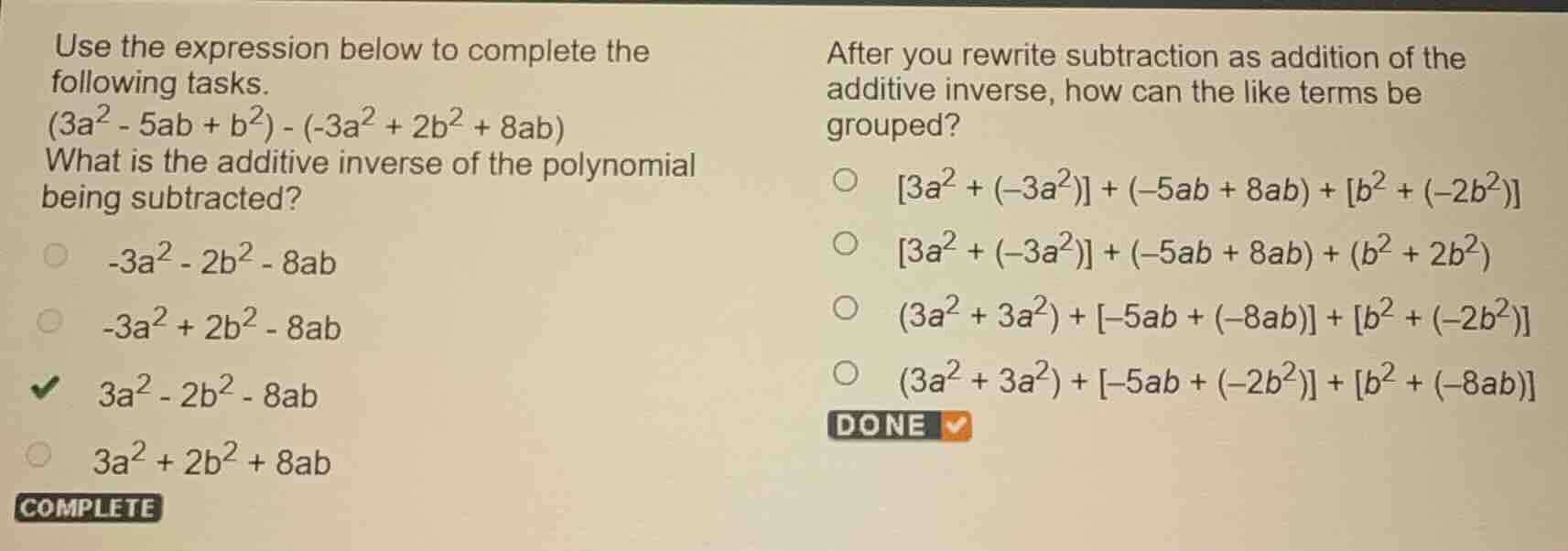
use the expression below to complete the following tasks.\\((3a^2 - 5ab + b^2) - (-3a^2 + 2b^2 + 8ab)\\)\
what is the additive inverse of the polynomial being subtracted?\
\\(\circ -3a^2 - 2b^2 - 8ab\\)\
\\(\circ -3a^2 + 2b^2 - 8ab\\)\
\\(\circ 3a^2 - 2b^2 - 8ab\\)\
\\(\circ 3a^2 + 2b^2 + 8ab\\)\
complete\
after you rewrite subtraction as addition of the additive inverse, how can the like terms be grouped?\
\\(\circ 3a^2 + (-3a^2) + (-5ab + 8ab) + b^2 + (-2b^2)\\)\
\\(\circ 3a^2 + (-3a^2) + (-5ab + 8ab) + (b^2 + 2b^2)\\)\
\\(\circ (3a^2 + 3a^2) + -5ab + (-8ab) + b^2 + (-2b^2)\\)\
\\(\circ (3a^2 + 3a^2) + -5ab + (-2b^2) + b^2 + (-8ab)\\)\
done
First Question: Additive Inverse of the Subtracted Polynomial
The polynomial being subtracted is \(-3a^2 + 2b^2 + 8ab\). The additive inverse of a polynomial \(P\) is \(-P\), which means we multiply each term by \(-1\).
- For the term \(-3a^2\), multiplying by \(-1\) gives \(3a^2\).
- For the term \(2b^2\), multiplying by \(-1\) gives \(-2b^2\).
- For the term \(8ab\), multiplying by \(-1\) gives \(-8ab\).
So the additive inverse is \(3a^2 - 2b^2 - 8ab\).
Second Question: Grouping Like Terms After Rewriting Subtraction as Addition
First, rewrite the original expression \((3a^2 - 5ab + b^2) - (-3a^2 + 2b^2 + 8ab)\) as addition of the additive inverse: \(3a^2 - 5ab + b^2 + 3a^2 - 2b^2 - 8ab\) (since the additive inverse of \(-3a^2 + 2b^2 + 8ab\) is \(3a^2 - 2b^2 - 8ab\), so subtraction becomes addition of this inverse).
Now, identify like terms:
- The \(a^2\) terms: \(3a^2\) and \(3a^2\) (which is \(3a^2 + (-(-3a^2)) = 3a^2 + 3a^2\) when we rewrite subtraction as adding the inverse, but more directly, after rewriting the original subtraction as addition, it's \(3a^2 + 3a^2\) for the \(a^2\) terms? Wait, no—wait, original subtraction: \((3a^2 - 5ab + b^2) + (3a^2 - 2b^2 - 8ab)\) (because we add the additive inverse). Wait, no, let's do it step by step. The original expression is \((3a^2 - 5ab + b^2) - (-3a^2 + 2b^2 + 8ab)\). Rewriting subtraction as adding the additive inverse: \((3a^2 - 5ab + b^2) + (3a^2 - 2b^2 - 8ab)\) (since additive inverse of \(-3a^2 + 2b^2 + 8ab\) is \(3a^2 - 2b^2 - 8ab\)). Now, let's rewrite each term with signs:
- \(3a^2\) (from first polynomial)
- \(-5ab\) (from first polynomial)
- \(b^2\) (from first polynomial)
- \(+3a^2\) (from the additive inverse, since we added \(3a^2 - 2b^2 - 8ab\))
- \(-2b^2\) (from the additive inverse)
- \(-8ab\) (from the additive inverse)
Now, group like terms:
- \(a^2\) terms: \(3a^2 + 3a^2\)
- \(ab\) terms: \(-5ab + (-8ab)\) (which is \(-5ab - 8ab\))
- \(b^2\) terms: \(b^2 + (-2b^2)\) (which is \(b^2 - 2b^2\))
So the grouping is \((3a^2 + 3a^2) + [-5ab + (-8ab)] + [b^2 + (-2b^2)]\), which matches the third option.

Snap & solve any problem in the app
Get step-by-step solutions on Sovi AI
Photo-based solutions with guided steps
Explore more problems and detailed explanations
s:
First Question:
The additive inverse of the polynomial being subtracted (\(-3a^2 + 2b^2 + 8ab\)) is \(3a^2 - 2b^2 - 8ab\), so the correct option is the one with \(3a^2 - 2b^2 - 8ab\) (the option with the checkmark in the original, which is the third option in the first set: \(3a^2 - 2b^2 - 8ab\)).
Second Question:
After rewriting subtraction as addition of the additive inverse, the like terms are grouped as \((3a^2 + 3a^2) + [-5ab + (-8ab)] + [b^2 + (-2b^2)]\), which is the third option among the choices.
Final Answers:
- For the additive inverse question: \(3a^2 - 2b^2 - 8ab\) (the option with \(3a^2 - 2b^2 - 8ab\))
- For the grouping question: \((3a^2 + 3a^2) + [-5ab + (-8ab)] + [b^2 + (-2b^2)]\) (the third option in the second set of choices)