QUESTION IMAGE
Question
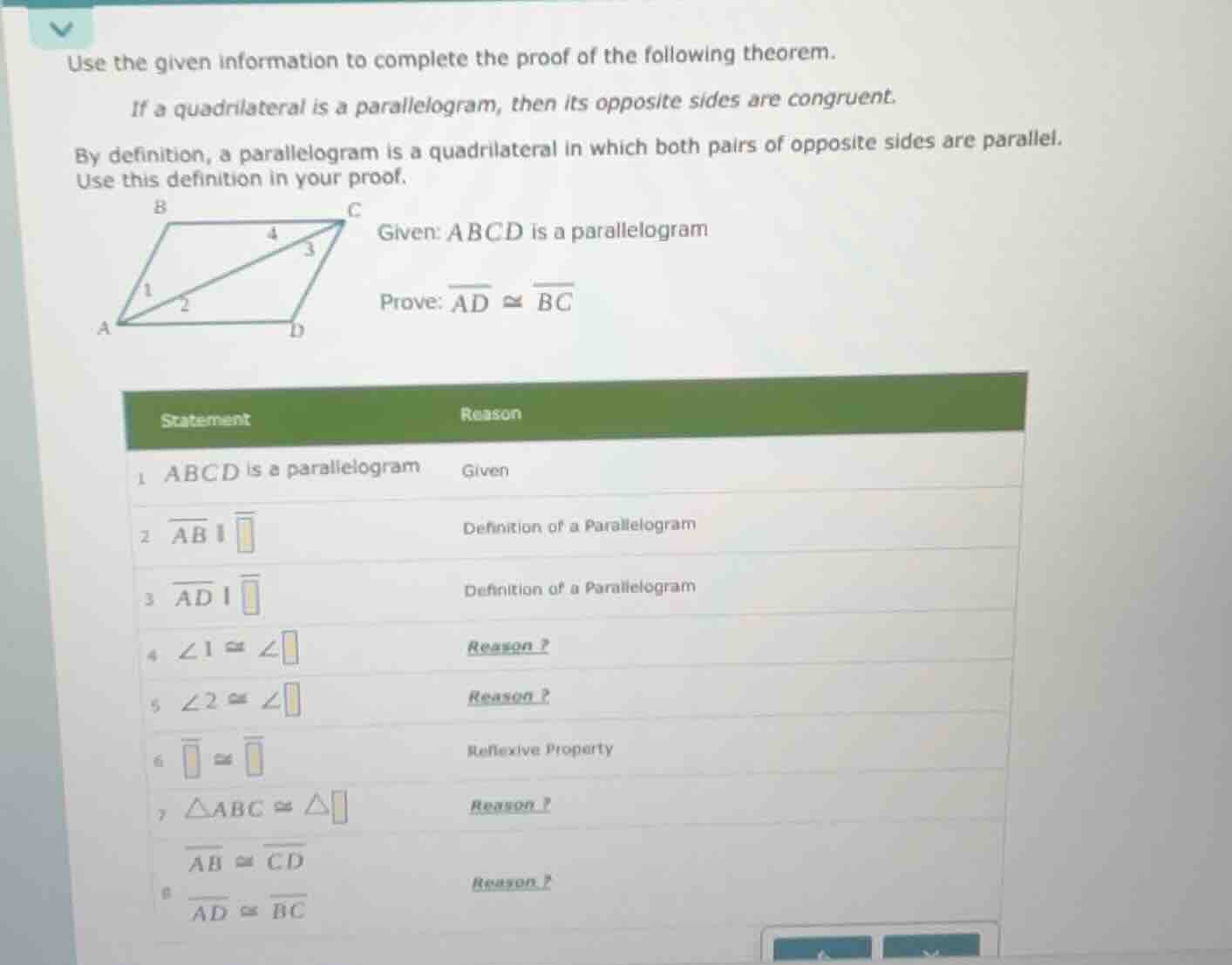
use the given information to complete the proof of the following theorem.
if a quadrilateral is a parallelogram, then its opposite sides are congruent.
by definition, a parallelogram is a quadrilateral in which both pairs of opposite sides are parallel.
use this definition in your proof.
given: (abcd) is a parallelogram
prove: (overline{ad} cong overline{bc})
| statement | reason |
|---|---|
| 2 (overline{ab} parallel square) | definition of a parallelogram |
| 3 (overline{ad} parallel square) | definition of a parallelogram |
| 4 (angle 1 cong angle square) | reason? |
| 5 (angle 2 cong angle square) | reason? |
| 6 (square cong square) | reflexive property |
| 7 (\triangle abc cong \triangle square) | reason? |
| 8 (overline{ab} cong overline{cd}) (overline{ad} cong overline{bc}) | reason? |
Step 1: Analyze \( \overline{AB} \parallel \)
In a parallelogram \(ABCD\), by the definition of a parallelogram (both pairs of opposite sides are parallel), \( \overline{AB} \parallel \overline{CD} \). So the missing side here is \( \overline{CD} \).
Step 2: Analyze \( \overline{AD} \parallel \)
Again, using the definition of a parallelogram, \( \overline{AD} \parallel \overline{BC} \). So the missing side here is \( \overline{BC} \).
Step 3: Analyze \( \angle 1 \cong \angle \)
Since \( \overline{AB} \parallel \overline{CD} \) and \( \overline{AC} \) is a transversal, the alternate interior angles \( \angle 1 \) and \( \angle 3 \) are congruent (Alternate Interior Angles Theorem). So the missing angle here is \( 3 \) (i.e., \( \angle 3 \)).
Step 4: Analyze \( \angle 2 \cong \angle \)
Since \( \overline{AD} \parallel \overline{BC} \) and \( \overline{AC} \) is a transversal, the alternate interior angles \( \angle 2 \) and \( \angle 4 \) are congruent (Alternate Interior Angles Theorem). So the missing angle here is \( 4 \) (i.e., \( \angle 4 \)).
Step 5: Analyze \( \overline{\quad} \cong \overline{\quad} \) (Reflexive Property)
The reflexive property states that a segment is congruent to itself. So \( \overline{AC} \cong \overline{AC} \).
Step 6: Analyze \( \triangle ABC \cong \triangle \)
We have \( \angle 1 \cong \angle 3 \), \( \overline{AC} \cong \overline{AC} \), and \( \angle 2 \cong \angle 4 \). By the Angle - Side - Angle (ASA) Congruence Postulate, \( \triangle ABC \cong \triangle CDA \).
Step 7: Analyze \( \overline{AD} \cong \overline{BC} \)
Since \( \triangle ABC \cong \triangle CDA \), their corresponding sides are congruent. So \( \overline{AD} \cong \overline{BC} \) (Corresponding Parts of Congruent Triangles are Congruent - CPCTC).

Snap & solve any problem in the app
Get step-by-step solutions on Sovi AI
Photo-based solutions with guided steps
Explore more problems and detailed explanations
- \( \overline{AB} \parallel \boldsymbol{\overline{CD}} \)
- \( \overline{AD} \parallel \boldsymbol{\overline{BC}} \)
- \( \angle 1 \cong \boldsymbol{\angle 3} \) (Alternate Interior Angles Theorem)
- \( \angle 2 \cong \boldsymbol{\angle 4} \) (Alternate Interior Angles Theorem)
- \( \boldsymbol{\overline{AC}} \cong \boldsymbol{\overline{AC}} \)
- \( \triangle ABC \cong \boldsymbol{\triangle CDA} \) (ASA Congruence Postulate)
- \( \overline{AD} \cong \overline{BC} \) (CPCTC)