QUESTION IMAGE
Question
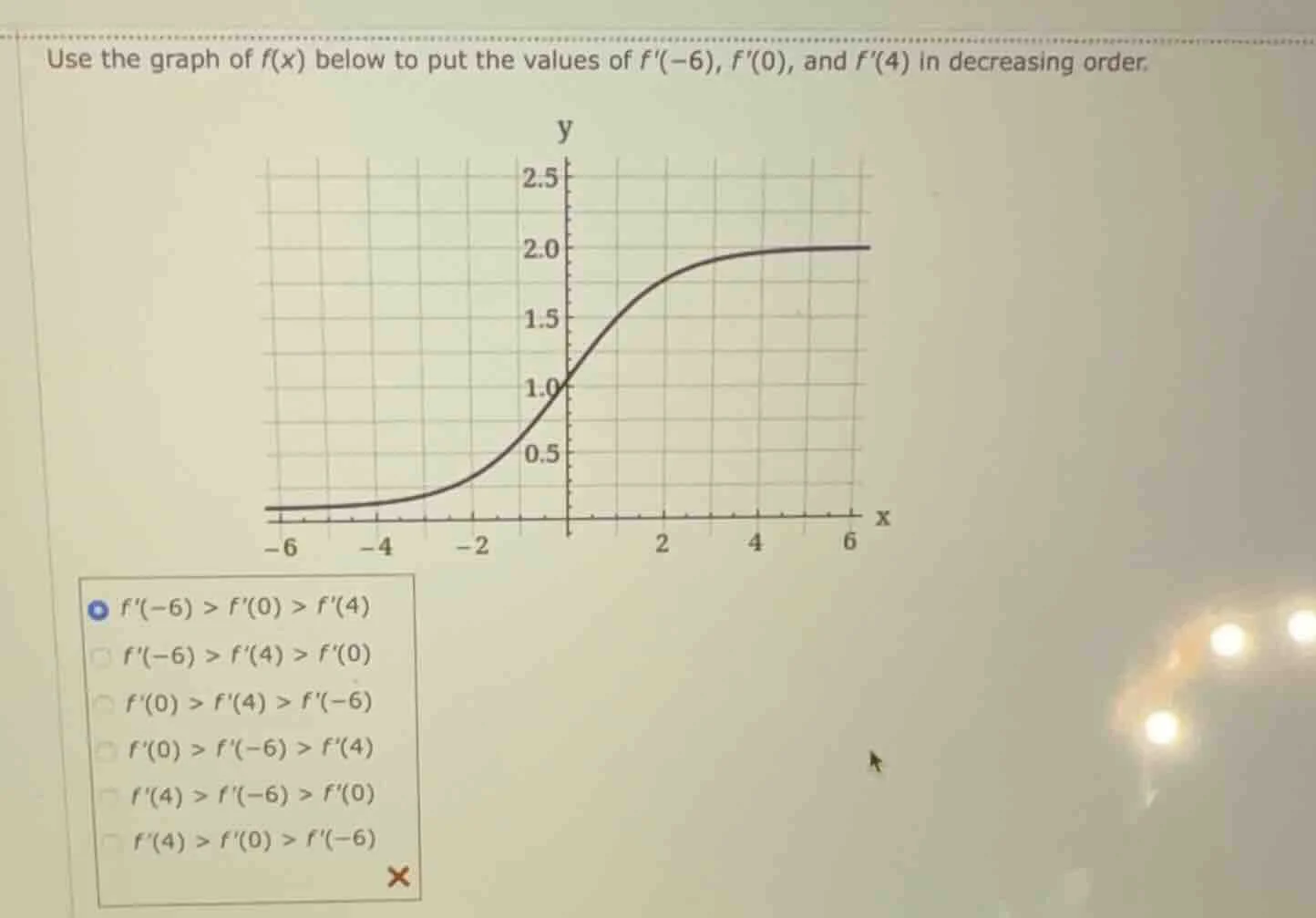
use the graph of f(x) below to put the values of f(-6), f(0), and f(4) in decreasing order.options: f(-6) > f(0) > f(4); f(-6) > f(4) > f(0); f(0) > f(4) > f(-6); f(0) > f(-6) > f(4); f(4) > f(-6) > f(0); f(4) > f(0) > f(-6)
Step1: Recall the meaning of the derivative
The derivative \( f'(x) \) at a point \( x \) represents the slope of the tangent line to the graph of \( f(x) \) at that point. A steeper positive slope means a larger value of \( f'(x) \), and a flatter slope (closer to zero) means a smaller value of \( f'(x) \).
Step2: Analyze the slope at \( x = -6 \)
At \( x = -6 \), the graph of \( f(x) \) is very flat (almost horizontal). So the slope of the tangent line here, \( f'(-6) \), is close to 0 (a small positive number, since the function is increasing very slowly).
Step3: Analyze the slope at \( x = 0 \)
At \( x = 0 \), the graph is steeper than at \( x = -6 \). The curve is increasing more rapidly here, so the slope \( f'(0) \) is larger than \( f'(-6) \).
Step4: Analyze the slope at \( x = 4 \)
At \( x = 4 \), the graph is flatter than at \( x = 0 \) (it's approaching a horizontal asymptote, maybe? The curve is increasing but very slowly, almost flat). So the slope \( f'(4) \) is smaller than \( f'(0) \) and, since the curve is still increasing (just slowly), it's positive but smaller than \( f'(0) \) and maybe even smaller than \( f'(-6) \)? Wait, no—wait, let's re-examine. Wait, at \( x = -6 \), the function is almost flat (slope near 0). At \( x = 0 \), the slope is steeper (larger positive). At \( x = 4 \), the slope is flatter than at \( x = 0 \), but is it flatter than at \( x = -6 \)? Wait, the graph at \( x = -6 \) is very flat (almost horizontal), at \( x = 0 \) it's steeper, and at \( x = 4 \) it's still increasing but approaching a horizontal line, so the slope at \( x = 4 \) is smaller than at \( x = 0 \), and the slope at \( x = -6 \) is also small (close to 0), but let's compare the slopes. Wait, the key is: the derivative \( f'(x) \) is the slope of the tangent. So when the graph is increasing, \( f'(x) > 0 \). The steeper the increase, the larger \( f'(x) \). So:
- At \( x = -6 \): very flat, so \( f'(-6) \) is a small positive number (close to 0).
- At \( x = 0 \): steeper, so \( f'(0) \) is a larger positive number.
- At \( x = 4 \): flatter than at \( x = 0 \), so \( f'(4) \) is a positive number but smaller than \( f'(0) \). Now, is \( f'(4) \) smaller than \( f'(-6) \)? Wait, at \( x = -6 \), the graph is almost horizontal (slope ~0), and at \( x = 4 \), the graph is still increasing but very slowly (slope ~0 but maybe slightly larger than at \( x = -6 \))? Wait, no—wait, the graph at \( x = -6 \) is a horizontal line (almost), so slope 0. At \( x = 0 \), slope is positive and steeper. At \( x = 4 \), slope is positive but less steep than at \( x = 0 \), but is it more or less steep than at \( x = -6 \)? Wait, the graph at \( x = -6 \) is horizontal (slope 0), at \( x = 4 \), the graph is still increasing (so slope positive) but very slowly. So \( f'(-6) \) is ~0, \( f'(0) \) is larger, \( f'(4) \) is positive but smaller than \( f'(0) \) and maybe smaller than \( f'(-6) \)? Wait, no—if at \( x = -6 \) the slope is 0 (or almost 0), and at \( x = 4 \) the slope is still positive (since the function is increasing), then \( f'(4) \) is positive, \( f'(-6) \) is ~0, so \( f'(4) > f'(-6) \)? Wait, that contradicts my earlier thought. Wait, let's look at the graph again. The graph starts at the left (x=-6) as a horizontal line (slope 0), then curves up, getting steeper until around x=0, then starts to flatten out as x increases (approaching y=2). So the slope (derivative) starts at 0 (x=-6), increases to a maximum at some point (maybe around x=0), then decreases back towards 0 as x increases (since the curv…

Snap & solve any problem in the app
Get step-by-step solutions on Sovi AI
Photo-based solutions with guided steps
Explore more problems and detailed explanations
\( f'(0) > f'(4) > f'(-6) \) (which corresponds to the option: \( f'(0) > f'(4) > f'(-6) \))