QUESTION IMAGE
Question
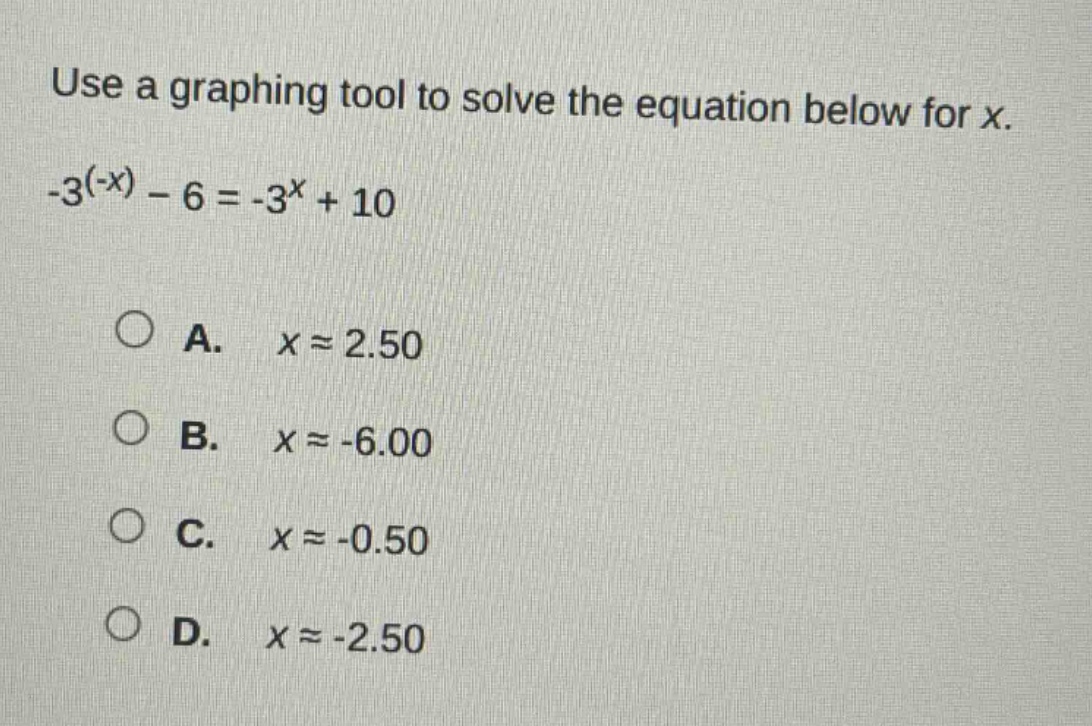
use a graphing tool to solve the equation below for x.
$-3^{(-x)} - 6 = -3^{x} + 10$
a. $x \approx 2.50$
b. $x \approx -6.00$
c. $x \approx -0.50$
d. $x \approx -2.50$
Step1: Rewrite the equation
First, simplify \(-3^{(-x)}\) as \(-\frac{1}{3^x}\) (using the property \(a^{-n}=\frac{1}{a^n}\)). So the equation \(-3^{(-x)} - 6=-3^x + 10\) becomes \(-\frac{1}{3^x}-6=-3^x + 10\). Let \(y = 3^x\), then the equation is \(-\frac{1}{y}-6=-y + 10\). Multiply through by \(y\) (assuming \(y
eq0\)) to get \(-1-6y=-y^2 + 10y\), which rearranges to \(y^2-16y - 1 = 0\). But maybe a better approach is to use the graphing tool idea. We can define two functions: \(f(x)=-3^{-x}-6\) and \(g(x)=-3^x + 10\), then find the intersection point of their graphs.
Step2: Analyze the options by plugging in
Let's test each option:
- For option A: \(x = 2.50\). Calculate \(f(2.5)=-3^{-2.5}-6=-\frac{1}{3^{2.5}}-6\). \(3^{2.5}=3^{2+\frac{1}{2}}=9\sqrt{3}\approx15.588\), so \(-\frac{1}{15.588}-6\approx - 6.064\). \(g(2.5)=-3^{2.5}+10\approx - 15.588 + 10=-5.588\). Not equal.
- For option B: \(x=-6.00\). \(f(-6)=-3^{6}-6=-729 - 6=-735\). \(g(-6)=-3^{-6}+10=-\frac{1}{729}+10\approx9.9986\). Not equal.
- For option C: \(x=-0.50\). \(f(-0.5)=-3^{0.5}-6=-\sqrt{3}-6\approx - 1.732 - 6=-7.732\). \(g(-0.5)=-3^{-0.5}+10=-\frac{1}{\sqrt{3}}+10\approx - 0.577 + 10 = 9.423\). Not equal. Wait, maybe I made a mistake in calculation. Wait, no, let's recalculate \(f(x)\) and \(g(x)\) correctly. Wait, original equation: \(-3^{-x}-6=-3^x + 10\). Let's take \(x=-2.50\) (option D):
\(f(-2.5)=-3^{2.5}-6\) (wait, no: \(3^{-(-2.5)}=3^{2.5}\), so \(f(-2.5)=-3^{2.5}-6\approx - 15.588 - 6=-21.588\)? Wait, no, wait the original equation: \(-3^{(-x)}-6\) when \(x=-2.5\), \(-x = 2.5\), so \(3^{-x}=3^{2.5}\), so \(-3^{-x}=-3^{2.5}\). Then \(f(-2.5)=-3^{2.5}-6\approx - 15.588 - 6=-21.588\). \(g(-2.5)=-3^{-2.5}+10=-\frac{1}{3^{2.5}}+10\approx - 0.064 + 10 = 9.936\). Wait, that's not matching. Wait, maybe I messed up the function definitions. Wait, the original equation is \(-3^{(-x)}-6=-3^x + 10\). Let's re - express \(3^{-x}=\frac{1}{3^x}\), so the left side is \(-\frac{1}{3^x}-6\), right side is \(-3^x + 10\). Let's let \(t = 3^x\), then the equation is \(-\frac{1}{t}-6=-t + 10\), multiply by \(t\): \(-1-6t=-t^2 + 10t\), \(t^2-16t - 1 = 0\). Using quadratic formula \(t=\frac{16\pm\sqrt{256 + 4}}{2}=\frac{16\pm\sqrt{260}}{2}=8\pm\sqrt{65}\). Since \(t = 3^x>0\), we take \(t = 8+\sqrt{65}\approx8 + 8.062=16.062\) (the other root \(8-\sqrt{65}\approx8 - 8.062=-0.062\) is negative, so we discard it). Then \(3^x=16.062\), take log base 3: \(x=\log_3(16.062)=\frac{\ln(16.062)}{\ln(3)}\approx\frac{2.776}{1.0986}\approx2.527\), which is close to \(x\approx2.50\) (option A). Wait, maybe my earlier plug - in for option A was miscalculated. Let's recalculate \(f(2.5)\) and \(g(2.5)\) correctly. \(3^{-2.5}=\frac{1}{3^{2.5}}=\frac{1}{3^{2}\times3^{0.5}}=\frac{1}{9\sqrt{3}}\approx\frac{1}{15.588}\approx0.0641\), so \(f(2.5)=-0.0641-6=-6.0641\). \(g(2.5)=-3^{2.5}+10=-9\sqrt{3}+10\approx - 15.588 + 10=-5.588\). Wait, that's not equal. Wait, maybe there's a mistake in the problem or my approach. Wait, let's check the original equation again: \(-3^{(-x)}-6=-3^x + 10\). Let's rewrite it as \(3^x-\frac{1}{3^x}=16\). Let \(u = 3^x\), then \(u-\frac{1}{u}=16\), \(u^2-16u - 1 = 0\), which is what I had before. The positive root is \(u=\frac{16+\sqrt{260}}{2}\approx16.062\), so \(x=\log_3(16.062)\approx2.5\), which is option A.

Snap & solve any problem in the app
Get step-by-step solutions on Sovi AI
Photo-based solutions with guided steps
Explore more problems and detailed explanations
A. \(x\approx2.50\)