QUESTION IMAGE
Question
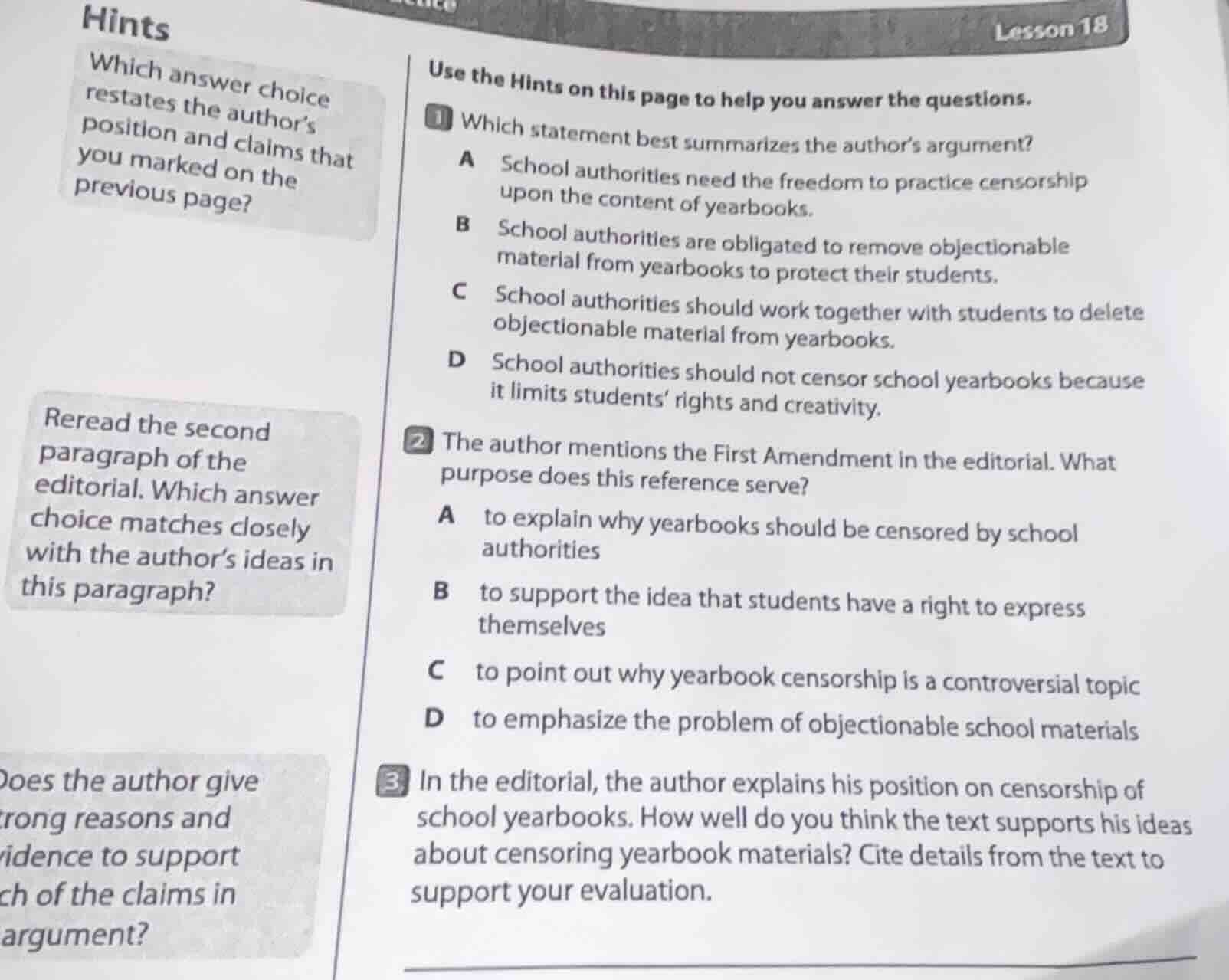
use the hints on this page to help you answer the questions. 1 which statement best summarizes the author’s argument? a school authorities need the freedom to practice censorship upon the content of yearbooks. b school authorities are obligated to remove objectionable material from yearbooks to protect their students. c school authorities should work together with students to delete objectionable material from yearbooks. d school authorities should not censor school yearbooks because it limits students’ rights and creativity. 2 the author mentions the first amendment in the editorial. what purpose does this reference serve? a to explain why yearbooks should be censored by school authorities b to support the idea that students have a right to express themselves c to point out why yearbook censorship is a controversial topic d to emphasize the problem of objectionable school materials 3 in the editorial, the author explains his position on censorship of school yearbooks. how well do you think the text supports his ideas about censoring yearbook materials? cite details from the text to support your evaluation.
Question 1
To summarize the author's argument, we analyze each option:
- Option A: Advocates for censorship freedom, but if the author is against censorship (implied by other options like D), this is incorrect.
- Option B: Says authorities must remove material to protect students, but the author might argue against such censorship limiting rights.
- Option C: Proposes working with students to delete material, but the author's stance is likely against censorship as in D.
- Option D: States authorities should not censor as it limits students' rights and creativity, which aligns with a common argument against censorship in educational contexts.
The First Amendment relates to freedom of speech/expression.
- Option A: Explaining why censorship should happen contradicts the First Amendment's purpose of protecting expression.
- Option B: The First Amendment supports students' right to express themselves, so referencing it would serve to back this idea.
- Option C: It's not about pointing out controversy but about supporting students' expression rights.
- Option D: Emphasizing objectionable materials is not the purpose of citing the First Amendment.
To evaluate how well the text supports the author's ideas on yearbook censorship, follow these steps:
- Identify the author's position (e.g., for/against censorship).
- Look for reasons/evidence:
- If against: Does the text mention students' rights (like First Amendment), impact on creativity, examples of unjust censorship?
- If for: Does it mention protecting students from harmful content, school's responsibility, examples of problematic material?
- Assess the strength: Are the reasons logical, supported by examples/citations (like legal references, anecdotes)?
For example, if the author is against censorship (as in Question 1's answer), check if the text:
- Cites the First Amendment to support students' expression rights.
- Describes how censorship limits creative freedom (e.g., students can't fully express their experiences).
- Gives examples of unnecessary censorship (e.g., removing harmless student art/opinions).
Then, conclude if the support is strong (clear reasons, relevant evidence) or weak (vague, few examples).

Snap & solve any problem in the app
Get step-by-step solutions on Sovi AI
Photo-based solutions with guided steps
Explore more problems and detailed explanations
D. School authorities should not censor school yearbooks because it limits students’ rights and creativity.