QUESTION IMAGE
Question
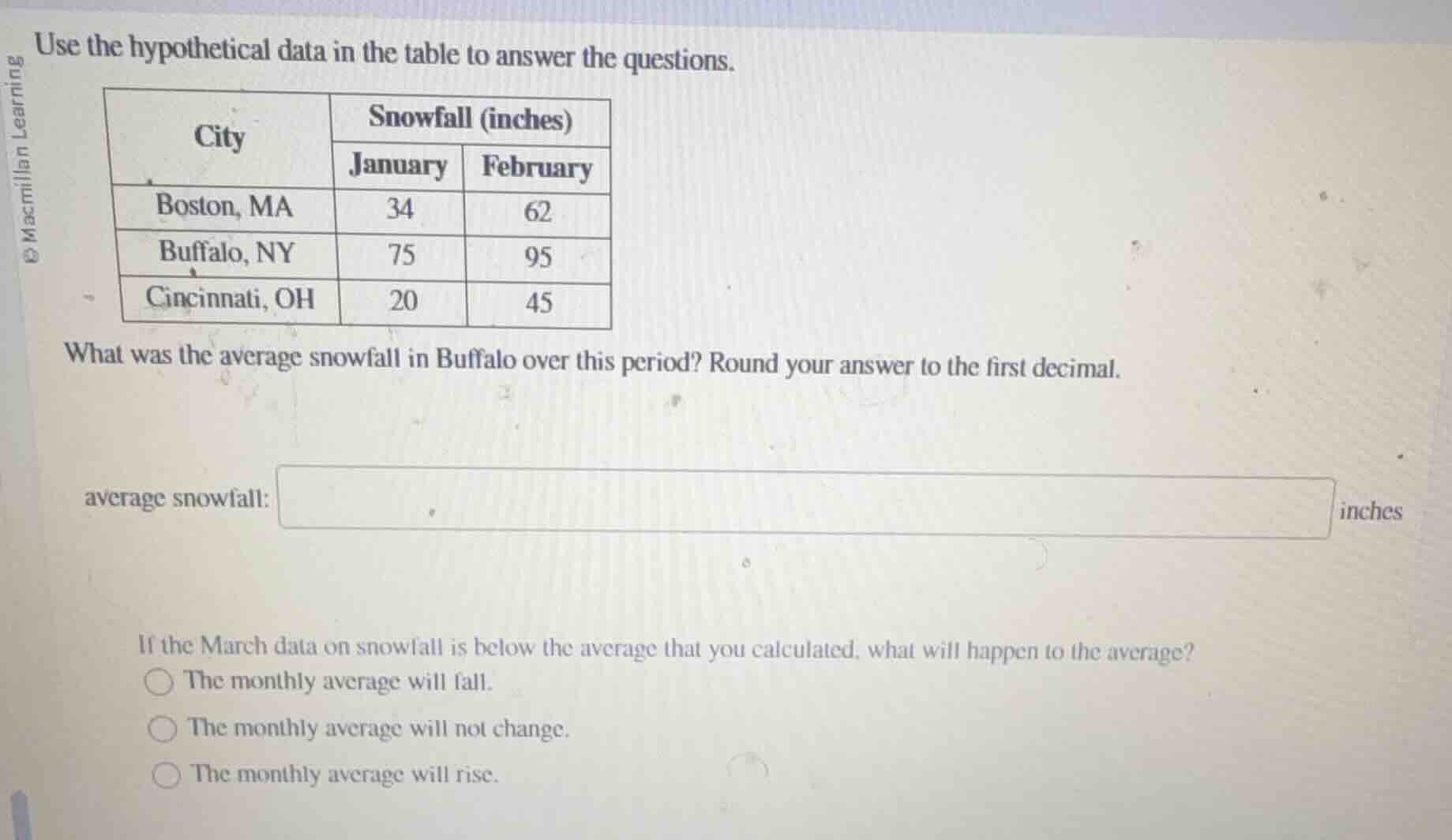
use the hypothetical data in the table to answer the questions.
city
snowfall (inches)
january
february
boston, ma
34
62
buffalo, ny
75
95
cincinnati, oh
20
45
what was the average snowfall in buffalo over this period? round your answer to the first decimal.
average snowfall:
inches
if the march data on snowfall is below the average that you calculated, what will happen to the average?
the monthly average will fall.
the monthly average will not change.
the monthly average will rise.
First Sub - Question (Average Snowfall in Buffalo)
Step1: Identify data for Buffalo
Buffalo's snowfall in January is 75 inches and in February is 95 inches.
Step2: Calculate the sum of snowfall
The sum of snowfall for Buffalo over January and February is $75 + 95=170$ inches.
Step3: Calculate the average
Since there are 2 months, the average is $\frac{170}{2} = 85.0$ inches (already to one decimal place).
The average of a set of numbers is the sum of the numbers divided by the count of numbers. If we add a new number (March snowfall) that is below the current average (85.0), the new sum will be the old sum plus a number less than the old average. When we divide this new sum by a larger count (3 instead of 2), the new average will be less than the old average. So the monthly average will fall.

Snap & solve any problem in the app
Get step-by-step solutions on Sovi AI
Photo-based solutions with guided steps
Explore more problems and detailed explanations
85.0