QUESTION IMAGE
Question
use the image to answer the question.
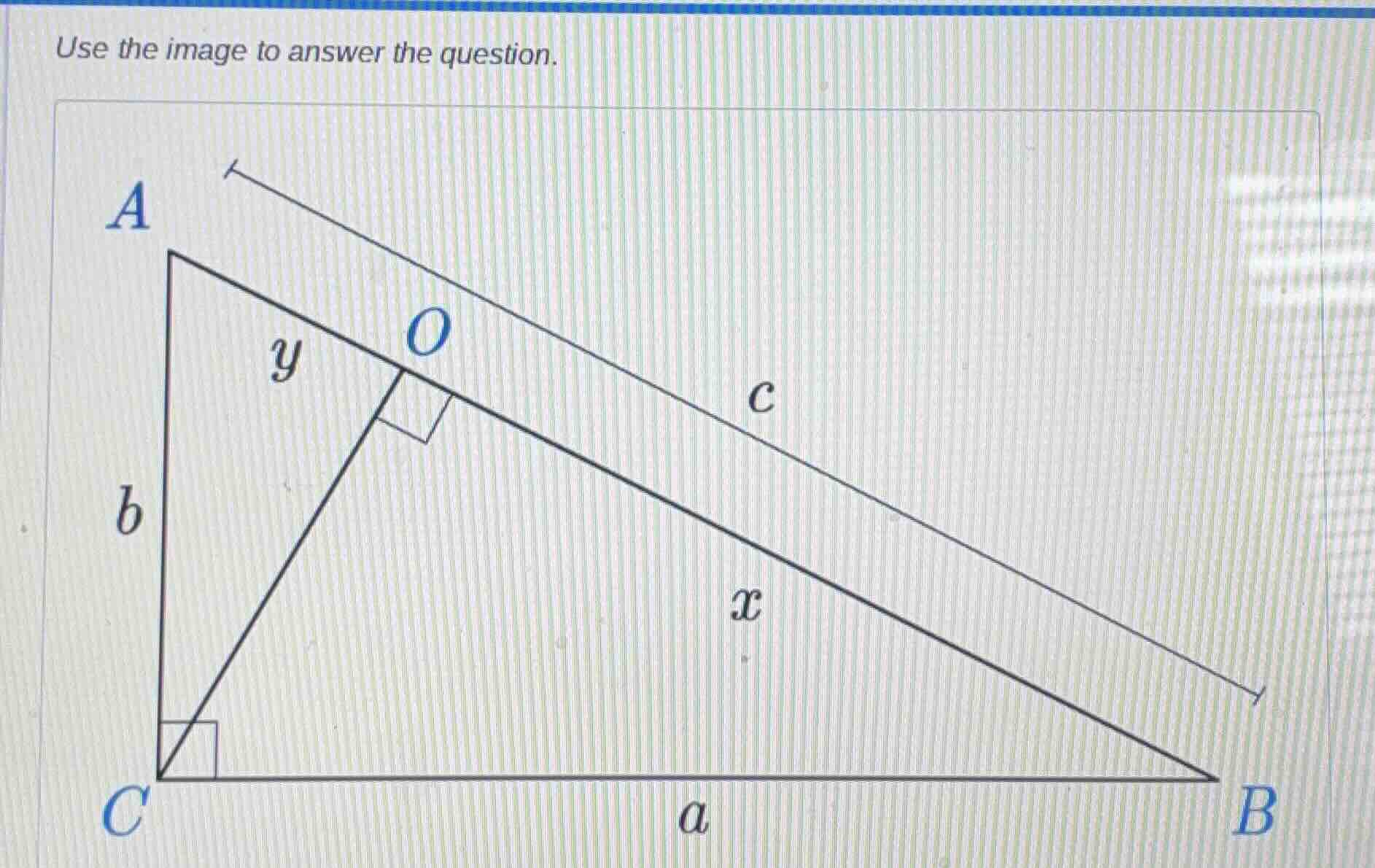
Since the problem involves a right triangle and geometric relationships (like the altitude to the hypotenuse in a right triangle), we can use similar triangles or geometric mean theorems. Let's assume we need to find a relationship (e.g., geometric mean: \( y = \frac{b^2}{y + c} \) or using similar triangles \( \triangle AOC \sim \triangle ACB \), so \( \frac{y}{b}=\frac{b}{y + c} \), leading to \( b^2 = y(y + c) \), or for \( x \), \( \triangle BOC \sim \triangle BCA \), so \( \frac{x}{a}=\frac{a}{x + c} \), \( a^2 = x(x + c) \), and also \( \triangle AOC \sim \triangle COB \), so \( \frac{y}{x}=\frac{x}{y} \)? Wait, no, \( \triangle AOC \sim \triangle COB \) (both right, share angle at O? Wait, angle at A is common? Wait, \( \angle A \) is common to \( \triangle AOC \) and \( \triangle ACB \), so they are similar. Similarly, \( \angle B \) is common to \( \triangle BOC \) and \( \triangle BCA \), so they are similar. Also, \( \triangle AOC \sim \triangle COB \) because \( \angle AOC = \angle COB = 90^\circ \), and \( \angle ACO = \angle B \) (since \( \angle A + \angle B = 90^\circ \), \( \angle A + \angle ACO = 90^\circ \), so \( \angle ACO = \angle B \)). So by AA similarity, \( \triangle AOC \sim \triangle COB \), so \( \frac{AO}{CO}=\frac{CO}{BO} \), i.e., \( x^2 = yc \) (if \( AO = y \), \( BO = c \), \( CO = x \))? Wait, the labels: \( AO = y \), \( OB = c \), \( CO = x \), \( AC = b \), \( BC = a \), \( AB = y + c \). Then from \( \triangle AOC \sim \triangle ACB \): \( \frac{AO}{AC}=\frac{AC}{AB} \implies \frac{y}{b}=\frac{b}{y + c} \implies b^2 = y(y + c) \). From \( \triangle BOC \sim \triangle BCA \): \( \frac{BO}{BC}=\frac{BC}{AB} \implies \frac{c}{a}=\frac{a}{y + c} \implies a^2 = c(y + c) \). From \( \triangle AOC \sim \triangle COB \): \( \frac{AO}{CO}=\frac{CO}{BO} \implies \frac{y}{x}=\frac{x}{c} \implies x^2 = yc \). Also, \( a^2 + b^2 = (y + c)^2 \) (Pythagoras), and substituting \( a^2 = c(y + c) \), \( b^2 = y(y + c) \), we get \( c(y + c) + y(y + c) = (y + c)^2 \), which holds.
If the question is, for example, to find \( x \) in terms of \( y \) and \( c \), using \( \triangle AOC \sim \triangle COB \), we have \( x^2 = yc \), so \( x = \sqrt{yc} \). Or to find \( b^2 = y(y + c) \), \( a^2 = c(y + c) \).
Assuming we need to derive a geometric mean relationship, let's take the standard geometric mean in right triangles: the altitude to the hypotenuse is the geometric mean of the segments into which it divides the hypotenuse, so \( x = \sqrt{yc} \), and each leg is the geometric mean of the hypotenuse and the adjacent segment, so \( b = \sqrt{y(y + c)} \), \( a = \sqrt{c(y + c)} \).
Step1: Identify Similar Triangles
\( \triangle AOC \sim \triangle COB \) (AA: \( \angle AOC = \angle COB = 90^\circ \), \( \angle ACO = \angle B \)).
Step2: Set Up Proportion
From similarity, \( \frac{AO}{CO} = \frac{CO}{BO} \). Let \( AO = y \), \( BO = c \), \( CO = x \).
\( \frac{y}{x} = \frac{x}{c} \)
Step3: Solve for \( x \)
Cross - multiply: \( x^2 = yc \)
Take square root: \( x = \sqrt{yc} \) (since length is positive)

Snap & solve any problem in the app
Get step-by-step solutions on Sovi AI
Photo-based solutions with guided steps
Explore more problems and detailed explanations
If finding \( x \) (altitude), \( \boldsymbol{x = \sqrt{yc}} \); if finding leg relationships, e.g., \( b^2 = y(y + c) \), \( a^2 = c(y + c) \) (depending on the exact question, but using geometric mean from similar right triangles).