QUESTION IMAGE
Question
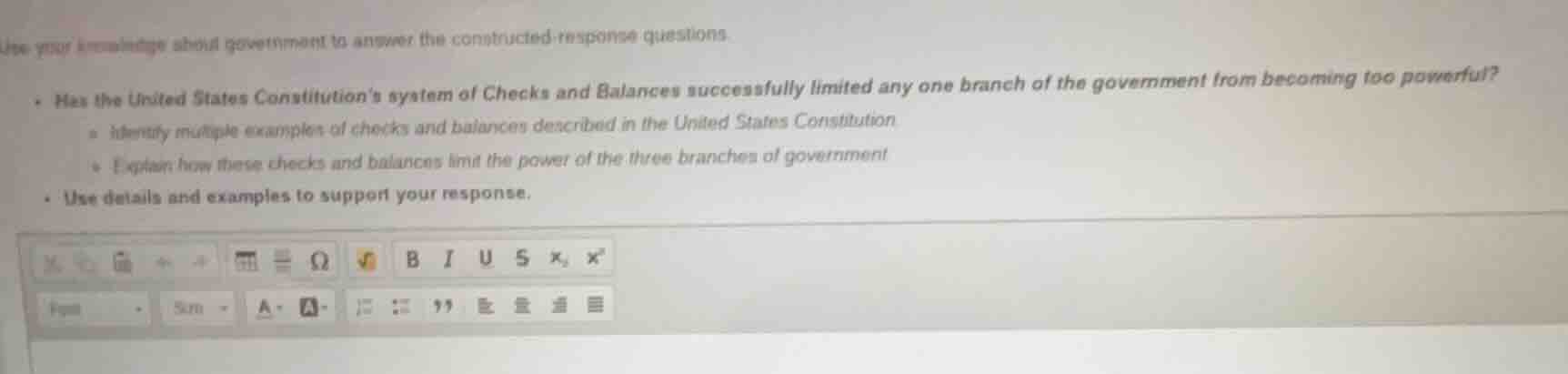
use your knowledge about government to answer the constructed - response questions.
- has the united states constitution’s system of checks and balances successfully limited any one branch of the government from becoming too powerful?
- identify multiple examples of checks and balances described in the united states constitution.
- explain how these checks and balances limit the power of the three branches of government
- use details and examples to support your response.
To answer this, we analyze the US Constitution's checks and balances:
1. Examples of Checks and Balances
- Legislative - Executive Checks:
- The President can veto legislation passed by Congress (Article I, Section 7). However, Congress can override a presidential veto with a two - thirds vote in both the House of Representatives and the Senate.
- The Senate has the power to confirm or reject presidential appointments (e.g., cabinet members, federal judges) (Article II, Section 2).
- Legislative - Judicial Checks:
- Congress can impeach and remove federal judges, including Supreme Court justices (Article I, Section 2 and 3; Article II, Section 4).
- Congress can propose amendments to the Constitution, which can modify the jurisdiction of the courts or overrule judicial decisions (Article V).
- Executive - Judicial Checks:
- The President appoints federal judges, including Supreme Court justices (Article II, Section 2).
- The judiciary can declare executive actions unconstitutional (Marbury v. Madison established judicial review, though not directly in the Constitution, the power is implied from Article III and the concept of judicial independence).
- Judicial - Legislative Checks:
- The courts can declare laws passed by Congress unconstitutional (judicial review).
2. How They Limit the Branches
- Legislative Branch:
- The presidential veto gives the Executive a check on Congress's law - making power. This means Congress cannot simply pass any law it wants; it must either gain the President's approval or have enough support to override the veto. The Senate's confirmation of presidential appointments also means that Congress has a say in who the President can put in key executive positions, limiting the President's ability to unilaterally choose officials.
- Executive Branch:
- Congressional oversight, including the power to impeach the President (and other executive officials) and the need for Senate confirmation of appointments, limits the Executive's power. The judicial power of judicial review can strike down executive orders or actions that are found to be unconstitutional, preventing the Executive from overstepping its constitutional bounds.
- Judicial Branch:
- The power of Congress to impeach judges and propose constitutional amendments limits the judiciary's power. The fact that judges are appointed by the President and confirmed by the Senate means that the other two branches have a role in shaping the judiciary, preventing it from becoming completely independent and unaccountable.
3. Success in Limiting Power
Overall, the system of checks and balances has been largely successful. For example, throughout US history, presidential vetoes have been overridden relatively rarely, showing that the threat of a veto encourages compromise between the President and Congress. Judicial review has been used to strike down laws that violate individual rights or constitutional principles, such as the Supreme Court's decision in Brown v. Board of Education which struck down racial segregation in public schools, showing that the courts can limit an overreaching Legislative or Executive. However, there have been challenges, such as during times of war or national crisis, when the Executive may exert more power, but the checks still exist in theory and can be used to rein in that power over time.

Snap & solve any problem in the app
Get step-by-step solutions on Sovi AI
Photo-based solutions with guided steps
Explore more problems and detailed explanations
The United States Constitution’s system of Checks and Balances has generally been successful in limiting any one branch from becoming too powerful.
Examples of Checks and Balances:
- Legislative - Executive:
- The President can veto congressional legislation (Article I, Section 7), but Congress can override the veto with a 2/3 vote in both houses.
- The Senate confirms presidential appointments (e.g., cabinet members, federal judges) (Article II, Section 2).
- Legislative - Judicial:
- Congress can impeach and remove federal judges (Article I, Section 2 - 3; Article II, Section 4).
- Congress can propose constitutional amendments to overrule judicial decisions or modify court jurisdiction (Article V).
- Executive - Judicial:
- The President appoints federal judges (Article II, Section 2).
- The judiciary can declare executive actions unconstitutional (implied judicial review).
- Judicial - Legislative:
- Courts can declare congressional laws unconstitutional (judicial review).
How They Limit Power:
- Legislative: Presidential veto forces compromise; Senate confirmation limits presidential appointments.
- Executive: Congressional impeachment/oversight and judicial review limit overreach.
- Judicial: Congressional impeachment/amendments and executive appointment confirmation limit judicial power.
Success:
Examples like presidential veto overrides being rare (encouraging compromise) and judicial review protecting rights (e.g., Brown v. Board of Education) show success. While challenges exist (e.g., executive overreach in crises), checks remain effective over time.