QUESTION IMAGE
Question
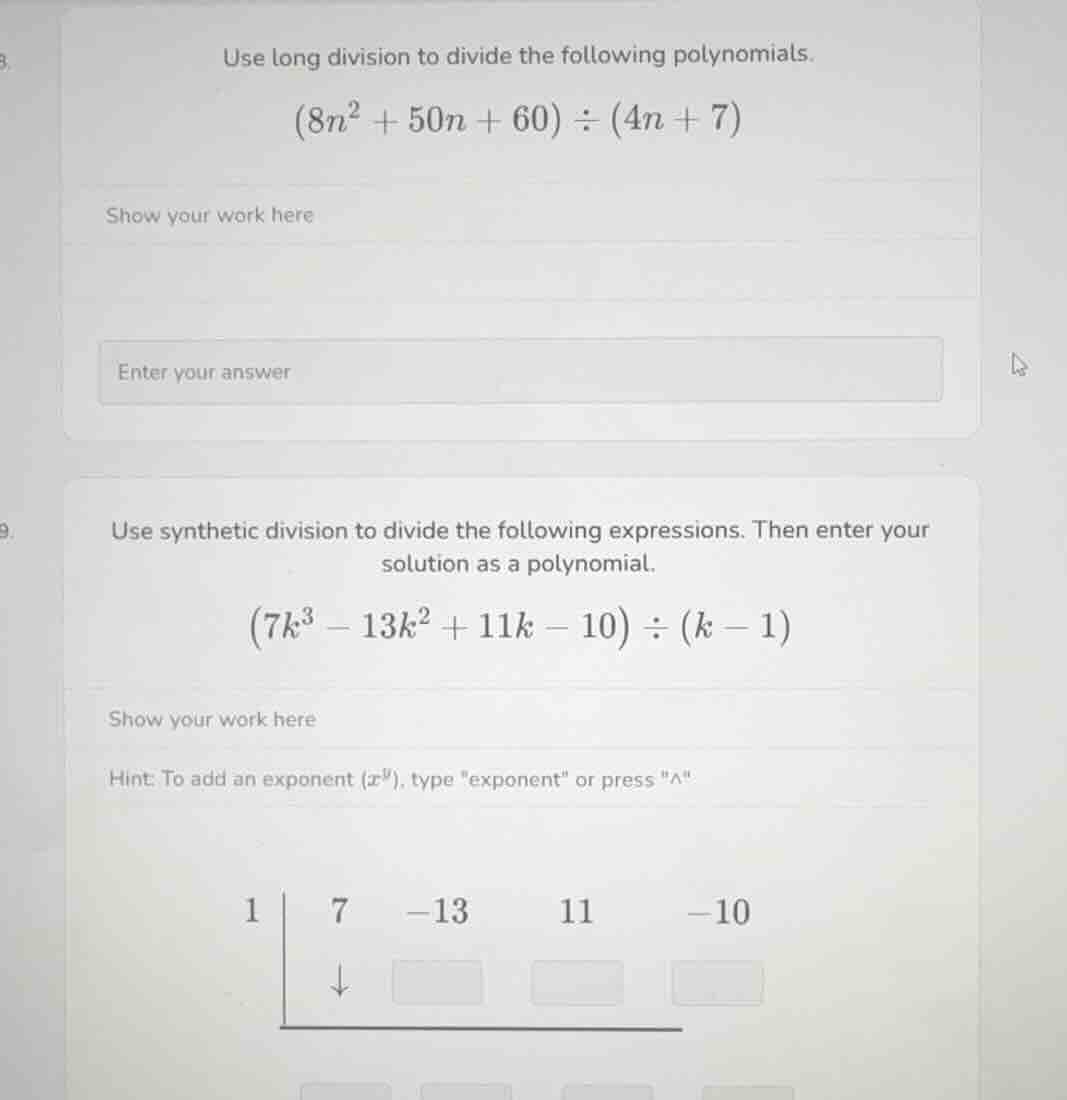
use long division to divide the following polynomials.
$(8n^2 + 50n + 60) \div (4n + 7)$
show your work here
enter your answer
use synthetic division to divide the following expressions. then enter your solution as a polynomial.
$(7k^3 - 13k^2 + 11k - 10) \div (k - 1)$
show your work here
hint: to add an exponent $(x^y)$, type \exponent\ or press \^\
1 | 7 -13 11 -10
\downarrow \square \square \square
First Sub - Question: Polynomial Long Division \((8n^{2}+50n + 60)\div(4n + 7)\)
Step 1: Divide the leading terms
Divide the leading term of the dividend \(8n^{2}\) by the leading term of the divisor \(4n\). So, \(\frac{8n^{2}}{4n}=2n\). This is the first term of the quotient.
Step 2: Multiply and subtract
Multiply the divisor \((4n + 7)\) by \(2n\): \(2n\times(4n + 7)=8n^{2}+14n\).
Subtract this from the dividend: \((8n^{2}+50n + 60)-(8n^{2}+14n)=36n + 60\).
Step 3: Divide the new leading terms
Divide the leading term of \(36n\) (from the new dividend) by the leading term of the divisor \(4n\). So, \(\frac{36n}{4n}=9\). This is the second term of the quotient.
Step 4: Multiply and subtract again
Multiply the divisor \((4n + 7)\) by \(9\): \(9\times(4n + 7)=36n+63\).
Subtract this from \(36n + 60\): \((36n + 60)-(36n + 63)=- 3\).
Step 1: Set up synthetic division
For synthetic division with divisor \(k - 1\), we use the root \(r = 1\). The coefficients of the dividend \(7k^{3}-13k^{2}+11k - 10\) are \(7,-13,11,-10\).
Step 2: Bring down the first coefficient
Bring down the first coefficient \(7\) as it is.
Step 3: Multiply and add
Multiply the number we just brought down (\(7\)) by the root \(1\): \(7\times1 = 7\).
Add this to the next coefficient: \(-13+7=-6\).
Step 4: Multiply and add again
Multiply \(-6\) by \(1\): \(-6\times1=-6\).
Add this to the next coefficient: \(11+(-6) = 5\).
Step 5: Multiply and add a third time
Multiply \(5\) by \(1\): \(5\times1 = 5\).
Add this to the last coefficient: \(-10 + 5=-5\).
The coefficients of the quotient polynomial (from left to right) are \(7,-6,5\) and the remainder is \(-5\). Since the original polynomial is of degree \(3\), the quotient polynomial is of degree \(2\). So the quotient is \(7k^{2}-6k + 5\) and the remainder is \(-5\).

Snap & solve any problem in the app
Get step-by-step solutions on Sovi AI
Photo-based solutions with guided steps
Explore more problems and detailed explanations
The quotient is \(2n + 9\) and the remainder is \(-3\), so \((8n^{2}+50n + 60)\div(4n + 7)=2n + 9-\frac{3}{4n + 7}\)