QUESTION IMAGE
Question
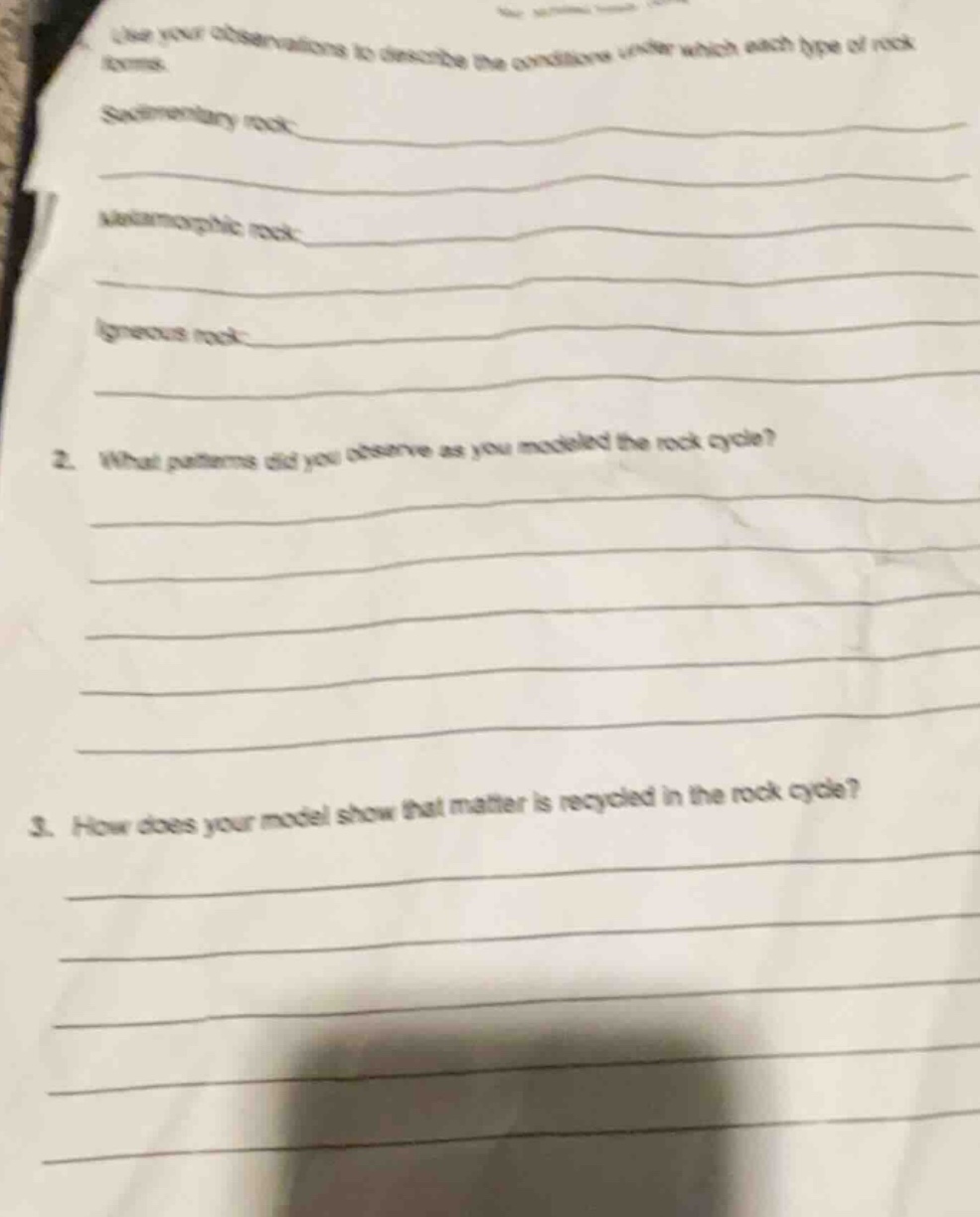
- use your observations to describe the conditions under which each type of rock forms.
sedimentary rock:
metamorphic rock:
igneous rock:
- what patterns did you observe as you modeled the rock cycle?
- how does your model show that matter is recycled in the rock cycle?
- For rock formation conditions:
- Sedimentary rocks form when sediment (rock fragments, organic matter, minerals) is deposited in low-energy environments like ocean floors, lakes, or river deltas, then compacted by overlying weight and cemented by mineral-rich fluids over time.
- Metamorphic rocks form when existing rocks are subjected to high heat (from magma or deep burial) and high pressure (from overlying rock layers or tectonic forces), without melting, which alters their mineral composition and texture.
- Igneous rocks form when molten rock (magma or lava) cools and solidifies; intrusive igneous rocks form from magma cooling slowly underground, while extrusive igneous rocks form from lava cooling quickly at Earth's surface.
- Rock cycle model patterns:
A key pattern is that any rock type can transform into another: igneous rocks can break down into sediment to form sedimentary rocks, or be metamorphosed by heat/pressure; sedimentary rocks can be metamorphosed or melted into igneous rocks; metamorphic rocks can melt into igneous rocks or erode into sediment for sedimentary rocks. Additionally, energy from Earth's interior (for melting/metamorphism) and surface processes (erosion, deposition) drive the cycle.
- Matter recycling in the rock cycle model:
The model shows that the same mineral matter is reused across all rock types. For example, when an igneous rock erodes, its mineral particles become sediment that forms a sedimentary rock. If that sedimentary rock is buried and metamorphosed, the same minerals are rearranged into a metamorphic rock. If any rock type melts, the minerals become part of magma that cools into a new igneous rock. No new matter is created; existing matter is continuously reshaped into different rock forms.

Snap & solve any problem in the app
Get step-by-step solutions on Sovi AI
Photo-based solutions with guided steps
Explore more problems and detailed explanations
- Sedimentary rock: Forms from compacted, cemented sediment in low-energy environments (e.g., ocean floors, deltas) over long periods.
Metamorphic rock: Forms from existing rocks altered by high heat and pressure (no melting) deep underground or near tectonic activity.
Igneous rock: Forms when magma (underground) or lava (surface) cools and solidifies; slow cooling creates coarse grains, fast cooling creates fine grains.
- Observed patterns: All rock types can interconvert; surface (erosion, deposition) and internal (heat, pressure, melting) energy sources drive the continuous cycle; rock texture/composition changes with formation conditions.
- Matter recycling: The model demonstrates that mineral matter is reused across rock types—rocks break down, are altered, or melt, and their constituent minerals are re-formed into new rocks, with no new matter added to the system.