QUESTION IMAGE
Question
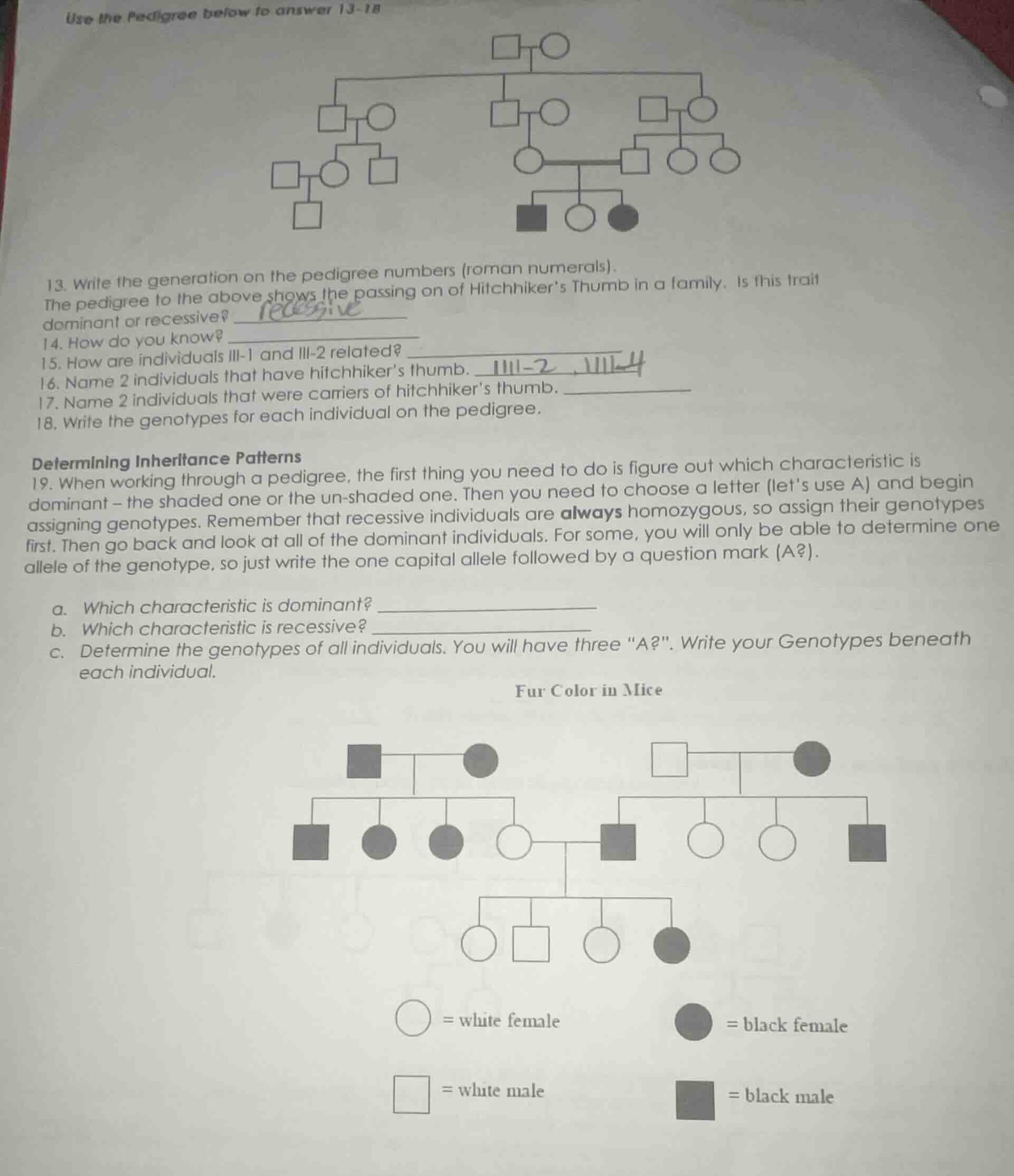
use the pedigree below to answer 13 - 18
- write the generation on the pedigree numbers (roman numerals).
the pedigree to the above shows the passing on of hitchhiker’s thumb in a family. is this trait dominant or recessive?
- how do you know?
- how are individuals iii - 1 and iii - 2 related?
- name 2 individuals that have hitchhiker’s thumb.
- name 2 individuals that were carriers of hitchhiker’s thumb.
- write the genotypes for each individual on the pedigree.
determining inheritance patterns
- when working through a pedigree, the first thing you need to do is figure out which characteristic is dominant – the shaded one or the un - shaded one. then you need to choose a letter (let’s use a) and begin assigning genotypes. remember that recessive individuals are always homozygous, so assign their genotypes first. then go back and look at all of the dominant individuals. for some, you will only be able to determine one allele of the genotype, so just write the one capital allele followed by a question mark (a?).
a. which characteristic is dominant?
b. which characteristic is recessive?
c. determine the genotypes of all individuals. you will have three “a?”. write your genotypes beneath each individual.
fur color in mice
= white female = black female
= white male = black male

Snap & solve any problem in the app
Get step-by-step solutions on Sovi AI
Photo-based solutions with guided steps
Explore more problems and detailed explanations
- I, II, III, IV
- Recessive; two unaffected parents (III-3 and III-4) have affected offspring (IV-1 and IV-3).
- Cousins
- IV-1 and IV-3
- III-3 and III-4
- I: 1-Aa, 2-Aa; II: 1-A?, 2-A?, 3-Aa, 4-Aa, 5-A?, 6-A?; III: 1-A?, 2-A?, 3-Aa, 4-Aa; IV: 1-aa, 2-A?, 3-aa
19a. Black fur
19b. White fur
19c. Row 1: Aa, Aa, aa, Aa; Row 2: Aa, Aa, Aa, aa, Aa, aa, aa, Aa; Row 3: aa, aa, aa, Aa