QUESTION IMAGE
Question
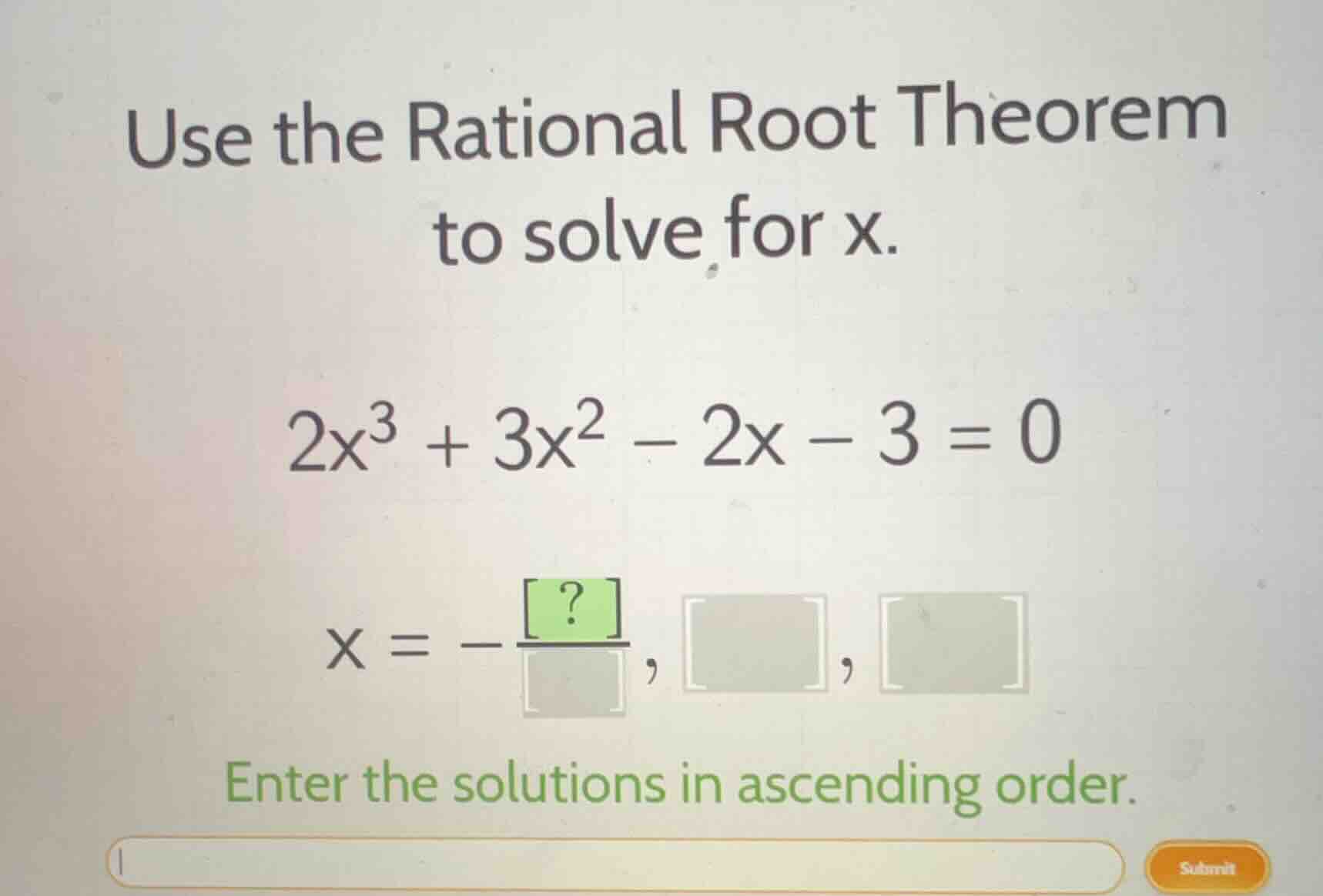
use the rational root theorem to solve for x.
$2x^3 + 3x^2 - 2x - 3 = 0$
$x = -\frac{?}{\square}, \square, \square$
enter the solutions in ascending order.
Step1: List possible rational roots
By Rational Root Theorem, possible roots are $\pm1, \pm3, \pm\frac{1}{2}, \pm\frac{3}{2}$
Step2: Test $x=1$
$2(1)^3 + 3(1)^2 - 2(1) - 3 = 2+3-2-3=0$, so $x=1$ is a root.
Step3: Factor out $(x-1)$
Use polynomial division or grouping:
$2x^3+3x^2-2x-3 = x^2(2x+3)-1(2x+3)=(x^2-1)(2x+3)$
Step4: Factor quadratic term
$x^2-1=(x-1)(x+1)$, so full factorization: $(x+1)(x-1)(2x+3)=0$
Step5: Solve for $x$
Set each factor to 0:
$x+1=0 \implies x=-1$
$x-1=0 \implies x=1$
$2x+3=0 \implies x=-\frac{3}{2}$
Step6: Order roots ascendingly
Compare $-\frac{3}{2}, -1, 1$

Snap & solve any problem in the app
Get step-by-step solutions on Sovi AI
Photo-based solutions with guided steps
Explore more problems and detailed explanations
$x = -\frac{3}{2}, -1, 1$